






15 February 2025 - 10:00am
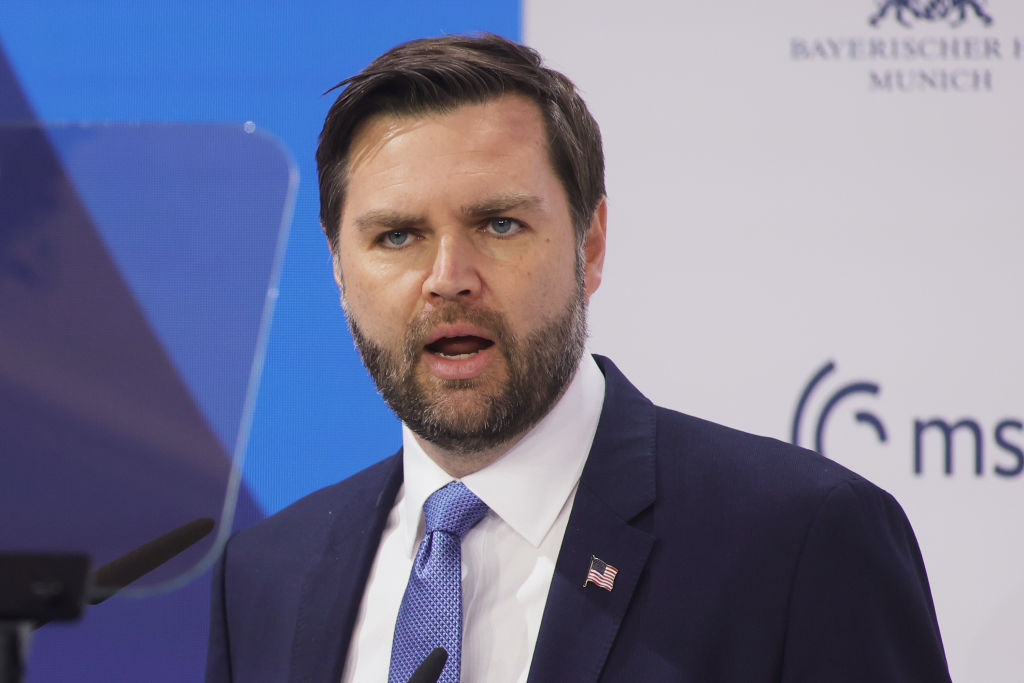
It’s easy to see why everyone in politics is talking about JD Vance’s speech at the Munich Security Conference yesterday. It was an astonishing speech, for several reasons, and one likely to be remembered as a watershed moment in post-World War II transatlantic relations.
In sharp contrast with the diplomatic platitudes often heard at these public events, the US Vice President launched a scathing and surprisingly blunt attack on Europe’s authoritarian and anti-democratic drift, accusing continental leaders of engaging in rampant censorship and even cancelling elections, as recently occurred in Romania. In his view, European governments do this in a desperate attempt to hold on to power and suppress the democratic backlash against their flawed policies — first and foremost mass immigration.
Vance directly called out the European Commission for threatening to shut down social media during civil unrest, and said he was shocked to hear a former European commissioner — he was referring to Thierry Breton — applaud Romania’s unprecedented decision to annul the elections following EU pressure over alleged Russian interference, and threaten to do the same in Germany should the AfD triumph.
In his sweeping attack, Vance didn’t exempt the UK either, harshly condemning the criminalisation of silent prayer as the sign of a broader tendency of European governments to encroach upon fundamental freedoms under the guise of social progressivism. He concluded by calling upon European leaders to “believe in democracy” — in other words, to step aside and allow a new generation of populists to take charge.
Vance’s comments have predictably sent shockwaves across Europe, sparking sharp criticism from mainstream leaders and pundits while earning enthusiastic praise from conservatives and populist sympathisers. Those of us who have long warned of Europe’s turn away from democracy will have felt a rush of schadenfreude at seeing these feckless leaders being scolded by their transatlantic master.
However, Vance’s remarks were also riddled with contradictions, not least because the United States has been an active participant — and often a guiding force — behind many of the very policies he condemned. While Vance’s attack on European authoritarianism is compelling, his omission of the US role in these developments is just as notable. The case of Romania illustrates this perfectly. As the entrepreneur and political commentator Arnaud Bertrand pointed out on X, it was the US State Department that first issued a statement expressing concern over Russian involvement, two days before the Romanian constitutional court annulled the election. American involvement also extends to the crucial role played by US-funded NGOs in orchestrating this unprecedented judicial intervention.
In short, the EU didn’t act independently: it followed the US’s lead. It’s therefore a bit rich for Vance to lecture the Europeans about democratic backsliding without acknowledging America’s instrumental role in setting the precedent. The same applies to censorship policies. Much of the EU’s approach to online censorship was developed in close coordination with American agencies and tech companies. The current Brussels content moderation framework is not a uniquely European creation — it was heavily influenced by American practices and pressures, particularly in the wake of US concerns over “disinformation”.
Indeed, as former US State Department official Mike Benz has highlighted, Nato — an organisation largely steered by Washington — has been instrumental in developing a the “anti-disinformation” framework that has significantly influenced global internet censorship policies. Vance completely ignores this reality as well, portraying Europe as the sole architect of policies that were, in fact, transatlantically coordinated — if not led by the US.
More broadly, it is important to recognise that the feebleness of today’s European leadership is not incidental. It is, in part, the result of decades of US efforts to keep Europe in a state of strategic vassalage and subordination. Washington has consistently cultivated European politicians willing to prioritise American interests over those of their own nations and citizens. This broader context is also completely absent from Vance’s speech.
On top of this, for all the talk of the US “disengagement” from Europe, the reality is that the Trump administration is continuing the longstanding tradition of US meddling in European politics — evident in its explicit backing of populist parties such as the AfD. Regardless of whether one supports this agenda or not, the fact remains that it represents yet another form of external influence.
Vance’s remarks may not necessarily signal a break in US-European relations, but rather the beginning of a new phase of American ideological dominance. Instead of fostering European autonomy, this shift would simply mark the transition from the liberal-progressive hegemonic phase to a post-liberal one, with the US still dictating the terms.
Thomas Fazi is an UnHerd columnist and translator. His latest book is The Covid Consensus, co-authored with Toby Green.
 battleforeurope