




X Close

JD Vance has spooked Germany’s political establishment

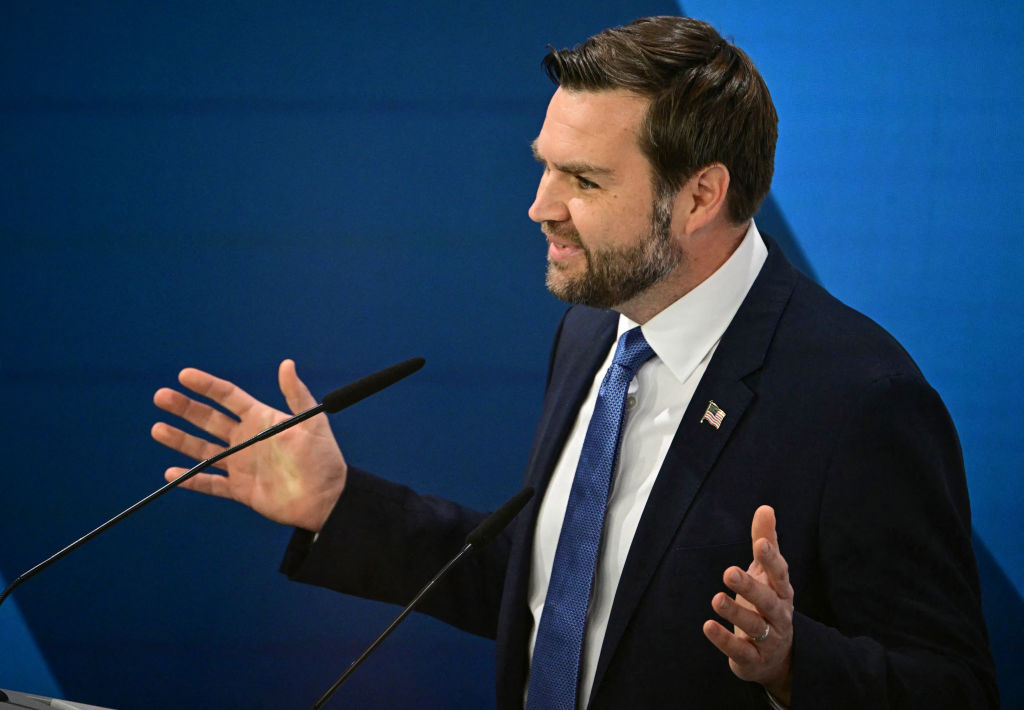
There's a new sheriff in town. Credit: Getty

There’s a new sheriff in town. Credit: Getty

15 February 2025 - 8:15pm

Blankenburg, Germany

It’s Friday night at a small AfD campaign rally in Blankenburg, on the outskirts of Berlin, and local party bigwig Beatrix von Storch is jubilant. After warming up by bashing Germany’s “woke public broadcasters” she switches to the subject she really wants to talk about: “JD Vance’s speech today was fantastic!” She is met by unbridled applause.

Speaking at the Munich Security Conference earlier that day, the American Vice President had declared: “What I worry about is the threat from within, the retreat of Europe from some of its most fundamental values […] More and more all over Europe, they are voting for political leaders who promise to put an end to out-of-control migration. Now, I happen to agree with a lot of these concerns, but you don’t have to agree with me.” He added: “There’s no room for firewalls.”

A week before the German elections, Vance’s comments are being viewed as nothing less than an endorsement of the Right-wing, anti-immigration AfD. This was compounded by the VP’s decision to snub German Chancellor Olaf Scholz in Munich and meet AfD leader Alice Weidel instead. Speaking at the conference earlier today, Scholz publicly accused Vance of interfering in his country’s elections. His likely successor, CDU leader Friedrich Merz, echoed the sentiment.

Only weeks before, Elon Musk’s face was projected on a giant screen at an AfD campaign event in eastern Germany. The Tesla boss has been promoting the party’s talking points for months, and even interviewed Weidel in January.

Back in Blankenburg, von Storch, who attended Donald Trump’s inauguration, rhapsodised about DOGE’s blitzkrieg on the US government: “That’s exactly what we need in Germany! Drain the swamp!” This time, the applause was more subdued. Could it be that AfD supporters, generally suspicious of elites, are somewhat less optimistic about the interventions of the world’s richest man?

That’s certainly true for the 80% of voters expected to vote for other parties. For normal, middle-class Germans, Musk is too unhinged, too reckless, and too rich. Young crypto-enthusiasts aside, few conservative voters will be persuaded to shift their votes. Indeed, Germans are now abandoning their Teslas.

Similar is true when considering German attitudes toward Vance and his indictment of Europe as a hotbed of censorship. This sort of talk might resonate with the AfD, but the majority of voters are more concerned about limiting irregular immigration and kickstarting the economy. From the centre-left to the centre-right, Vance’s polemic didn’t feel like the encouragement of an ally — it felt like a threat. There’s a new sheriff in town, essentially.

One popular theory is that the strategy behind this MAGA meddling is to sow disruption and uncertainty at the heart of the EU: to divide and conquer, not unlike the Kremlin’s pro-AfD bot armies. Whether this is true or not, and the German polls haven’t substantially moved as a result, centrist politicians have received an almighty wake-up call.

If, after winning next Sunday’s election, Merz dared to form a coalition with the AfD, he would face serious social unrest and mass defections from the CDU. Instead, he will opt for the same middle-of-the-road grand coalition with the SPD that Germans experienced during the Merkel era — albeit with significantly tougher rules on immigration.

However, the CDU leader will also be preoccupied with how he can forge a relationship with the White House. A former lawyer who has bolstered his fortune by sitting on the boards of corporate giants such as BlackRock, Merz is confident he speaks the same language as Trump and can make deals which are beneficial for Germany and Europe.

Yet the messages coming from the new sheriff and his deputies suggest this isn’t going to be easy. Merz is as pro-European and transatlanticist as any other postwar German leader. The challenges he faces — fixing immigration, defence and the economy — are huge. What’s more, he’ll have to solve all of these without American help. Maybe the maximalist MAGA rhetoric is just the usual Trumpian opening gambit in an attempt to strike a better deal for America. Maybe it’s more serious. Either way, Merz should start practicing his poker face.


Maurice Frank co-founded the English magazine Exberliner and now co-writes the newsletter Update Germany.

mauricetfrank

China is threatening America in the AI race

Reports sugget Zhipu AI  has released a new model that can rival leading US systems. Credit: Getty

Reports sugget Zhipu AI has released a new model that can rival leading US systems. Credit: Getty

1 July 2026 - 10:18am

China is trying to catch up with America on artificial intelligence. The Wall Street Journal has reported that Zhipu AI — one of China’s six “AI tiger” LLMs — has released a new model that can rival leading US systems, including Anthropic’s Mythos, in cybersecurity tasks such as pinpointing security bugs. While this marks a milestone in China’s drive to catch up with Western AI capabilities, strong performance on a single benchmark does not mean it has taken the lead. Chinese models still lag behind their Western counterparts in broader capabilities, such as autonomous operation. Skepticism is therefore warranted before resorting to hysterical conclusions, but complacency about the geopolitical implications of China’s AI advances would be an even greater mistake.

On the infrastructure side, Chinese AI is still constrained by access to advanced chips, with American labs way ahead in computing capacity as well as investment. Analysis from earlier this year suggests that Chinese models are likely to be at least a few months behind those in the US. But they are still continuing to make progress, or that the geopolitical importance of AI will be decided only by whose LLM has ventured deeper into the technological frontier. The practical applications of AI, countries’ to capture foreign markets, and the application of AI into the real economy will matter just as much.

Here, China may hold an advantage. As with its dominance across many critical supply chains, Beijing may not need to produce the most advanced AI systems — only those that are affordable and widely deployable. In doing so, it could consolidate global influence by supplying functional, low-cost AI at scale.

Beijing seems to be pursuing exactly that path, developing an AI “open-source” strategy that offers affordable, widely available AI models for companies and individuals to use and modify as they wish. The production of the DeepSeek AI model, which matched the performance of Silicon Valley tools such as ChatGPT at a fraction of the cost for users, created goodwill among Chinese models with developers.

The four most popular models on OpenRouter, an AI hardware platform for developers, are now all Chinese. The goal for China is not only to win the frontier-model race, but to make its systems the default layer of AI adoption across industries and global markets. For most economies, the choice is increasingly between an affordable tool they can deploy now and a more robust one that may be out of reach.

And while the countries adopting Chinese models may be exposed to political pressure and cyber threats from Beijing, safer and more capable alternatives matter little if they are unaffordable. American AI companies are already under pressure to monetize products whose operating costs are rising. If Chinese open-source models become the cheap default for startups, universities, governments and businesses across the developing world, then America’s AI lead will be eroded from below.

Perhaps more concerning for America in the long run is how AI can give Chinese manufacturing even more strength, through the ongoing integration of AI as a general-purpose technology. China’s new Five-Year Plan mentioned AI more than 50 times and includes an “AI+” action plan aimed at spreading AI across the economy.

Beijing has been pioneering automation of its critical infrastructure for years, with promising recent results in increasing warplane production capacity. In that regard, China’s open-model strategy and manufacturing dominance will reinforce each other. Cheap, adaptable models accelerate deployment across the real economy while those deployments generate real-world data and use cases that can feed back into further model improvement.

The United States should not dismiss the importance of its lead in the AI race. That lead worries Beijing, not least because a more automated Chinese economy would also become more vulnerable to AI-generated cyber threats. But nor should Washington assume that China cannot catch up with American capabilities over time.

This AI competition represents part of a broader struggle over tech supply chains and geopolitical influence. Decisions over whether to adopt US or Chinese models could produce a more fragmented global reality, with different regions relying on different cloud providers, chips and security structures. The result will likely be a global economy which is divided into competing spheres, rather than one which produces a single winner.


Miquel Vila is a political and geopolitical risk consultant focusing on industrial strategy, critical infrastructure and global supply chains.

miquelvilam