



X Close

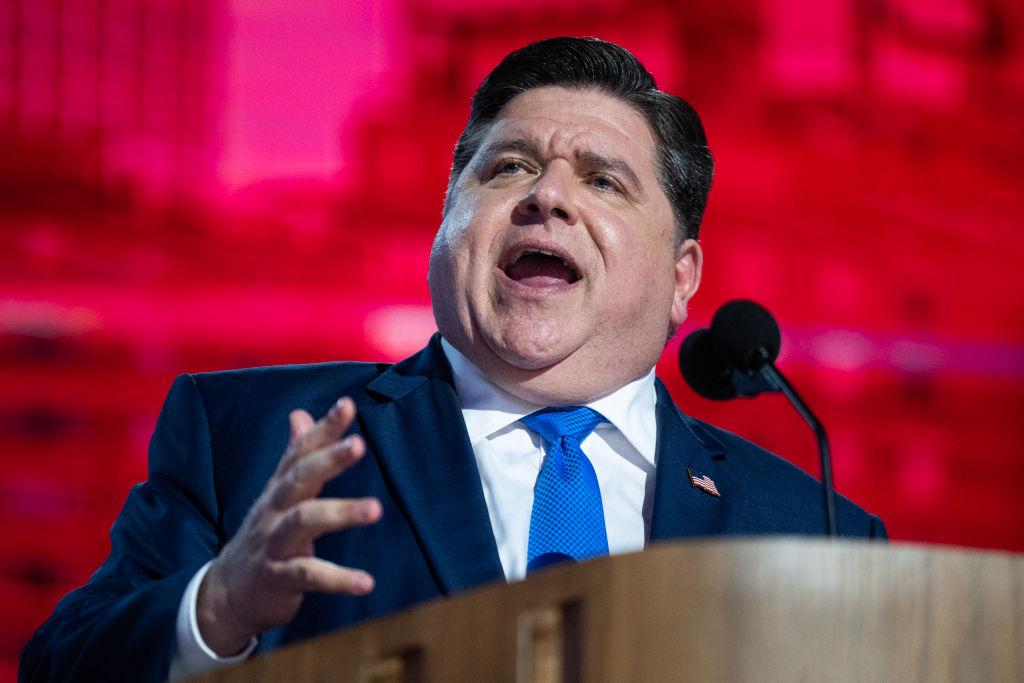
JB Pritzker is replacing Newsom as anti-Trump figurehead

The billionaire Illinois Governor may not be a total blessing for the Democrats. Credit: Getty

The billionaire Illinois Governor may not be a total blessing for the Democrats. Credit: Getty

10 February 2025 - 7:30pm

As a beleaguered Democratic Party grapples for ways to mount effective opposition to an ever-more assertive Trump administration, one governor has taken the lead in demonstrating how it may be done. It is not California’s Gavin Newsom, whose need to work with the President on disaster relief has muted his earlier posturing. Rather, the title of “Resistance governor” could go to Illinois’s JB Pritzker. Like Trump, he’s a billionaire-turned-politician with national ambitions; and aside from antics such as renaming Lake Michigan “Lake Illinois” and threatening to annex Green Bay, he’s been in the news for efforts to counter key items in the agenda of Trump 2.0.

As the flashy governor of the largest and most conspicuously liberal state, Newsom had been most likely to play the part of “Resistance governor”. The Californian was a staunch critic of Trump’s border wall, calling it “pure political theatre”. In 2019, he said: “A 2,000-mile wall is a monument to stupidity. Not just vanity, to stupidity.” Shortly after last year’s presidential election, Newsom took a stand against the President, saying: “Donald Trump has a playbook […] If our American values and freedoms are attacked, we will not stand idly by.”

But that role is not available to him as he acknowledges a “hierarchy of needs” and realises the importance of palying nice with the administration in order to secure disaster relief. Pritzker, as the head of another prominent reliably Democratic state, has a chance to take that mantle, raise his profile, and write the template for a blue-state anti-Trump playbook — credit for which might come in handy in 2028.

On migration, Pritzker has vowed “to stand in the way” of the administration’s deportation orders. He makes a distinction between migrants who are violent criminals, whom he agrees ought to be sent back, and those “law-abiding” illegal migrants. This may be a contradiction in terms, but it’s one which carries some weight with significant portions of the American public, including some of Trump’s own Latino voters.

Pritzker, like many other Democrats, and even some Republicans, does not wish to see members of the undocumented population without criminal records swept along in Immigration and Customs Enforcement (ICE) raids. In opposing this, the Illinois Governor could be on to something, but he risks tipping his party back over into the Biden-era “open borders” stances that cost it dearly in 2024. He will also have to contend with an anti-sanctuary lawsuit from Trump’s administration.

On Trump’s January 6 pardons, Pritzker is similarly closer to public opinion: he condemned the move and barred those pardoned from state jobs. Yet his “tough-on-crime” stance is seemingly at odds with the state parole board’s own record in freeing violent offenders early and without oversight, for which the governor has taken heat.

Pritzker has also objected to DOGE’s efforts to shrink the size of the federal bureaucracy by offering its workers hefty compensation packages. “Federal employees [are being asked] to give up their legal rights, agree to a vague severance, and just hope for the best,” he said. “It’s insulting.” This makes sense practically: the federal government happens to be Illinois’s largest employer after the state government, with 40,000 civil servants based there. The governor’s response, however, reinforces the image of Democrats as reliant on a bloated, non-competitive public sector to generate jobs, a particularly resonant criticism in a state like Illinois, where machine-driven patronage has a long and storied history.

At a time when both parties are accusing the other of abetting “oligarchy”, Pritzker — a scion of the Hyatt hotel dynasty — certainly does nothing to reassure his party’s Left flank on that score. But he is not shy in using state government to push for policies that align with progressive priorities, whether on border enforcement or public sector privileges. In the words of new DNC chair Ken Martin, Pritzker is one of the “good billionaires”.

Democrats will wonder, though, how progressive their agenda can really be if it is being led by an “actual billionaire”. The visibility of Pritzker as a leading anti-Trump Democrat — and possible 2028 contender — raises more uncomfortable questions for the party than it answers.


Michael Cuenco is Senior Editor at American Affairs.
1TrueCuencoism

China is threatening America in the AI race

Reports sugget Zhipu AI  has released a new model that can rival leading US systems. Credit: Getty

Reports sugget Zhipu AI has released a new model that can rival leading US systems. Credit: Getty

1 July 2026 - 10:18am

China is trying to catch up with America on artificial intelligence. The Wall Street Journal has reported that Zhipu AI — one of China’s six “AI tiger” LLMs — has released a new model that can rival leading US systems, including Anthropic’s Mythos, in cybersecurity tasks such as pinpointing security bugs. While this marks a milestone in China’s drive to catch up with Western AI capabilities, strong performance on a single benchmark does not mean it has taken the lead. Chinese models still lag behind their Western counterparts in broader capabilities, such as autonomous operation. Skepticism is therefore warranted before resorting to hysterical conclusions, but complacency about the geopolitical implications of China’s AI advances would be an even greater mistake.

On the infrastructure side, Chinese AI is still constrained by access to advanced chips, with American labs way ahead in computing capacity as well as investment. Analysis from earlier this year suggests that Chinese models are likely to be at least a few months behind those in the US. But they are still continuing to make progress, or that the geopolitical importance of AI will be decided only by whose LLM has ventured deeper into the technological frontier. The practical applications of AI, countries’ to capture foreign markets, and the application of AI into the real economy will matter just as much.

Here, China may hold an advantage. As with its dominance across many critical supply chains, Beijing may not need to produce the most advanced AI systems — only those that are affordable and widely deployable. In doing so, it could consolidate global influence by supplying functional, low-cost AI at scale.

Beijing seems to be pursuing exactly that path, developing an AI “open-source” strategy that offers affordable, widely available AI models for companies and individuals to use and modify as they wish. The production of the DeepSeek AI model, which matched the performance of Silicon Valley tools such as ChatGPT at a fraction of the cost for users, created goodwill among Chinese models with developers.

The four most popular models on OpenRouter, an AI hardware platform for developers, are now all Chinese. The goal for China is not only to win the frontier-model race, but to make its systems the default layer of AI adoption across industries and global markets. For most economies, the choice is increasingly between an affordable tool they can deploy now and a more robust one that may be out of reach.

And while the countries adopting Chinese models may be exposed to political pressure and cyber threats from Beijing, safer and more capable alternatives matter little if they are unaffordable. American AI companies are already under pressure to monetize products whose operating costs are rising. If Chinese open-source models become the cheap default for startups, universities, governments and businesses across the developing world, then America’s AI lead will be eroded from below.

Perhaps more concerning for America in the long run is how AI can give Chinese manufacturing even more strength, through the ongoing integration of AI as a general-purpose technology. China’s new Five-Year Plan mentioned AI more than 50 times and includes an “AI+” action plan aimed at spreading AI across the economy.

Beijing has been pioneering automation of its critical infrastructure for years, with promising recent results in increasing warplane production capacity. In that regard, China’s open-model strategy and manufacturing dominance will reinforce each other. Cheap, adaptable models accelerate deployment across the real economy while those deployments generate real-world data and use cases that can feed back into further model improvement.

The United States should not dismiss the importance of its lead in the AI race. That lead worries Beijing, not least because a more automated Chinese economy would also become more vulnerable to AI-generated cyber threats. But nor should Washington assume that China cannot catch up with American capabilities over time.

This AI competition represents part of a broader struggle over tech supply chains and geopolitical influence. Decisions over whether to adopt US or Chinese models could produce a more fragmented global reality, with different regions relying on different cloud providers, chips and security structures. The result will likely be a global economy which is divided into competing spheres, rather than one which produces a single winner.


Miquel Vila is a political and geopolitical risk consultant focusing on industrial strategy, critical infrastructure and global supply chains.

miquelvilam
