




X Close

‘Japan First’ Sanseito threatens decades of one-party dominance

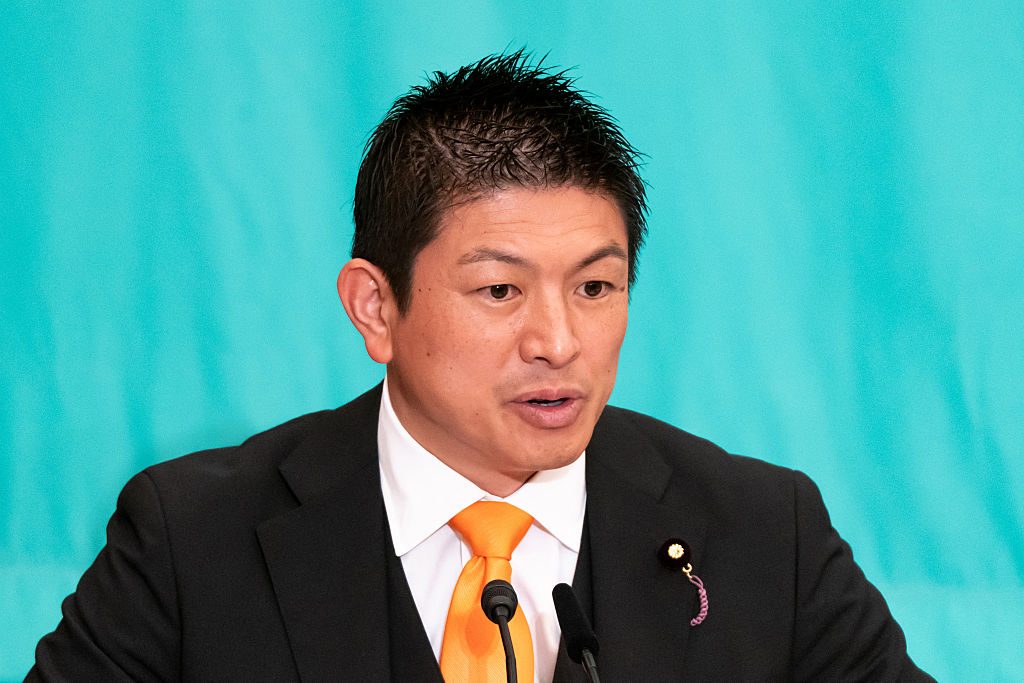
Sanseito leader Sohei Kamiya scored a strong result in today’s election. Credit: Getty

Sanseito leader Sohei Kamiya scored a strong result in today’s election. Credit: Getty

20 July 2025 - 4:30pm

In what would be a seismic political shock in an earthquake-prone country, Japan’s ruling bloc (consisting of the eternal party of government the Liberal Democratic Party and their coalition partners Komeito) are projected to lose their majority in Japan’s upper house elections after Sunday’s vote.

According to exit polls, the coalition will fall short of the 50 seats it needs to hold on to power, coming in at only 41. This will be the worst result since their alliance was forged in 1999.

This is terrible news for Prime Minister Shigeru Ishiba. He has vowed to fight on, but in the wake of this likely humiliation (his third after the deflating Lower House elections last year and the recent Tokyo municipal poll), his time may be up.

The LDP could hang on to power by cobbling together some form of expanded coalition, but that would be difficult and messy because there is no obvious option. And in any case, Ishiba, who is so uncharismatic and uninspiring that some of his own party requested that he not join them on the campaign trail, would have real trouble maintaining any kind of authority over his fractious and factional party.

Ishiba was never popular with the LDP grandees and however determined he may be to carry on, figures like ex-Prime Minister Taro Aso, who is still believed to be the LDP shot-caller (or “shadow shogun” as the Japanese say) may step in.

One of the winners of the night looks likely to be the highly controversial Sanseito (an English translation of their name is the “Do it yourself” party) which is predicted to see its seat count rise from two to between 15 and 22. Sanseito has been branded rather predictably as far-Right conspiracy theorists for their “Japan First” message which advocates strict immigration policies and includes scepticism about Covid lockdowns and mandated vaccinations. Sanseito also opposes “globalism”, extreme gender politics and radical green policies. They also want to rewrite the constitution.

My sources, and my instincts, tell me that much of the criticism of Sanseito is overblown. Sanseito is actually quite a broad church and if they have indulged in some provocative rhetoric with regard to immigrants, it may simply have been a cynical ploy to get attention (if so, it worked). The party certainly got the government’s attention — Ishiba’s cabinet recently set up a new body, called the “control tower” to deal with issues related to immigration in Japan, such as crime (probably not much of a problem in reality) and over-tourism (a genuine issue).

Sanseito has also been heavily criticised for their Covid scepticism, but this is far more widespread in Japan than is acknowledged by the mainstream media. And no wonder, since Japan has a history of vaccine scandals that have made many people wary of government-mandated health policies. And as if to complete the full set of “populist party” attack lines, Sanseito has even been accused of being supported by Russia after one of its members spoke on Russian state television.

There was a whiff of desperation about all these claims, which appear to have fallen flat. Sanseito’s slick and innovative social networking-based membership model and energised campaigning — I was offered a leaflet yesterday so they can’t be that xenophobic — appears to have paid dividends. They look like serious players now.

The truth about Sanseito is that it appears to offer a genuine alternative to the tired and uninspiring LDP and other traditional parties. And it is probably not immigration or Covid concerns that were the main accelerants for its surge. It was the economy. At a time when prices are rising, the yen is weakening, salaries are stagnant, and Trump’s tariffs are threatening the vital automobile sector, people have been emboldened to take a chance on something new. This marks a shift in Japanese electoral behaviour, introducing a dynamism to the otherwise predictable voting patterns.

There are parallels here with the UK. The LDP, which has many similarities with the Conservative Party, is losing its grip on its traditional voter base, partly through its persistent failure, and partly perhaps through sheer boredom. Sanseito, which has similarities to Reform, looks to be one of the chief beneficiaries. Untainted by failure, and rather transgressive, the party looks to have sensed the mood of a jaded and anxious electorate and capitalised. What it does next will be very interesting.


Philip Patrick is a lecturer at a Tokyo university and a freelance journalist.
@Pbp19Philip

China is threatening America in the AI race

Reports sugget Zhipu AI  has released a new model that can rival leading US systems. Credit: Getty

Reports sugget Zhipu AI has released a new model that can rival leading US systems. Credit: Getty

1 July 2026 - 10:18am

China is trying to catch up with America on artificial intelligence. The Wall Street Journal has reported that Zhipu AI — one of China’s six “AI tiger” LLMs — has released a new model that can rival leading US systems, including Anthropic’s Mythos, in cybersecurity tasks such as pinpointing security bugs. While this marks a milestone in China’s drive to catch up with Western AI capabilities, strong performance on a single benchmark does not mean it has taken the lead. Chinese models still lag behind their Western counterparts in broader capabilities, such as autonomous operation. Skepticism is therefore warranted before resorting to hysterical conclusions, but complacency about the geopolitical implications of China’s AI advances would be an even greater mistake.

On the infrastructure side, Chinese AI is still constrained by access to advanced chips, with American labs way ahead in computing capacity as well as investment. Analysis from earlier this year suggests that Chinese models are likely to be at least a few months behind those in the US. But they are still continuing to make progress, or that the geopolitical importance of AI will be decided only by whose LLM has ventured deeper into the technological frontier. The practical applications of AI, countries’ to capture foreign markets, and the application of AI into the real economy will matter just as much.

Here, China may hold an advantage. As with its dominance across many critical supply chains, Beijing may not need to produce the most advanced AI systems — only those that are affordable and widely deployable. In doing so, it could consolidate global influence by supplying functional, low-cost AI at scale.

Beijing seems to be pursuing exactly that path, developing an AI “open-source” strategy that offers affordable, widely available AI models for companies and individuals to use and modify as they wish. The production of the DeepSeek AI model, which matched the performance of Silicon Valley tools such as ChatGPT at a fraction of the cost for users, created goodwill among Chinese models with developers.

The four most popular models on OpenRouter, an AI hardware platform for developers, are now all Chinese. The goal for China is not only to win the frontier-model race, but to make its systems the default layer of AI adoption across industries and global markets. For most economies, the choice is increasingly between an affordable tool they can deploy now and a more robust one that may be out of reach.

And while the countries adopting Chinese models may be exposed to political pressure and cyber threats from Beijing, safer and more capable alternatives matter little if they are unaffordable. American AI companies are already under pressure to monetize products whose operating costs are rising. If Chinese open-source models become the cheap default for startups, universities, governments and businesses across the developing world, then America’s AI lead will be eroded from below.

Perhaps more concerning for America in the long run is how AI can give Chinese manufacturing even more strength, through the ongoing integration of AI as a general-purpose technology. China’s new Five-Year Plan mentioned AI more than 50 times and includes an “AI+” action plan aimed at spreading AI across the economy.

Beijing has been pioneering automation of its critical infrastructure for years, with promising recent results in increasing warplane production capacity. In that regard, China’s open-model strategy and manufacturing dominance will reinforce each other. Cheap, adaptable models accelerate deployment across the real economy while those deployments generate real-world data and use cases that can feed back into further model improvement.

The United States should not dismiss the importance of its lead in the AI race. That lead worries Beijing, not least because a more automated Chinese economy would also become more vulnerable to AI-generated cyber threats. But nor should Washington assume that China cannot catch up with American capabilities over time.

This AI competition represents part of a broader struggle over tech supply chains and geopolitical influence. Decisions over whether to adopt US or Chinese models could produce a more fragmented global reality, with different regions relying on different cloud providers, chips and security structures. The result will likely be a global economy which is divided into competing spheres, rather than one which produces a single winner.


Miquel Vila is a political and geopolitical risk consultant focusing on industrial strategy, critical infrastructure and global supply chains.

miquelvilam