




X Close

It’s time for a British Panthéon

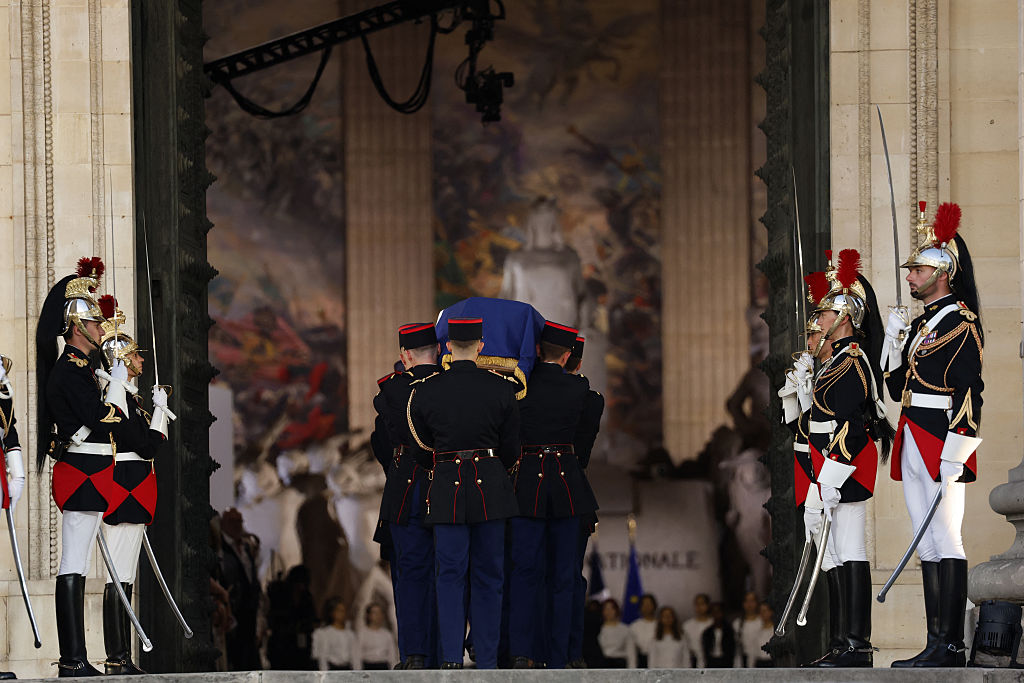
French Republican Guards carry symbolic caskets for Marc and Simonne Bloch into the Panthéon in Paris earlier this week. Credit: Getty

French Republican Guards carry symbolic caskets for Marc and Simonne Bloch into the Panthéon in Paris earlier this week. Credit: Getty

28 June 2026 - 1:00pm

“Is there a doctor here?”
“I am a doctor, what’s the matter?”
“This man’s having a cardiac arrest!”
“I am a doctor of philosophy.”
“Ah, then this man will die!”
“We’re all going to die…”

This favourite meme says something important about the touching seriousness with which the French treat philosophical matters. But so does the interment this week of the French academic and Resistance hero Marc Bloch in a solemn republican liturgy, conducted by President Emmanuel Macron himself, in the Panthéon in Paris. Surrounded by the tombs of Voltaire, Rousseau, Louis Braille and Marie Curie, symbolic caskets representing Bloch and his wife, Simonne — their bodies will remain in Le Bourg-d’Hem, where they were buried — were carried into the former church constructed on the orders of Louis XV. This duty was performed by soldiers wearing the sort of kepis and epaulettes that Bloch would have remembered from his service to the “steely, war-like France” for which “the French were required to die and mourn uncomplainingly”.

Panthéonisation is one of the highest civic honours that the French Republic can bestow, commemorating individuals judged to have made an exceptional contribution to the nation. The ceremony possessed that peculiarly French genius for solemnity: a country that abolished kings centuries ago nevertheless understands the value of ritual, provided the ritual is dedicated to the very French ideals of intellect and sacrifice. One could almost imagine Bloch himself observing proceedings with anthropological curiosity, taking notes, as the melancholic strains of Gabriel Fauré’s “Pavane” filled the great space beneath the dome, and Macron, the frustrated thespian, paid his tributes with typical suavité.

In laying Bloch to rest in the Panthéon, the Republic honours not only a patriot who died for his country, but a historian who taught it how to understand itself. For the French, the life of the mind is part of the nation’s inheritance, and its greatest thinkers — and those who lived up to its ideals — deserve a place alongside its greatest heroes.

Where the austerity of the Panthéon ceremony invited reflection upon the republican and democratic ideals of modern France, its legibility also highlighted the contrast with Britain’s own impenetrable state ceremonial. I have always been a fan of the Gilbert and Sullivan aesthetic of red tunics and horsehair wigs at state openings, and the King’s coronation was an immersive experience for anyone partial to Ruritanian splendour. But I imagine that much of the arcana involved in what has sometimes been referred to as “British Shinto” — special cushions, medieval cutlery and men in tights with titles like Silver Stick-in-Waiting and Rouge Croix Pursuivant — is utterly baffling to the wider public.

The British genius lies in performing these mysteries with such confidence that asking too many questions feels vaguely unpatriotic. And unlike the French devotion to Liberté, Égalité, Fraternité, we are more suspicious of abstract nouns, as recent attempts by our governments to define specific “British values” have shown.

But what the UK does miss is its own version of Panthéonisation for non-royals, where Britons could pay their respects with suitable gravitas. The closest analogue is Westminster Abbey, which houses the remains of figures ranging from Geoffrey Chaucer to Charles Darwin, yet the building’s function is primarily religious. Perhaps, in the age of Northern devolution, this charge could be best led locally; I have long dreamed of a Walhalla-style hall of fame on the banks of the Tyne, with marble statues of Northumbrian heroes such as George Stephenson, Grace Darling and Dan Burn.

After all, if France can elevate its philosophers to the Panthéon, the least we can do is give our own heroes somewhere more dignified than a roundabout. Britain has never lacked heroes, only the confidence to celebrate them with quite the same theatrical conviction as the French.


Dan Jackson is the author of the best-selling book The Northumbrians: The North East of England and its People. A New History, published by Hurst (2019)


northumbriana

China is threatening America in the AI race

Reports sugget Zhipu AI  has released a new model that can rival leading US systems. Credit: Getty

Reports sugget Zhipu AI has released a new model that can rival leading US systems. Credit: Getty

1 July 2026 - 10:18am

China is trying to catch up with America on artificial intelligence. The Wall Street Journal has reported that Zhipu AI — one of China’s six “AI tiger” LLMs — has released a new model that can rival leading US systems, including Anthropic’s Mythos, in cybersecurity tasks such as pinpointing security bugs. While this marks a milestone in China’s drive to catch up with Western AI capabilities, strong performance on a single benchmark does not mean it has taken the lead. Chinese models still lag behind their Western counterparts in broader capabilities, such as autonomous operation. Skepticism is therefore warranted before resorting to hysterical conclusions, but complacency about the geopolitical implications of China’s AI advances would be an even greater mistake.

On the infrastructure side, Chinese AI is still constrained by access to advanced chips, with American labs way ahead in computing capacity as well as investment. Analysis from earlier this year suggests that Chinese models are likely to be at least a few months behind those in the US. But they are still continuing to make progress, or that the geopolitical importance of AI will be decided only by whose LLM has ventured deeper into the technological frontier. The practical applications of AI, countries’ to capture foreign markets, and the application of AI into the real economy will matter just as much.

Here, China may hold an advantage. As with its dominance across many critical supply chains, Beijing may not need to produce the most advanced AI systems — only those that are affordable and widely deployable. In doing so, it could consolidate global influence by supplying functional, low-cost AI at scale.

Beijing seems to be pursuing exactly that path, developing an AI “open-source” strategy that offers affordable, widely available AI models for companies and individuals to use and modify as they wish. The production of the DeepSeek AI model, which matched the performance of Silicon Valley tools such as ChatGPT at a fraction of the cost for users, created goodwill among Chinese models with developers.

The four most popular models on OpenRouter, an AI hardware platform for developers, are now all Chinese. The goal for China is not only to win the frontier-model race, but to make its systems the default layer of AI adoption across industries and global markets. For most economies, the choice is increasingly between an affordable tool they can deploy now and a more robust one that may be out of reach.

And while the countries adopting Chinese models may be exposed to political pressure and cyber threats from Beijing, safer and more capable alternatives matter little if they are unaffordable. American AI companies are already under pressure to monetize products whose operating costs are rising. If Chinese open-source models become the cheap default for startups, universities, governments and businesses across the developing world, then America’s AI lead will be eroded from below.

Perhaps more concerning for America in the long run is how AI can give Chinese manufacturing even more strength, through the ongoing integration of AI as a general-purpose technology. China’s new Five-Year Plan mentioned AI more than 50 times and includes an “AI+” action plan aimed at spreading AI across the economy.

Beijing has been pioneering automation of its critical infrastructure for years, with promising recent results in increasing warplane production capacity. In that regard, China’s open-model strategy and manufacturing dominance will reinforce each other. Cheap, adaptable models accelerate deployment across the real economy while those deployments generate real-world data and use cases that can feed back into further model improvement.

The United States should not dismiss the importance of its lead in the AI race. That lead worries Beijing, not least because a more automated Chinese economy would also become more vulnerable to AI-generated cyber threats. But nor should Washington assume that China cannot catch up with American capabilities over time.

This AI competition represents part of a broader struggle over tech supply chains and geopolitical influence. Decisions over whether to adopt US or Chinese models could produce a more fragmented global reality, with different regions relying on different cloud providers, chips and security structures. The result will likely be a global economy which is divided into competing spheres, rather than one which produces a single winner.


Miquel Vila is a political and geopolitical risk consultant focusing on industrial strategy, critical infrastructure and global supply chains.

miquelvilam