




X Close

It’s not just tariffs causing Nvidia’s price drop

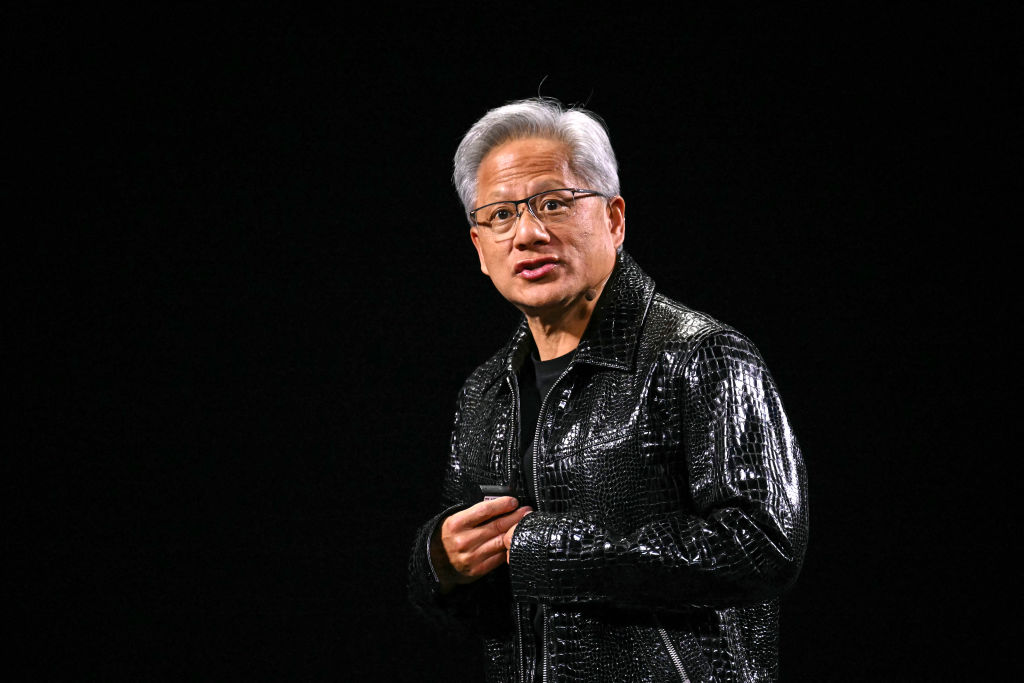
Nvidia CEO Jensen Huang pictured earlier this year. Credit: Getty

Nvidia CEO Jensen Huang pictured earlier this year. Credit: Getty

March 4 2025 - 1:00pm

Nvidia’s share price is under pressure once more, falling 9% in trading yesterday ahead of Donald Trump’s tariffs coming into effect today. The stock has dropped over 12% in the past week and has shed its impressive $3 trillion market cap, with the tech company now valued at $2.79 trillion.

It is difficult to see how far Trump’s tariffs, which for now are mainly targeted at Mexico and Canada, would affect the chip producer. It seems more likely that a lack of confidence in Nvidia itself is driving the decline, and that traders are sending the value of the stock down on days when the broader market declines. Yesterday, when Nvidia dropped by 9%, the overall NASDAQ index lost around 2.6%.

Since the release of DeepSeek led to initial declines in Nvidia’s valuation, there has been an ongoing debate about the importance of the Chinese company and what it means for the broader AI market. Elon Musk has weighed in, stating that while DeepSeek’s performance is impressive, American AI programs would soon beat it. While this may be true, it raises questions about whether these new developments might not have been helped along by DeepSeek, which is open-source.

More importantly, Musk claims not to believe the DeepSeek team when they say that they trained the program on a much smaller number of chips than is normal in AI. If DeepSeek is telling the truth, Nvidia’s future revenues will probably suffer as AI developers are required to buy fewer chips than expected. But it is hard not to view Musk’s comments in light of the fact that the release of DeepSeek has reportedly lost the tycoon around $90 billion.

The Trump administration and other US-aligned governments appear to be running with Musk’s interpretation. If the Tesla boss is correct, the Chinese skirted export bans on Nvidia chips, used a large number to develop DeepSeek, and then lied about how many semiconductors were required to cover their tracks. Soon after the DeepSeek release, Singaporean police arrested three men accused of engaging in fraud to smuggle Nvidia chips into China. At the end of last week, the Wall Street Journal ran an article making similar accusations against domestic Chinese firms.

Beijing is evidently swerving export regulations on Western technology, and the fact that this is so easy to accomplish raises serious questions about the purpose of the restrictions. If they are not working, they are only enriching middlemen and encouraging criminal enterprise. But just because China is importing Nvidia chips via the black market does not mean that DeepSeek researchers are lying about the quality of their product.

More broadly, the DeepSeek saga raised the uncomfortable possibility that investors were factoring in very modest efficiency gains when dealing with the economization of chips in AI development. Even if the Chinese have not broken through an efficiency barrier with DeepSeek, it is still likely that at some point the technology will improve. It will be worth watching the stock price of Nvidia in the coming months to see how markets process this debate, as the ramifications are sure to be huge for Silicon Valley and the global tech industry.


Philip Pilkington is a macroeconomist and investment professional, and the author of The Reformation in Economics

philippilk

China is threatening America in the AI race

Reports sugget Zhipu AI  has released a new model that can rival leading US systems. Credit: Getty

Reports sugget Zhipu AI has released a new model that can rival leading US systems. Credit: Getty

July 1 2026 - 10:18am

China is trying to catch up with America on artificial intelligence. The Wall Street Journal has reported that Zhipu AI — one of China’s six “AI tiger” LLMs — has released a new model that can rival leading US systems, including Anthropic’s Mythos, in cybersecurity tasks such as pinpointing security bugs. While this marks a milestone in China’s drive to catch up with Western AI capabilities, strong performance on a single benchmark does not mean it has taken the lead. Chinese models still lag behind their Western counterparts in broader capabilities, such as autonomous operation. Skepticism is therefore warranted before resorting to hysterical conclusions, but complacency about the geopolitical implications of China’s AI advances would be an even greater mistake.

On the infrastructure side, Chinese AI is still constrained by access to advanced chips, with American labs way ahead in computing capacity as well as investment. Analysis from earlier this year suggests that Chinese models are likely to be at least a few months behind those in the US. But they are still continuing to make progress, or that the geopolitical importance of AI will be decided only by whose LLM has ventured deeper into the technological frontier. The practical applications of AI, countries’ to capture foreign markets, and the application of AI into the real economy will matter just as much.

Here, China may hold an advantage. As with its dominance across many critical supply chains, Beijing may not need to produce the most advanced AI systems — only those that are affordable and widely deployable. In doing so, it could consolidate global influence by supplying functional, low-cost AI at scale.

Beijing seems to be pursuing exactly that path, developing an AI “open-source” strategy that offers affordable, widely available AI models for companies and individuals to use and modify as they wish. The production of the DeepSeek AI model, which matched the performance of Silicon Valley tools such as ChatGPT at a fraction of the cost for users, created goodwill among Chinese models with developers.

The four most popular models on OpenRouter, an AI hardware platform for developers, are now all Chinese. The goal for China is not only to win the frontier-model race, but to make its systems the default layer of AI adoption across industries and global markets. For most economies, the choice is increasingly between an affordable tool they can deploy now and a more robust one that may be out of reach.

And while the countries adopting Chinese models may be exposed to political pressure and cyber threats from Beijing, safer and more capable alternatives matter little if they are unaffordable. American AI companies are already under pressure to monetize products whose operating costs are rising. If Chinese open-source models become the cheap default for startups, universities, governments and businesses across the developing world, then America’s AI lead will be eroded from below.

Perhaps more concerning for America in the long run is how AI can give Chinese manufacturing even more strength, through the ongoing integration of AI as a general-purpose technology. China’s new Five-Year Plan mentioned AI more than 50 times and includes an “AI+” action plan aimed at spreading AI across the economy.

Beijing has been pioneering automation of its critical infrastructure for years, with promising recent results in increasing warplane production capacity. In that regard, China’s open-model strategy and manufacturing dominance will reinforce each other. Cheap, adaptable models accelerate deployment across the real economy while those deployments generate real-world data and use cases that can feed back into further model improvement.

The United States should not dismiss the importance of its lead in the AI race. That lead worries Beijing, not least because a more automated Chinese economy would also become more vulnerable to AI-generated cyber threats. But nor should Washington assume that China cannot catch up with American capabilities over time.

This AI competition represents part of a broader struggle over tech supply chains and geopolitical influence. Decisions over whether to adopt US or Chinese models could produce a more fragmented global reality, with different regions relying on different cloud providers, chips and security structures. The result will likely be a global economy which is divided into competing spheres, rather than one which produces a single winner.


Miquel Vila is a political and geopolitical risk consultant focusing on industrial strategy, critical infrastructure and global supply chains.

miquelvilam