

X Close

Is Trump pulling back from Taiwan?

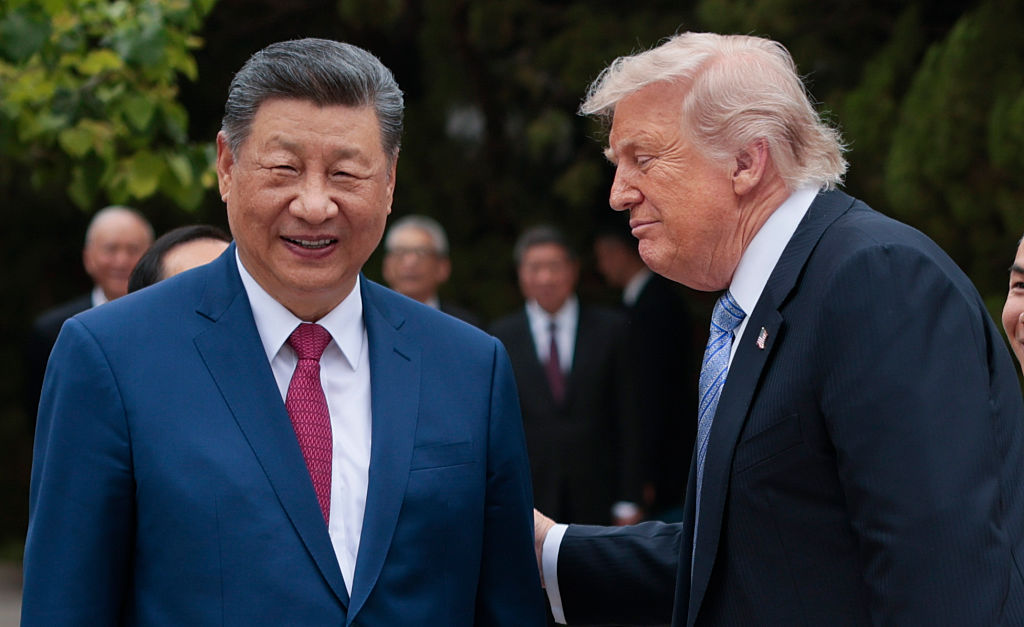
For the first time in nearly two decades, Washington issued a sharp rebuke to Taiwan. Credit: Getty

For the first time in nearly two decades, Washington issued a sharp rebuke to Taiwan. Credit: Getty

3 August 2025 - 1:00pm

A remarkable shift in US foreign policy unfolded last week, with potentially far-reaching consequences for global security. For the first time in nearly two decades, Washington issued a sharp and public rebuke to Taiwan.

The immediate trigger was the cancellation of President Lai Ching-te’s trip to Latin America, which had included planned stopovers in New York and Dallas. According to reports, the Trump administration instructed Lai to skip his US visits.

This marks a possible course correction in America’s stance toward Taipei. Lai’s grounded trip follows the suspension of another planned visit — by Taiwan’s defence minister, Wellington Koo, in June — which was reportedly scrapped after a Trump-Xi phone call. One report suggested the shift reflects Trump’s desire to “avoid antagonising China”.

That may well be true, but there’s likely more to the story. President Lai’s recent rhetoric has added an unnecessary layer of tension to already fraught cross-Strait relations. In recent months, Lai has been giving a series of 10 speeches on Taiwan’s history, identity, and nationhood. These risk-laden statements mark a brazen departure from the more moderate policies of Lai’s predecessor and have resulted in a series of sharp warnings from Beijing that started in late June. Most recently, the Chinese PLA spokesman remarked that members of Taiwan’s ruling DPP party are “willing to be ‘pawns’ and ultimately will become ‘sacrificed pawns’”.

It’s a muted reaction compared to the major show of force that occurred back in April 2025, when China held large-scale military exercises around Taiwan. The bottom line is that Washington has most likely seen these and other signals, understands the volatility of the situation, and is attempting to rein in this highly dangerous escalation.

Predictably, hawks in Washington are not happy. Matthew Pottinger, deputy national security adviser from the first Trump administration, complained, “Beijing will pocket this concession and ask for more”. Ely Ratner, who served as a senior Pentagon official in the Biden administration, similarly opined, “These concessions send a dangerous signal that America’s approach to Taiwan is negotiable”.

These hawks fail to understand that diplomacy involves compromise, setting priorities, and, above all, a responsible eye to the risks and potential costs of war. A compromise solution can and should be found regarding Taiwan. This has been done in the past and it can be done in the future.

“America First” cannot mean that this little island with a complex history and serious identity issues becomes the sine qua non of American strategy in the vast Asia-Pacific region and even globally. There are vital matters, not least the US-China trading relationship exceeding $600 billion annually, that should be prioritised over Taiwan.

More to the point, these hawks seem all too oblivious to the military risks involved in a Taiwan conflict. The most authoritative wargame of a Taiwan scenario predicts that the US would almost certainly lose two aircraft carriers during the first week of combat. Likewise, another detailed assessment by a veteran of the US Navy submarine force suggests that the result “might be large portions of the [American] Seventh Fleet at the bottom of the ocean”. That’s not even to broach the possible use of nuclear weapons in such a conflict.

For years, the US has been building up military forces in the western Pacific that include common warship transits of the Taiwan Strait. On the diplomatic side, Washington has regularly dispatched high-level official delegations to the island, engaged in rhetoric that suggests it has the right and will to intervene in a Taiwan conflict, encouraged allies to become involved in the dispute, built a thoroughly modern facility that functions as a de facto embassy at the cost of hundreds of millions of US taxpayer dollars, and even deployed American troops to the island.

A major course correction is now overdue. To preserve peace in the Asia-Pacific, Washington must act to restrain Taiwan’s growing push toward formal nationhood and independence.

There are signs this shift may already be underway — and rightly so. It aligns with a broader, long-needed pivot away from the destructive excesses of globalism and toward a more measured, “America First” approach to foreign and defence policy.


Lyle Goldstein is Director of Asia Engagement at Defense Priorities and a Senior Fellow at Brown University.

lylegoldstein

China is threatening America in the AI race

Reports sugget Zhipu AI  has released a new model that can rival leading US systems. Credit: Getty

Reports sugget Zhipu AI has released a new model that can rival leading US systems. Credit: Getty

1 July 2026 - 10:18am

China is trying to catch up with America on artificial intelligence. The Wall Street Journal has reported that Zhipu AI — one of China’s six “AI tiger” LLMs — has released a new model that can rival leading US systems, including Anthropic’s Mythos, in cybersecurity tasks such as pinpointing security bugs. While this marks a milestone in China’s drive to catch up with Western AI capabilities, strong performance on a single benchmark does not mean it has taken the lead. Chinese models still lag behind their Western counterparts in broader capabilities, such as autonomous operation. Skepticism is therefore warranted before resorting to hysterical conclusions, but complacency about the geopolitical implications of China’s AI advances would be an even greater mistake.

On the infrastructure side, Chinese AI is still constrained by access to advanced chips, with American labs way ahead in computing capacity as well as investment. Analysis from earlier this year suggests that Chinese models are likely to be at least a few months behind those in the US. But they are still continuing to make progress, or that the geopolitical importance of AI will be decided only by whose LLM has ventured deeper into the technological frontier. The practical applications of AI, countries’ to capture foreign markets, and the application of AI into the real economy will matter just as much.

Here, China may hold an advantage. As with its dominance across many critical supply chains, Beijing may not need to produce the most advanced AI systems — only those that are affordable and widely deployable. In doing so, it could consolidate global influence by supplying functional, low-cost AI at scale.

Beijing seems to be pursuing exactly that path, developing an AI “open-source” strategy that offers affordable, widely available AI models for companies and individuals to use and modify as they wish. The production of the DeepSeek AI model, which matched the performance of Silicon Valley tools such as ChatGPT at a fraction of the cost for users, created goodwill among Chinese models with developers.

The four most popular models on OpenRouter, an AI hardware platform for developers, are now all Chinese. The goal for China is not only to win the frontier-model race, but to make its systems the default layer of AI adoption across industries and global markets. For most economies, the choice is increasingly between an affordable tool they can deploy now and a more robust one that may be out of reach.

And while the countries adopting Chinese models may be exposed to political pressure and cyber threats from Beijing, safer and more capable alternatives matter little if they are unaffordable. American AI companies are already under pressure to monetize products whose operating costs are rising. If Chinese open-source models become the cheap default for startups, universities, governments and businesses across the developing world, then America’s AI lead will be eroded from below.

Perhaps more concerning for America in the long run is how AI can give Chinese manufacturing even more strength, through the ongoing integration of AI as a general-purpose technology. China’s new Five-Year Plan mentioned AI more than 50 times and includes an “AI+” action plan aimed at spreading AI across the economy.

Beijing has been pioneering automation of its critical infrastructure for years, with promising recent results in increasing warplane production capacity. In that regard, China’s open-model strategy and manufacturing dominance will reinforce each other. Cheap, adaptable models accelerate deployment across the real economy while those deployments generate real-world data and use cases that can feed back into further model improvement.

The United States should not dismiss the importance of its lead in the AI race. That lead worries Beijing, not least because a more automated Chinese economy would also become more vulnerable to AI-generated cyber threats. But nor should Washington assume that China cannot catch up with American capabilities over time.

This AI competition represents part of a broader struggle over tech supply chains and geopolitical influence. Decisions over whether to adopt US or Chinese models could produce a more fragmented global reality, with different regions relying on different cloud providers, chips and security structures. The result will likely be a global economy which is divided into competing spheres, rather than one which produces a single winner.


Miquel Vila is a political and geopolitical risk consultant focusing on industrial strategy, critical infrastructure and global supply chains.

miquelvilam