




X Close

Is the NHS caving to pressure over trans clinic age limits?

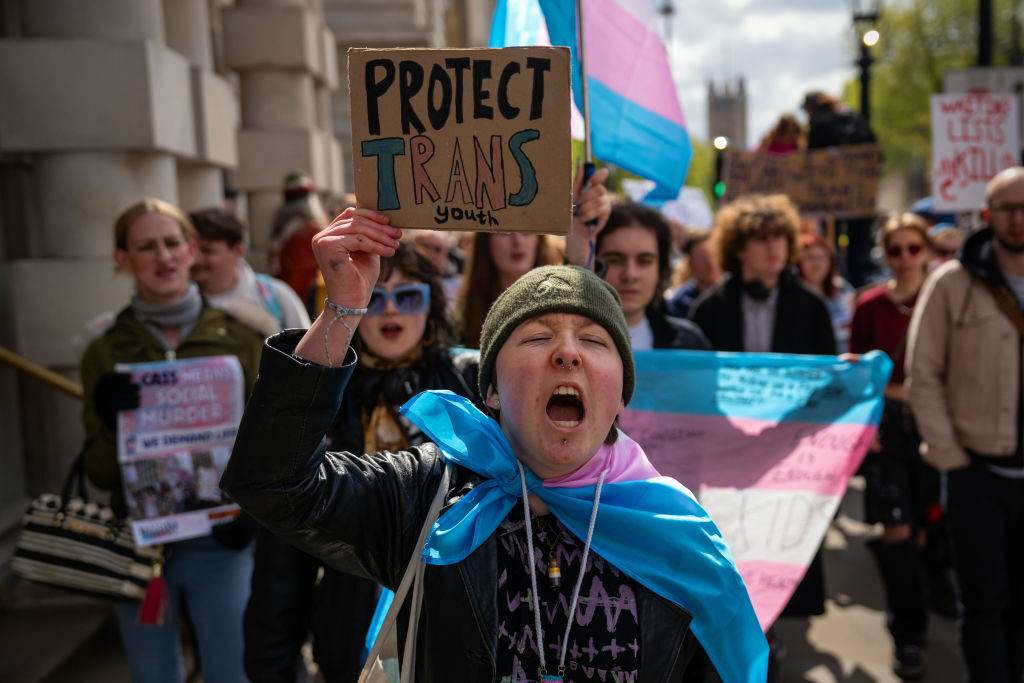
Trans activists continue to resist the Cass Review. Credit: Getty

Trans activists continue to resist the Cass Review. Credit: Getty

16 May 2025 - 1:00pm

Should there be an age restriction on something which shouldn’t be happening at all? It’s a question prompted by news that the NHS may be backing down on a proposal to set a minimum age of seven for referrals to its gender clinics.

The proposed threshold had been part of draft guidance published in 2023, which stated that “showing an interest in clothes or toys of the opposite sex – or displaying behaviours more commonly associated with the opposite sex – is reasonably common behaviour in childhood and is usually not indicative of gender incongruence”. Seven was suggested as a minimum age for intervention on the basis that children would, by then, be more capable of articulating their needs and engaging with healthcare professionals.

The current backtracking would appear to be the result of pressure from trans activists during the consultation process. Just what impact this will have on very young children — those at an age where many still believe if you change your clothes, you literally change your sex — remains to be seen. Stephanie Davies-Arai of Transgender Trend has suggested it may have some benefits, enabling families to access professional advice as early as possible rather than be misdirected by trans lobbyists. At the same time, as long as such advice is delivered in the context of  “gender medicine” — as long as there is a perceived need for “gender clinics” and “paediatric gender care” — misdirection seems unavoidable. This will be the case whether the patient is four years old or 10.

Of course, “burn it all to the ground” is not considered a rational or nuanced response to an issue. Nonetheless, following the Cass Review, the Tavistock closure and numerous court cases highlighting the sheer madness of trans ideology, one can’t help feeling that any discussion of when a child is “ready” to be diagnosed as trans avoids getting to the heart of the issue.  After many years of outright denial that there was any problem with socially and (eventually) medically transitioning children, it feels as though we have entered a prolonged period of tinkering. There’s a willingness to admit that some things need to change, but no one who has been complicit in this scandal is yet prepared to question the entire concept of “the trans child”.

It’s a concept rooted entirely in stereotypes, regressive beliefs about masculinity and femininity and, at its worst, male fantasies. Re-reading the 2023 draft guidance, one is struck by how bizarre it is for any supposedly progressive institution to be delivering judgements on how “normal” — or not — it is for a child to be interested in “clothes or toys of the opposite sex”, even if the conclusion is that it is “reasonably common”. It’s a reminder that gender identity, as an idea, comes from a time when gender roles were deeply ingrained, homosexuality was illegal, and “unmasculine” men and “unfeminine” women were considered aberrant. It is insane, years later, to think that a child’s relationship to masculinity or femininity should ever, in and of itself, be subject to medicalisation.

If the ugly aftermath of the Supreme Court’s ruling on the definition of “woman” has highlighted anything, it is the need to stop pretending that adult male transitioners have anything in common with the traumatised children they hide behind. Some men are attracted to the idea of feminine subjugation, but a child’s rejection of gender norms and/or hatred of their sexed body should not be used to validate misogynistic fantasies. As long as there is a belief that some — even a tiny minority, perhaps only identifiable in late childhood — are born in the wrong body, their very real needs will be reframed in order to pander to the desires of more powerful others.

There should be no age threshold when it comes to children accessing meaningful psychological support. But in a progressive, open-minded society, isn’t it time to stop referring those with varied needs — some abuse survivors, some autistic, some who might grow up to be gay — to “gender clinics”? If the practice sounds like something from the Fifties, that’s because it is. It’s not the age limit that’s the problem — it’s the whole thing.


Victoria Smith is a writer and creator of the Glosswitch newsletter.

glosswitch

China is threatening America in the AI race

Reports sugget Zhipu AI  has released a new model that can rival leading US systems. Credit: Getty

Reports sugget Zhipu AI has released a new model that can rival leading US systems. Credit: Getty

1 July 2026 - 10:18am

China is trying to catch up with America on artificial intelligence. The Wall Street Journal has reported that Zhipu AI — one of China’s six “AI tiger” LLMs — has released a new model that can rival leading US systems, including Anthropic’s Mythos, in cybersecurity tasks such as pinpointing security bugs. While this marks a milestone in China’s drive to catch up with Western AI capabilities, strong performance on a single benchmark does not mean it has taken the lead. Chinese models still lag behind their Western counterparts in broader capabilities, such as autonomous operation. Skepticism is therefore warranted before resorting to hysterical conclusions, but complacency about the geopolitical implications of China’s AI advances would be an even greater mistake.

On the infrastructure side, Chinese AI is still constrained by access to advanced chips, with American labs way ahead in computing capacity as well as investment. Analysis from earlier this year suggests that Chinese models are likely to be at least a few months behind those in the US. But they are still continuing to make progress, or that the geopolitical importance of AI will be decided only by whose LLM has ventured deeper into the technological frontier. The practical applications of AI, countries’ to capture foreign markets, and the application of AI into the real economy will matter just as much.

Here, China may hold an advantage. As with its dominance across many critical supply chains, Beijing may not need to produce the most advanced AI systems — only those that are affordable and widely deployable. In doing so, it could consolidate global influence by supplying functional, low-cost AI at scale.

Beijing seems to be pursuing exactly that path, developing an AI “open-source” strategy that offers affordable, widely available AI models for companies and individuals to use and modify as they wish. The production of the DeepSeek AI model, which matched the performance of Silicon Valley tools such as ChatGPT at a fraction of the cost for users, created goodwill among Chinese models with developers.

The four most popular models on OpenRouter, an AI hardware platform for developers, are now all Chinese. The goal for China is not only to win the frontier-model race, but to make its systems the default layer of AI adoption across industries and global markets. For most economies, the choice is increasingly between an affordable tool they can deploy now and a more robust one that may be out of reach.

And while the countries adopting Chinese models may be exposed to political pressure and cyber threats from Beijing, safer and more capable alternatives matter little if they are unaffordable. American AI companies are already under pressure to monetize products whose operating costs are rising. If Chinese open-source models become the cheap default for startups, universities, governments and businesses across the developing world, then America’s AI lead will be eroded from below.

Perhaps more concerning for America in the long run is how AI can give Chinese manufacturing even more strength, through the ongoing integration of AI as a general-purpose technology. China’s new Five-Year Plan mentioned AI more than 50 times and includes an “AI+” action plan aimed at spreading AI across the economy.

Beijing has been pioneering automation of its critical infrastructure for years, with promising recent results in increasing warplane production capacity. In that regard, China’s open-model strategy and manufacturing dominance will reinforce each other. Cheap, adaptable models accelerate deployment across the real economy while those deployments generate real-world data and use cases that can feed back into further model improvement.

The United States should not dismiss the importance of its lead in the AI race. That lead worries Beijing, not least because a more automated Chinese economy would also become more vulnerable to AI-generated cyber threats. But nor should Washington assume that China cannot catch up with American capabilities over time.

This AI competition represents part of a broader struggle over tech supply chains and geopolitical influence. Decisions over whether to adopt US or Chinese models could produce a more fragmented global reality, with different regions relying on different cloud providers, chips and security structures. The result will likely be a global economy which is divided into competing spheres, rather than one which produces a single winner.


Miquel Vila is a political and geopolitical risk consultant focusing on industrial strategy, critical infrastructure and global supply chains.

miquelvilam