




X Close

Is Putin deliberately torpedoing Ukraine talks?

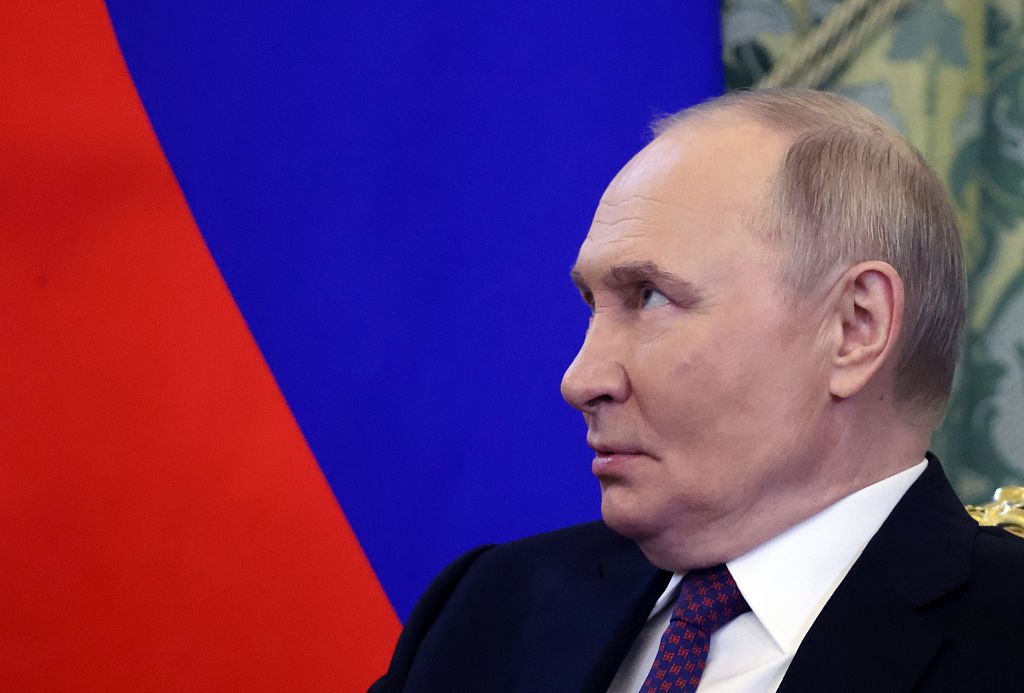
Putin has nothing to lose and everything to gain from continuing the war. Credit: Getty

Putin has nothing to lose and everything to gain from continuing the war. Credit: Getty

3 June 2025 - 4:15pm

Representatives of Russia and Ukraine met this week in Istanbul for the latest round of what are labelled peace negotiations — but they seem anything but. The Kremlin’s latest gambit has been to introduce a memorandum outlining a series of impossible preconditions for peace that seem intended only to inflame Ukrainian President Volodymyr Zelenskyy’s representatives.

The memorandum demands that Ukraine withdraw from the four occupied regions of Eastern Ukraine that Russia annexed in 2022 and now claims as part of its legal territory, that Ukraine and other countries accept both these regions and those seized in 2014 (including Crimea) now belong to Russia, and that Ukraine limit the size of its armed forces and adopt a permanently neutral status. Additionally, it insists that Russian once again be made an official language in Ukraine and that Kyiv ban “the glorification and promotion of Nazism”.

In return for these concessions, neither the negotiating team nor senior Russian politicians have provided any hints of how they might address Ukrainian concerns about the plight of civilians, including deported children, from the occupied territories. Indeed, Dmitry Medvedev today took to Telegram to assert that Russia sought only “swift victory and the complete destruction of the neo-Nazi regime” in Kyiv.

Unsurprisingly, Ukraine has refused to even countenance any aspect of Russia’s memorandum. Speaking on Monday at a security forum in Lithuania attended by Nato and European leaders, Zelensky emphasised that “the aggressor must not receive any reward for war. Putin must get nothing that would justify his aggression. Any reward would only show him that war pays off.”

Vladimir Putin, of course, must have predicted this reaction. Russia does not control the entirety of the four occupied regions it claims as its own, and there is no need for Ukraine to recognise Russian ownership of either these regions or Crimea to end the war. Ukraine will see any commitment to downsize its military as suicidal, leaving it defenceless against a rejuvenated Russian army in the coming years, and the impossibility of Nato membership as adding insult to injury. While before 2022 there might have been room for negotiation on questions of language and “Nazism”, which speak more to historical and cultural politics than military realities, they have become shibboleths in Ukrainian national debates.

Putin’s proposal reveals the Russian leader’s continued confidence in achieving his long-term goals: ensuring his own security, subjugating Ukraine, and bolstering his country’s position in the global economic and political order. The population has become accustomed to the high casualty rate in Ukraine, and the economy — notwithstanding some hiccups — is functioning well. Money from vast state spending on war is fuelling a socioeconomic boom in Russia’s impoverished regions, and international companies are already discussing a return to business in the country. With no internal competition and no existential military threat from Ukraine, Putin knows he can keep the war machine rolling and reap the benefits.

Russian and Ukrainian negotiators may be sitting in close proximity in Istanbul, but neither side is really talking to each other. Rather, they are performing to audiences offstage. Russia is demonstrating to the international community, and in particular Donald Trump, that it can keep fighting as long as it chooses, and showing off the boisterous quasi-diplomacy which domestic patriots enthusiastically lap up. Ukraine, knowing that its opponent will concede nothing, is playing to Trump in the hopes that the American President will finally tire of Putin’s tactics. Indeed, should Trump commit to providing military or economic escape mechanisms for either side, the tenor of negotiations might suddenly shift.

In this round of negotiations, at least, peace remains as far away as ever. Zelensky’s team is hopeful of a change of heart in the White House — although weekend strikes against Russia’s strategic bomber fleet show how the country’s military will keep pressuring the Kremlin regardless of American support. Meanwhile, Putin has nothing to lose and everything to gain from continuing the fight.

Nonetheless, a few months ago it seemed impossible that the two sides could even be coaxed to enter the same room. The existence of any form of engagement is a positive step. An optimist might believe that those analysts who observe that Putin’s army will have to “kill their way out of this war” may yet be proven wrong.


Dr. Ian Garner is assistant professor of totalitarian studies at the Pilecki Institute in Warsaw. His latest book is Z Generation: Russia’s Fascist Youth (Hurst).

irgarner

China is threatening America in the AI race

Reports sugget Zhipu AI  has released a new model that can rival leading US systems. Credit: Getty

Reports sugget Zhipu AI has released a new model that can rival leading US systems. Credit: Getty

1 July 2026 - 10:18am

China is trying to catch up with America on artificial intelligence. The Wall Street Journal has reported that Zhipu AI — one of China’s six “AI tiger” LLMs — has released a new model that can rival leading US systems, including Anthropic’s Mythos, in cybersecurity tasks such as pinpointing security bugs. While this marks a milestone in China’s drive to catch up with Western AI capabilities, strong performance on a single benchmark does not mean it has taken the lead. Chinese models still lag behind their Western counterparts in broader capabilities, such as autonomous operation. Skepticism is therefore warranted before resorting to hysterical conclusions, but complacency about the geopolitical implications of China’s AI advances would be an even greater mistake.

On the infrastructure side, Chinese AI is still constrained by access to advanced chips, with American labs way ahead in computing capacity as well as investment. Analysis from earlier this year suggests that Chinese models are likely to be at least a few months behind those in the US. But they are still continuing to make progress, or that the geopolitical importance of AI will be decided only by whose LLM has ventured deeper into the technological frontier. The practical applications of AI, countries’ to capture foreign markets, and the application of AI into the real economy will matter just as much.

Here, China may hold an advantage. As with its dominance across many critical supply chains, Beijing may not need to produce the most advanced AI systems — only those that are affordable and widely deployable. In doing so, it could consolidate global influence by supplying functional, low-cost AI at scale.

Beijing seems to be pursuing exactly that path, developing an AI “open-source” strategy that offers affordable, widely available AI models for companies and individuals to use and modify as they wish. The production of the DeepSeek AI model, which matched the performance of Silicon Valley tools such as ChatGPT at a fraction of the cost for users, created goodwill among Chinese models with developers.

The four most popular models on OpenRouter, an AI hardware platform for developers, are now all Chinese. The goal for China is not only to win the frontier-model race, but to make its systems the default layer of AI adoption across industries and global markets. For most economies, the choice is increasingly between an affordable tool they can deploy now and a more robust one that may be out of reach.

And while the countries adopting Chinese models may be exposed to political pressure and cyber threats from Beijing, safer and more capable alternatives matter little if they are unaffordable. American AI companies are already under pressure to monetize products whose operating costs are rising. If Chinese open-source models become the cheap default for startups, universities, governments and businesses across the developing world, then America’s AI lead will be eroded from below.

Perhaps more concerning for America in the long run is how AI can give Chinese manufacturing even more strength, through the ongoing integration of AI as a general-purpose technology. China’s new Five-Year Plan mentioned AI more than 50 times and includes an “AI+” action plan aimed at spreading AI across the economy.

Beijing has been pioneering automation of its critical infrastructure for years, with promising recent results in increasing warplane production capacity. In that regard, China’s open-model strategy and manufacturing dominance will reinforce each other. Cheap, adaptable models accelerate deployment across the real economy while those deployments generate real-world data and use cases that can feed back into further model improvement.

The United States should not dismiss the importance of its lead in the AI race. That lead worries Beijing, not least because a more automated Chinese economy would also become more vulnerable to AI-generated cyber threats. But nor should Washington assume that China cannot catch up with American capabilities over time.

This AI competition represents part of a broader struggle over tech supply chains and geopolitical influence. Decisions over whether to adopt US or Chinese models could produce a more fragmented global reality, with different regions relying on different cloud providers, chips and security structures. The result will likely be a global economy which is divided into competing spheres, rather than one which produces a single winner.


Miquel Vila is a political and geopolitical risk consultant focusing on industrial strategy, critical infrastructure and global supply chains.

miquelvilam