



X Close

Is Obama the reason Democrats are now ‘underdogs’?

Obama's legacy haunts today's Democrats. Credit: Getty

Obama's legacy haunts today's Democrats. Credit: Getty

August 21 2024 - 7:10am

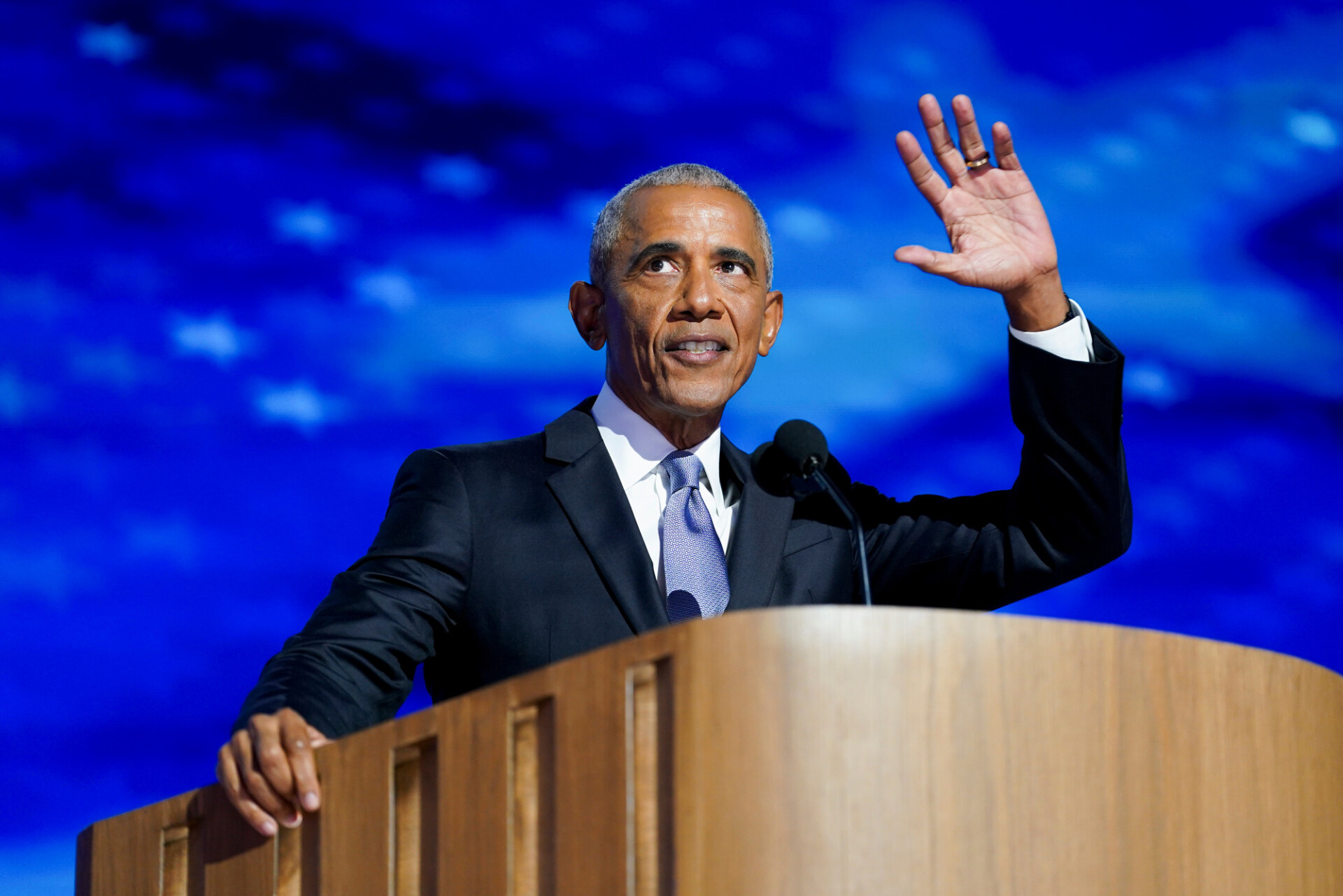
While neither the second-to-last Republican president nor the last pre-Trump nominee appeared at the GOP convention, the DNC has been only too happy to dust off its former standard-bearers, starting with Barack Obama who gave the keynote speech on Tuesday evening.

Obama’s theme last night was much less rosy than ‘Hope and Change’ and the Sorkin-esque homilies about ‘the arc of history‘ which sounded so soothing 16 years ago. Instead, the former president sounded a somewhat more fearful note, making clear that ‘it will be a fight [over] a closely divided country.’ He urged his listeners: ‘Do not boo — vote,’ and issued a warning against complacency in the face of an existential threat to democracy.

This echoes Obama’s belief that Democrats are ‘the underdogs’ of this race. Yet the sight of the 44th president, to be followed tomorrow by the 42nd, also invites reflection on the trajectory the party has taken since their respective campaigns. For the challenges now facing Kamala Harris as she attempts to assemble a winning coalition arguably have their roots in the political choices made during the Obama and Clinton eras.

Consider that when Obama last ran, the Midwest was still known as an impenetrable Blue Wall, while Florida and Ohio were still purple states. When Bill Clinton gave his acceptance speech in 1996, the Democrats were competitive throughout large swathes of the South. During that period, they had gone on to win not just Clinton’s Arkansas and Al Gore’s Tennessee, but states such as Kentucky and Louisiana too.

The story of the last three decades has been one of political success for Democrats, who have won the popular vote in seven out of the last eight elections. Yet it is also one of narrowing political constituencies and pyrrhic victories, as the party attracted college-educated professionals at the expense of the non-college-educated majority. In particular, non-college educated whites were lost, but in recent years they have increasingly been joined by significant numbers of non-college educated minorities. As recently as 2007, ‘56% of voters without a degree were Democrats or leaned Democratic, while 42% were Republicans or GOP leaners’; today, Republicans hold ‘a six-percentage-point advantage over the Democratic Party,’ according to Pew Research. These are precisely the voters that Harris must win back. But how did the Democrats lose them in the first place?

One could explain that these trends are part of a broader process of educational polarization which is beyond the control of either party, or one can instead look at how the last two Democratic administrations made conscious decisions to encourage such a realignment. The party’s fulsome embrace of finance, tech, and globalization under the Clintons and Obama did not just mean Democratic Party assent for policies that hollowed out the industrial economy in which non-college educated workers found gainful employment. It also effectively pressured working-class Americans into adopting four-year college diplomas as the ultimate standard of moral validation and economic success.

And while Obama’s efforts to save the economy after 2008 may have earned him a second term, the lopsided nature of that recovery, which preserved the structural status quo — and his administration’s inability to discern the depth of social displacement in its aftermath — is what directly led to his repudiation in 2016 via the election of Trump, who stood against both party’s elites and consolidated the non-college-educated vote for the GOP.

The last eight years have amounted to a protracted continuation of this contest and 2024 will decide how it is settled. As a belated concession, perhaps, Obama acknowledged halfway through his speech that Americans ‘shouldn’t need a degree’ to get ahead in his vision of ‘a country that is more secure, more just, and more equal’.

Much will depend now on whether the Harris-Walz campaign is able to recapture just enough of these disaffected non-credentialed voters with promises of a more economically populist future. In light of this, the task of Democrats is not to try to relive the glory days of Obama and Clinton, but rather to exorcise the ghosts of those eras as a necessary step toward genuine political renewal.


Michael Cuenco is Senior Editor at American Affairs.
1TrueCuencoism

China is threatening America in the AI race

Reports sugget Zhipu AI  has released a new model that can rival leading US systems. Credit: Getty

Reports sugget Zhipu AI has released a new model that can rival leading US systems. Credit: Getty

July 1 2026 - 10:18am

China is trying to catch up with America on artificial intelligence. The Wall Street Journal has reported that Zhipu AI — one of China’s six “AI tiger” LLMs — has released a new model that can rival leading US systems, including Anthropic’s Mythos, in cybersecurity tasks such as pinpointing security bugs. While this marks a milestone in China’s drive to catch up with Western AI capabilities, strong performance on a single benchmark does not mean it has taken the lead. Chinese models still lag behind their Western counterparts in broader capabilities, such as autonomous operation. Skepticism is therefore warranted before resorting to hysterical conclusions, but complacency about the geopolitical implications of China’s AI advances would be an even greater mistake.

On the infrastructure side, Chinese AI is still constrained by access to advanced chips, with American labs way ahead in computing capacity as well as investment. Analysis from earlier this year suggests that Chinese models are likely to be at least a few months behind those in the US. But they are still continuing to make progress, or that the geopolitical importance of AI will be decided only by whose LLM has ventured deeper into the technological frontier. The practical applications of AI, countries’ to capture foreign markets, and the application of AI into the real economy will matter just as much.

Here, China may hold an advantage. As with its dominance across many critical supply chains, Beijing may not need to produce the most advanced AI systems — only those that are affordable and widely deployable. In doing so, it could consolidate global influence by supplying functional, low-cost AI at scale.

Beijing seems to be pursuing exactly that path, developing an AI “open-source” strategy that offers affordable, widely available AI models for companies and individuals to use and modify as they wish. The production of the DeepSeek AI model, which matched the performance of Silicon Valley tools such as ChatGPT at a fraction of the cost for users, created goodwill among Chinese models with developers.

The four most popular models on OpenRouter, an AI hardware platform for developers, are now all Chinese. The goal for China is not only to win the frontier-model race, but to make its systems the default layer of AI adoption across industries and global markets. For most economies, the choice is increasingly between an affordable tool they can deploy now and a more robust one that may be out of reach.

And while the countries adopting Chinese models may be exposed to political pressure and cyber threats from Beijing, safer and more capable alternatives matter little if they are unaffordable. American AI companies are already under pressure to monetize products whose operating costs are rising. If Chinese open-source models become the cheap default for startups, universities, governments and businesses across the developing world, then America’s AI lead will be eroded from below.

Perhaps more concerning for America in the long run is how AI can give Chinese manufacturing even more strength, through the ongoing integration of AI as a general-purpose technology. China’s new Five-Year Plan mentioned AI more than 50 times and includes an “AI+” action plan aimed at spreading AI across the economy.

Beijing has been pioneering automation of its critical infrastructure for years, with promising recent results in increasing warplane production capacity. In that regard, China’s open-model strategy and manufacturing dominance will reinforce each other. Cheap, adaptable models accelerate deployment across the real economy while those deployments generate real-world data and use cases that can feed back into further model improvement.

The United States should not dismiss the importance of its lead in the AI race. That lead worries Beijing, not least because a more automated Chinese economy would also become more vulnerable to AI-generated cyber threats. But nor should Washington assume that China cannot catch up with American capabilities over time.

This AI competition represents part of a broader struggle over tech supply chains and geopolitical influence. Decisions over whether to adopt US or Chinese models could produce a more fragmented global reality, with different regions relying on different cloud providers, chips and security structures. The result will likely be a global economy which is divided into competing spheres, rather than one which produces a single winner.


Miquel Vila is a political and geopolitical risk consultant focusing on industrial strategy, critical infrastructure and global supply chains.

miquelvilam
