




X Close

Is Nicola Sturgeon softening her stance on independence?

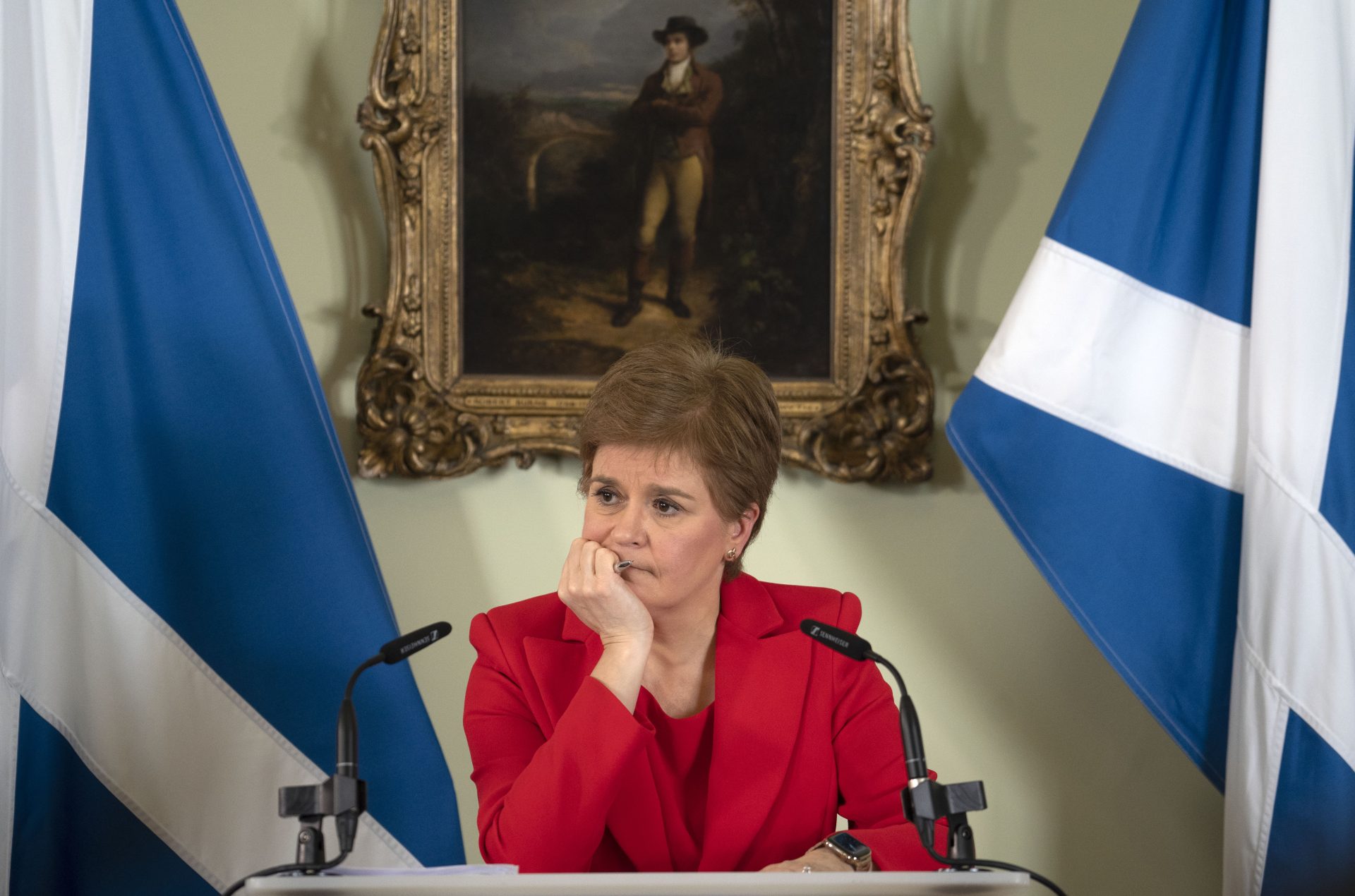
Freedom... Credit: Getty

Freedom… Credit: Getty

13 August 2025 - 7:00am

Amid all the score-settling and hints of non-binary sexuality, something genuinely eye-opening has emerged from Nicola Sturgeon’s new autobiography, Frankly. After a lifetime dedicated to the cause of Scottish independence, the former SNP first minister appears to have given up on it.

“I predict that in 20 years, perhaps sooner, the UK in its current form will no longer exist,” she writes in her memoir, which reaches shops this week. “What will emerge in its place will be stronger, healthier and more democratic. An independent Scotland, a more autonomous Wales and a reunified Ireland will join England, enjoying the benefits of the home rule it will gain as a result, in a new British Isles confederation of nations.”

Home rule? Join England? A new British Isles? It’s enough to have any serious Scottish nationalist reaching for their claymore. The SNP has always envisaged Scotland becoming a fully self-governing state, and running it like a Scandinavian country. But confederation implies a new union with the Auld Enemy, similar to the 1707 Union that nationalists have always condemned as servitude.

True, Sturgeon still says she supports “independence”. But imagining Scotland as part of a new confederal Britain is such a weak version of this that she has robbed the term of any real meaning.

It has always been de rigueur for SNP leaders to promise that Scotland will be free from London’s domination within their lifetime. What Sturgeon seems to be talking about here is the timorous halfway house that used to be called “devo-max”, which she rejected so vehemently in the 2014 referendum campaign.

By flirting with federalism, she is allying herself, perhaps unconsciously, with her great enemy: Gordon Brown. The former Labour PM has been pressing for a new federal UK for years, most recently in his “Renewing Our Democracy” report in 2022. That envisaged a new federal constitution and a senate elected by the UK regions to replace the House of Lords.

Maybe there’s a subtle difference between a full-fat federation and a looser confederation. But it’s not much, and neither constitutes “independence”. An independent country would not share sovereignty, especially with an England which nationalists believe has been holding Scotland in a state of colonial subordination for centuries. Nor does an independent country allow another country to dictate its foreign policy or control its economy. But all of these would come with a confederation.

This would mean Scotland having to accept nuclear weapons on the Clyde, which Sturgeon, a unilateralist, always said was one of the most important reasons why Scotland needed to be fully independent. Unless the rest of the confederation went with it, Scotland would also lose the right to rejoin the European Union, another of the key reasons many SNP voters support independence.

Scotland would surely also have to be represented in the new UK federal parliament. Otherwise, Scots would have no say in decisions affecting its economy and its relations with other countries. Scottish MPs would have to troop down to the new UK federal parliament, which would inevitably be located in London because England has the largest population and thus will always be the dominant partner.

It’s difficult to explain exactly how this new, confederal UK would differ from what exists right now, Ireland aside. Scotland already has a parliament in Edinburgh with extensive powers over domestic affairs, including health, education and justice. It has been acquiring a range of economic powers, too, over taxation and even borrowing.

So, has Scotland’s leading living nationalist given up the ghost? She even says she may move to London — which she “loves” — because she “can’t breathe in Scotland”. These are sentiments to horrify any pure-blooded Scot.

Would Sturgeon’s younger self, who grew up a passionate nationalist in small-town Irvine, recognise this London mediarati aspirant? Sturgeon, in nationalist slang, may not be a “Yoon” quite yet, but she’s definitely been on a journey.


Iain Macwhirter was political commentator for The Herald between 1999 and 2022, and is the author of Disunited Kingdom: How Westminster Won a Referendum But Lost Scotland. He was Rector of the University of Edinburgh from 2009-12.

iainmacwhirter

China is threatening America in the AI race

Reports sugget Zhipu AI  has released a new model that can rival leading US systems. Credit: Getty

Reports sugget Zhipu AI has released a new model that can rival leading US systems. Credit: Getty

1 July 2026 - 10:18am

China is trying to catch up with America on artificial intelligence. The Wall Street Journal has reported that Zhipu AI — one of China’s six “AI tiger” LLMs — has released a new model that can rival leading US systems, including Anthropic’s Mythos, in cybersecurity tasks such as pinpointing security bugs. While this marks a milestone in China’s drive to catch up with Western AI capabilities, strong performance on a single benchmark does not mean it has taken the lead. Chinese models still lag behind their Western counterparts in broader capabilities, such as autonomous operation. Skepticism is therefore warranted before resorting to hysterical conclusions, but complacency about the geopolitical implications of China’s AI advances would be an even greater mistake.

On the infrastructure side, Chinese AI is still constrained by access to advanced chips, with American labs way ahead in computing capacity as well as investment. Analysis from earlier this year suggests that Chinese models are likely to be at least a few months behind those in the US. But they are still continuing to make progress, or that the geopolitical importance of AI will be decided only by whose LLM has ventured deeper into the technological frontier. The practical applications of AI, countries’ to capture foreign markets, and the application of AI into the real economy will matter just as much.

Here, China may hold an advantage. As with its dominance across many critical supply chains, Beijing may not need to produce the most advanced AI systems — only those that are affordable and widely deployable. In doing so, it could consolidate global influence by supplying functional, low-cost AI at scale.

Beijing seems to be pursuing exactly that path, developing an AI “open-source” strategy that offers affordable, widely available AI models for companies and individuals to use and modify as they wish. The production of the DeepSeek AI model, which matched the performance of Silicon Valley tools such as ChatGPT at a fraction of the cost for users, created goodwill among Chinese models with developers.

The four most popular models on OpenRouter, an AI hardware platform for developers, are now all Chinese. The goal for China is not only to win the frontier-model race, but to make its systems the default layer of AI adoption across industries and global markets. For most economies, the choice is increasingly between an affordable tool they can deploy now and a more robust one that may be out of reach.

And while the countries adopting Chinese models may be exposed to political pressure and cyber threats from Beijing, safer and more capable alternatives matter little if they are unaffordable. American AI companies are already under pressure to monetize products whose operating costs are rising. If Chinese open-source models become the cheap default for startups, universities, governments and businesses across the developing world, then America’s AI lead will be eroded from below.

Perhaps more concerning for America in the long run is how AI can give Chinese manufacturing even more strength, through the ongoing integration of AI as a general-purpose technology. China’s new Five-Year Plan mentioned AI more than 50 times and includes an “AI+” action plan aimed at spreading AI across the economy.

Beijing has been pioneering automation of its critical infrastructure for years, with promising recent results in increasing warplane production capacity. In that regard, China’s open-model strategy and manufacturing dominance will reinforce each other. Cheap, adaptable models accelerate deployment across the real economy while those deployments generate real-world data and use cases that can feed back into further model improvement.

The United States should not dismiss the importance of its lead in the AI race. That lead worries Beijing, not least because a more automated Chinese economy would also become more vulnerable to AI-generated cyber threats. But nor should Washington assume that China cannot catch up with American capabilities over time.

This AI competition represents part of a broader struggle over tech supply chains and geopolitical influence. Decisions over whether to adopt US or Chinese models could produce a more fragmented global reality, with different regions relying on different cloud providers, chips and security structures. The result will likely be a global economy which is divided into competing spheres, rather than one which produces a single winner.


Miquel Vila is a political and geopolitical risk consultant focusing on industrial strategy, critical infrastructure and global supply chains.

miquelvilam