






 Prefer us on Google

July 20 2025 - 9:00pm
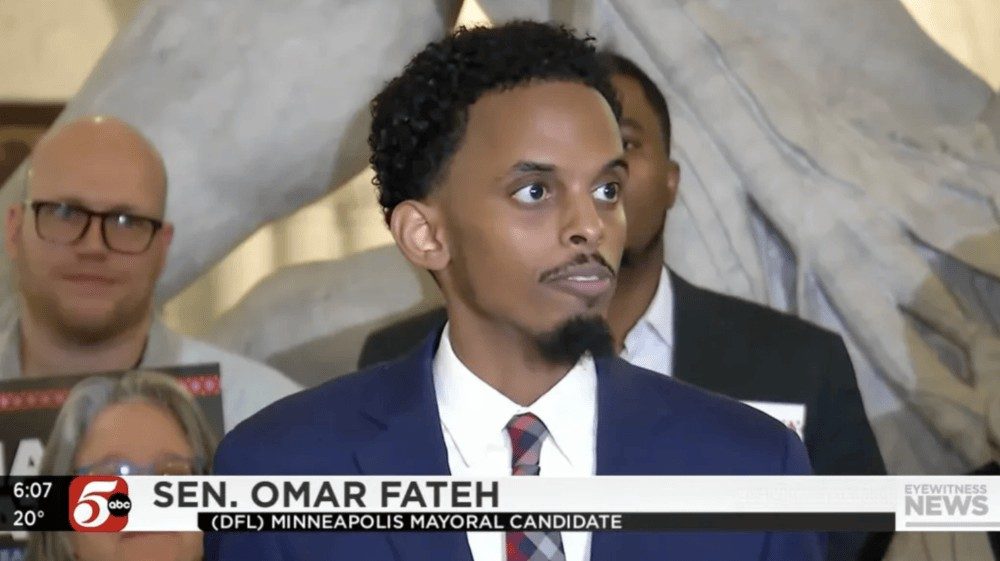
Jacob Frey may have seen his political career unravel on Saturday at Minneapolis’s Target Center. The incumbent mayor, who’d spent four years trying to rebuild his reputation after George Floyd’s murder exposed him as ineffective, lost the Democratic-Farmer-Labor Party (the state affiliate of the national Democratic Party) endorsement to state senator Omar Fateh by a crushing margin. When delegates raised their badges to deliver the 60% victory to the democratic socialist challenger, many of Frey’s supporters had already walked off the convention floor in disgust.
The chaotic scene, which was replete with electronic voting failures, quorum challenges, and Frey’s campaign desperately claiming the whole process was “flawed and irregular”, captured something larger than one mayor’s humiliation. This was yet more proof that Donald Trump, through design or accident, has succeeded in upending the moderate center that once governed American cities. What remains are two stark choices: full socialism or reactive conservatism.
Frey entered office as a typical center-left Democrat, the kind who’d dominated urban politics for decades. Young, good-looking (he had run track in college at William & Mary), and well-educated, he looked straight out of central casting for higher office. That is, until May 2020, when a Minneapolis police officer murdered George Floyd. Frey’s fumbling response — getting booed out of a protest for refusing to abolish the police department and watching parts of his city burn — turned him into damaged goods.
Fateh, by contrast, promises to end “the inhumane way we have been treating our unhoused neighbors” and represents the ascendant socialist wing of the Minneapolis DFL. His victory speech hit the expected notes: “Today we witnessed a rejection of politics as usual.” What he didn’t say, but what everyone understood, was that this rejection extends far beyond Minneapolis.
The convention itself descended into factional warfare between traditional Democrats and democratic socialists. A group calling itself “Protect Our Platform” tried blocking candidates from accepting both DFL and Democratic Socialists of America (DSA) endorsements, complaining that socialists want to “defund the police”, “disarm all law enforcement officers”, and “free all incarcerated people”. They failed, but the battle lines were drawn. Yet when state chair Richard Carlbom mentioned “democratic socialists” in his coalition-building speech, the Minnesota Star Tribune reported that he received the loudest applause of the day.
This pattern repeats across urban America. In New York, Zohran Mamdani just crushed Andrew Cuomo in the Democratic mayoral primary by mobilizing young (and largely white) voters with promises of free buses and rent control. However, Pittsburgh, a city that is trending Republican, went in the opposite direction, with extreme moderate Corey O’Connor defeating progressive incumbent Ed Gainey. He was backed by lots of Republican money and campaigned on hiring more cops and cost-cutting.
These aren’t random local variations. They represent cities making fundamental choices about their political identity in response to the Trump realignment. The moderate Democratic mayor — socially liberal but fiscally cautious — is fast going extinct. In their place, once-monolithic metros controlled by the national center-left party are choosing between Fateh-style socialism and O’Connor-style conservatism dressed in Democratic clothing.
The Minneapolis split between establishment Democrats and socialists mirrors the national party’s identity crisis. But while the national party can paper over these divisions with vague rhetoric about unity, city politics forces a choice. You either embrace the socialist platform or you don’t. You either defend the police or defund them. There’s no middle ground when you’re deciding whether to clear homeless encampments or provide them with clean needles and prophylactics.
Trump didn’t create these divisions, but his presidency crystallized them. By forcing every political question into a binary choice — with him or against him — he eliminated the space for mushy centrism that allowed mayors like Frey to thrive.
Fateh won’t necessarily become mayor — Minneapolis uses ranked-choice voting and the DFL hasn’t successfully endorsed a mayoral winner since R.T. Rybak in 2009. Frey is smart enough to appeal to individual power brokers within the state party, perhaps even fight through November like New York’s Cuomo and incumbent Eric Adams. But the endorsement itself matters more than the eventual outcome.
We’re heading for a world of pure red and blue cities to match our pure red and blue states. Minneapolis chose its direction on Saturday. Other cities will follow, one way or another. Trump may not have intended to reshape urban politics so dramatically, but he’s succeeded in creating the conditions where moderation equals political defeat.
Oliver Bateman is a historian and journalist based in Pittsburgh. He blogs, vlogs, and podcasts at his Substack, Oliver Bateman Does the Work
 MoustacheClubUS