




X Close

Is Germany heading for a Russia reset?

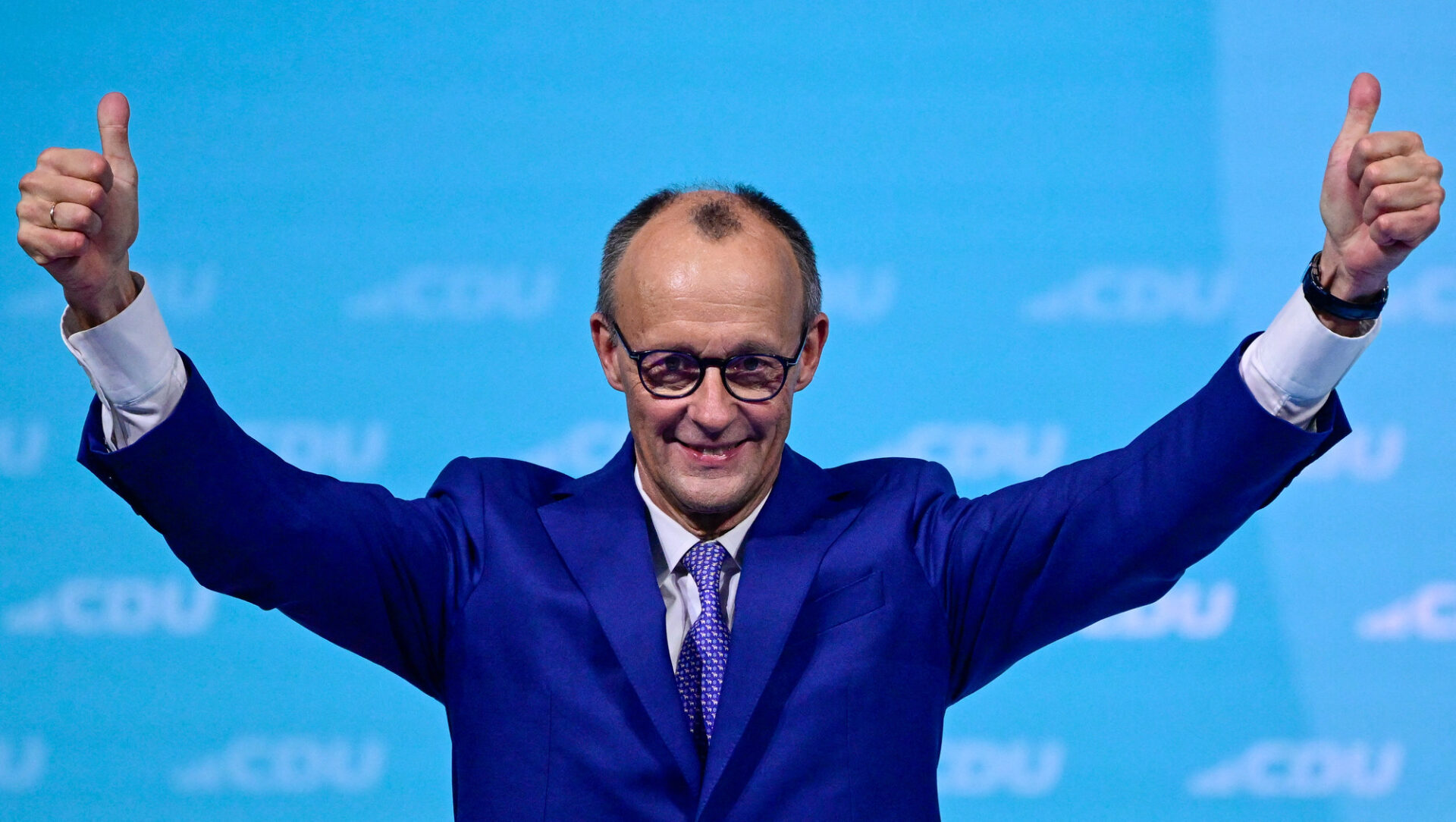
CDU leader Friedrich Merz has made no attempt to silence pro-Russia elements in his party. Credit: Getty

CDU leader Friedrich Merz has made no attempt to silence pro-Russia elements in his party. Credit: Getty

April 1 2025 - 1:00pm

Well, that didn’t take long. Peace negotiations over an end to the war in Ukraine are barely underway, and senior German politicians are already calling for their country to resume its ties to Russia.

The next German government is set to contain fewer people who have a problem with that, and the lure of a return to cheap energy is great. Is Germany on the brink of reverting to its pre-war relationship with Moscow?

Michael Kretschmer, a deputy chairman of Friedrich Merz’s center-right Christian Democrats (CDU), is just the latest politician to moot the idea of an end to sanctions. Arguing that European sanctions against Russia are “completely out of date”, and out of sync with “what the Americans are doing”, he has demanded “constant discussion over which of the sanctions are perhaps more to our detriment than they have an impact in Russia”.

Kretschmer is not the only one to voice such views now. CDU MP Thomas Bareiß floated the idea of restoring energy deliveries through the Nord Stream pipelines once the situation in Ukraine settles. “Of course, gas can flow again,” he argued, and “relationships will normalize.” His party colleague Jan Heinisch agreed in an interview with Politico earlier this month that Germany “should also be able to discuss purchasing Russian gas again”.

This is not a line of argument that comes solely out of the CDU. The Social Democrats (SPD) of Chancellor Olaf Scholz, who are likely to be the Christian Democrats’ coalition partner, also have many supporters of a resumption of ties with Russia. Dietmar Woidke, head of the state of Brandenburg, has said that he’d be happy “if we could return to normal economic relations with Russia”. This is hardly surprising as his state contains the Schwedt oil refinery, which was once majority Russian-owned and provided most of the fuel used in Berlin. It’s a major employer in the region.

In the past, Merz has presented himself as a hawkish supporter of Ukraine. Before the election earlier this year, he’d promised to send Kyiv long-range Taurus missiles, something that Scholz had refused to do. He’d also criticized the Chancellor for his telephone call with Russian President Vladimir Putin last year. A huge spending package he’s just pushed through the German parliament was supposed to boost the country’s deterrence value, specifically against the threat from Russia. Moscow seems to believe Merz, with Foreign Minister Sergey Lavrov calling him “pretty aggressive”.

While Merz may not belong to the pro-Russia camp of his party, it’s telling that he has so far made little attempt to silence it either. On the contrary, many of its most vocal proponents are sitting at the negotiating table which hammers out the conditions for the next coalition. Kretschmer is in the senior negotiating group alongside Merz. Bareiß sits in a subgroup on infrastructure (much of which Germany had to wrestle out of Russian control when the war began), and Heinisch is a member of the all-important energy group.

Russian energy has been so central to the German economic model that it has also seeped into the country’s political DNA. Merz won’t be able to eliminate this tendency in the short term, but he must ensure that Berlin doesn’t return to business as usual with Moscow the moment there is an opportunity. Germany needs to diversify its energy sources to keep itself independent of the whims of foreign powers.
Unfortunately, there is little evidence so far that Merz is exercising any leadership in this matter. Negotiations over the exact policies of the next coalition are not yet complete, but the results so far do not indicate a coherent strategy to solve Germany’s energy crisis. Before the war, Russia supplied a third of Germany’s oil, half of its coal imports and over half of its gas. With the exception of an extension of the country’s exit from coal from 2030 to 2038, there appears to be no plan as to how to replace the other fossil fuel imports. The CDU would like to bring nuclear energy back, but the SPD would not.

Negotiations over the exact policies of the next coalition are not yet complete, but the results so far do not indicate a coherent strategy to solve Germany’s energy crisis. Before the war, Russia supplied a third of Germany’s oil, half of its coal imports and over half of its gas. With the exception of an extension of the country’s exit from coal from 2030 to 2038, there appears to be no plan as to how to replace the other fossil fuel imports. The CDU would like to bring nuclear energy back, but the SPD would not.

With the Greens — who were the most hawkish about Moscow while in government — now in opposition, Germany’s next ruling coalition may well find that its lowest common denominator is a return to Russian fossil fuels.


Katja Hoyer is a German-British historian and writer. Her latest book Weimar: Life on the Edge of Catastrophe will be released in May 2026.

hoyer_kat

China is threatening America in the AI race

Reports sugget Zhipu AI  has released a new model that can rival leading US systems. Credit: Getty

Reports sugget Zhipu AI has released a new model that can rival leading US systems. Credit: Getty

July 1 2026 - 10:18am

China is trying to catch up with America on artificial intelligence. The Wall Street Journal has reported that Zhipu AI — one of China’s six “AI tiger” LLMs — has released a new model that can rival leading US systems, including Anthropic’s Mythos, in cybersecurity tasks such as pinpointing security bugs. While this marks a milestone in China’s drive to catch up with Western AI capabilities, strong performance on a single benchmark does not mean it has taken the lead. Chinese models still lag behind their Western counterparts in broader capabilities, such as autonomous operation. Skepticism is therefore warranted before resorting to hysterical conclusions, but complacency about the geopolitical implications of China’s AI advances would be an even greater mistake.

On the infrastructure side, Chinese AI is still constrained by access to advanced chips, with American labs way ahead in computing capacity as well as investment. Analysis from earlier this year suggests that Chinese models are likely to be at least a few months behind those in the US. But they are still continuing to make progress, or that the geopolitical importance of AI will be decided only by whose LLM has ventured deeper into the technological frontier. The practical applications of AI, countries’ to capture foreign markets, and the application of AI into the real economy will matter just as much.

Here, China may hold an advantage. As with its dominance across many critical supply chains, Beijing may not need to produce the most advanced AI systems — only those that are affordable and widely deployable. In doing so, it could consolidate global influence by supplying functional, low-cost AI at scale.

Beijing seems to be pursuing exactly that path, developing an AI “open-source” strategy that offers affordable, widely available AI models for companies and individuals to use and modify as they wish. The production of the DeepSeek AI model, which matched the performance of Silicon Valley tools such as ChatGPT at a fraction of the cost for users, created goodwill among Chinese models with developers.

The four most popular models on OpenRouter, an AI hardware platform for developers, are now all Chinese. The goal for China is not only to win the frontier-model race, but to make its systems the default layer of AI adoption across industries and global markets. For most economies, the choice is increasingly between an affordable tool they can deploy now and a more robust one that may be out of reach.

And while the countries adopting Chinese models may be exposed to political pressure and cyber threats from Beijing, safer and more capable alternatives matter little if they are unaffordable. American AI companies are already under pressure to monetize products whose operating costs are rising. If Chinese open-source models become the cheap default for startups, universities, governments and businesses across the developing world, then America’s AI lead will be eroded from below.

Perhaps more concerning for America in the long run is how AI can give Chinese manufacturing even more strength, through the ongoing integration of AI as a general-purpose technology. China’s new Five-Year Plan mentioned AI more than 50 times and includes an “AI+” action plan aimed at spreading AI across the economy.

Beijing has been pioneering automation of its critical infrastructure for years, with promising recent results in increasing warplane production capacity. In that regard, China’s open-model strategy and manufacturing dominance will reinforce each other. Cheap, adaptable models accelerate deployment across the real economy while those deployments generate real-world data and use cases that can feed back into further model improvement.

The United States should not dismiss the importance of its lead in the AI race. That lead worries Beijing, not least because a more automated Chinese economy would also become more vulnerable to AI-generated cyber threats. But nor should Washington assume that China cannot catch up with American capabilities over time.

This AI competition represents part of a broader struggle over tech supply chains and geopolitical influence. Decisions over whether to adopt US or Chinese models could produce a more fragmented global reality, with different regions relying on different cloud providers, chips and security structures. The result will likely be a global economy which is divided into competing spheres, rather than one which produces a single winner.


Miquel Vila is a political and geopolitical risk consultant focusing on industrial strategy, critical infrastructure and global supply chains.

miquelvilam