




X Close

Iran talks could exacerbate Trump’s dispute with Europe

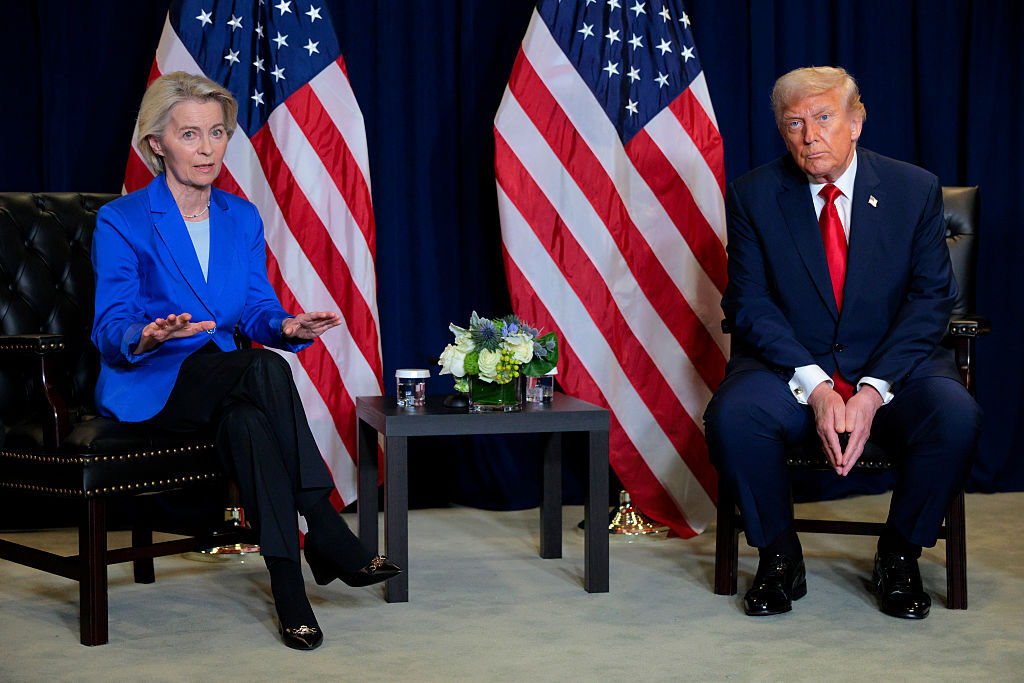
'The Trump administration is widely unpopular in Western and Central Europe.' (Chip Somodevilla/Getty)

‘The Trump administration is widely unpopular in Western and Central Europe.’ (Chip Somodevilla/Getty)

21 June 2026 - 6:00pm

One aspect of American foreign policy that is unlikely to be changed by the Iran war settlement is its attitudes towards Europe, and in particular European security. With Vice President JD Vance arriving in Switzerland today for talks centred on Tehran’s nuclear programme, every sign indicates that the Trump administration will continue to both deprioritise Europe and try to change its arrangements with European countries. It’s no coincidence that on Thursday Defense Secretary Pete Hegseth announced a wide-ranging six-month review of American military assets in Europe, the same week that Donald Trump was in Versailles to sign a memorandum of understanding with Iran.

What is telling about the announced review is that it mentions base access arrangements specifically. There have been various conflicting reports of troop withdrawals, as well as different leaked estimates for how much military equipment the US would seek to remove from Europe. These military equipment withdrawals, which include fighter jets and air-to-air refuelling aircraft, should be taken more seriously than the troop announcements, which in some cases were hastily reversed and seemed mostly to have a signalling effect.

Mentioning access arrangements suggests, however, that the Trump administration will leverage its current troops and equipment in Europe to secure the broader use of military bases. There were several instances of European countries — including the UK and Italy — not allowing the US access to bases for its Iran-related operations. Spain went even further at the end of March, closing its airspace for Iran military operation overflights. All of this clearly irritated the Trump administration, with Hegseth this week labelling the obstructions “shameful”.

In justification for restricting access, these countries cited bilateral agreements struck with the US when the bases were established. The agreements vary in detail, but generally give host countries latitude to deny America permission to use the bases for certain operations, and require Washington to seek approval first.

But, of course, the agreements can be renegotiated. This may well be one of the Trump administration’s aims. If or when that happens, it puts European governments in a difficult spot. The Trump administration is widely unpopular in Western and Central Europe. Giorgia Meloni, for instance, managed to dig herself out of a fairly deep political hole earlier this year in part by being more critical of Trump and his administration, and has engaged in a fresh spat with him this week. How would it look if she went back and signed a much more permissive base agreement? Then there’s the fact that it could drag European countries into even more unpopular US military campaigns.

This is an edited version of an article that first appeared in the Eurointelligence newsletter.


Jack Smith is an analyst at Eurointelligence. He focuses on energy policy, security and defence, EU politics, and the domestic politics of Italy, Spain, and the Netherlands.


China is threatening America in the AI race

Reports sugget Zhipu AI  has released a new model that can rival leading US systems. Credit: Getty

Reports sugget Zhipu AI has released a new model that can rival leading US systems. Credit: Getty

1 July 2026 - 10:18am

China is trying to catch up with America on artificial intelligence. The Wall Street Journal has reported that Zhipu AI — one of China’s six “AI tiger” LLMs — has released a new model that can rival leading US systems, including Anthropic’s Mythos, in cybersecurity tasks such as pinpointing security bugs. While this marks a milestone in China’s drive to catch up with Western AI capabilities, strong performance on a single benchmark does not mean it has taken the lead. Chinese models still lag behind their Western counterparts in broader capabilities, such as autonomous operation. Skepticism is therefore warranted before resorting to hysterical conclusions, but complacency about the geopolitical implications of China’s AI advances would be an even greater mistake.

On the infrastructure side, Chinese AI is still constrained by access to advanced chips, with American labs way ahead in computing capacity as well as investment. Analysis from earlier this year suggests that Chinese models are likely to be at least a few months behind those in the US. But they are still continuing to make progress, or that the geopolitical importance of AI will be decided only by whose LLM has ventured deeper into the technological frontier. The practical applications of AI, countries’ to capture foreign markets, and the application of AI into the real economy will matter just as much.

Here, China may hold an advantage. As with its dominance across many critical supply chains, Beijing may not need to produce the most advanced AI systems — only those that are affordable and widely deployable. In doing so, it could consolidate global influence by supplying functional, low-cost AI at scale.

Beijing seems to be pursuing exactly that path, developing an AI “open-source” strategy that offers affordable, widely available AI models for companies and individuals to use and modify as they wish. The production of the DeepSeek AI model, which matched the performance of Silicon Valley tools such as ChatGPT at a fraction of the cost for users, created goodwill among Chinese models with developers.

The four most popular models on OpenRouter, an AI hardware platform for developers, are now all Chinese. The goal for China is not only to win the frontier-model race, but to make its systems the default layer of AI adoption across industries and global markets. For most economies, the choice is increasingly between an affordable tool they can deploy now and a more robust one that may be out of reach.

And while the countries adopting Chinese models may be exposed to political pressure and cyber threats from Beijing, safer and more capable alternatives matter little if they are unaffordable. American AI companies are already under pressure to monetize products whose operating costs are rising. If Chinese open-source models become the cheap default for startups, universities, governments and businesses across the developing world, then America’s AI lead will be eroded from below.

Perhaps more concerning for America in the long run is how AI can give Chinese manufacturing even more strength, through the ongoing integration of AI as a general-purpose technology. China’s new Five-Year Plan mentioned AI more than 50 times and includes an “AI+” action plan aimed at spreading AI across the economy.

Beijing has been pioneering automation of its critical infrastructure for years, with promising recent results in increasing warplane production capacity. In that regard, China’s open-model strategy and manufacturing dominance will reinforce each other. Cheap, adaptable models accelerate deployment across the real economy while those deployments generate real-world data and use cases that can feed back into further model improvement.

The United States should not dismiss the importance of its lead in the AI race. That lead worries Beijing, not least because a more automated Chinese economy would also become more vulnerable to AI-generated cyber threats. But nor should Washington assume that China cannot catch up with American capabilities over time.

This AI competition represents part of a broader struggle over tech supply chains and geopolitical influence. Decisions over whether to adopt US or Chinese models could produce a more fragmented global reality, with different regions relying on different cloud providers, chips and security structures. The result will likely be a global economy which is divided into competing spheres, rather than one which produces a single winner.


Miquel Vila is a political and geopolitical risk consultant focusing on industrial strategy, critical infrastructure and global supply chains.

miquelvilam