




X Close

Iran is now conducting foreign policy through memes

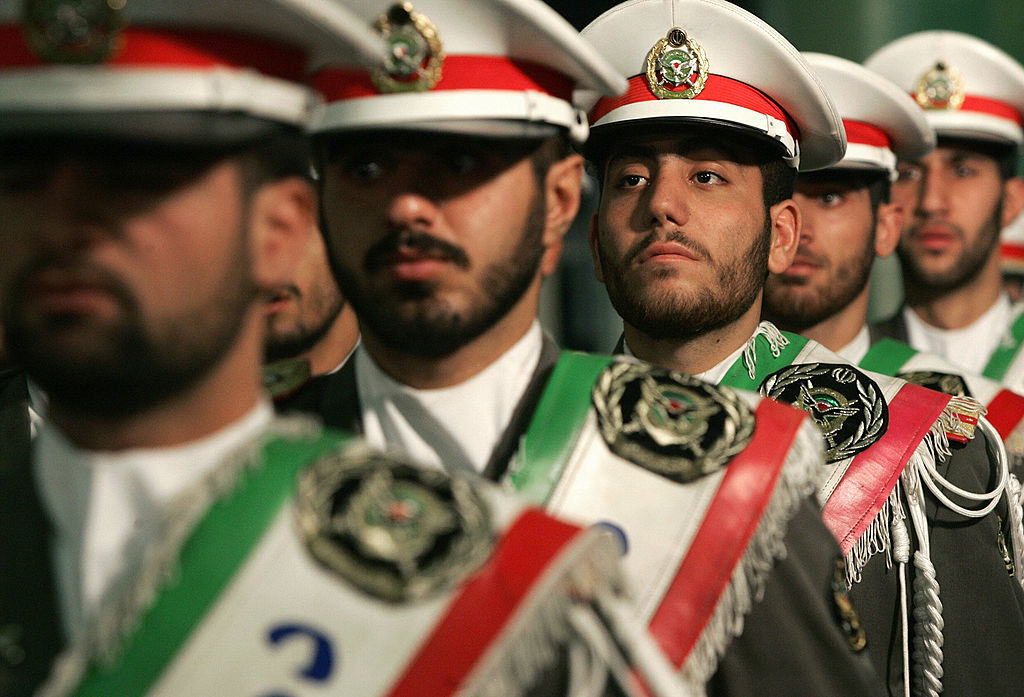
A new age of warfare. Credit: Getty

A new age of warfare. Credit: Getty

4 November 2024 - 6:30pm

Over the weekend, what appeared to be an Iranian news agency account posted online what can only be described as a cutesy infographic for a missile. It didn’t look like the usual military imagery, more a cross between something your politically engaged little sister would post to her Instagram story and a Coachella poster. The tweet caption read (in Arabic): “Hajj Qassem missile…the missile designed to target ‘Israel’.” The post’s slick graphics and engagement-optimised formatting exemplified something increasingly true about our global political landscape: to be heard above the cacophony of distractions, politics must  — and increasingly does — speak in memes.

Our current information landscape reveals this dynamic everywhere. When the war in Ukraine started in 2022, the country’s official Twitter account posted numerous memes, including one from The Simpsons, about the conflict. Just last week, the Catholic Church unveiled “Luce”, an anime girl mascot who instantly went viral and spawned an entire ecosystem of fan art. As Mary Harrington observed, the demographic shrewdness of the Vatican evoking anime aesthetics was almost irrelevant. Luce succeeded because she possessed raw memetic power, something which the Bible is lacking these days. The mascot’s ability to generate engagement and inspire derivative content was more salient than anything else.

The recent controversy about rumours of Haitian immigrants in Springfield, Ohio eating dogs and cats is another example of why memes matter. The story began with a viral X post and gained momentum through high-engagement Facebook posts. The claim’s truthfulness was secondary to its shareability, which hinged in part on its “emotional truth”. Its memetic power eventually drove it from X and Facebook to the presidential debate stage, forcing responses from Ohio’s Governor and the White House. When vice-presidential nominee J.D. Vance urged followers to “keep the cat memes flowing”, he acknowledged this new reality: in modern politics, memetic reach is invaluable.

In a Missouri State Journal interview, Dr Brian Ott explains just how much our media landscape has transformed in recent years. Just as television once collapsed the boundary between entertainment and news by forcing serious journalism to compete with sitcoms, social media has created what Ott calls “a giant river of stuff”— a single algorithmic feed where congressional hearings and war footage compete with mukbang for attention. It’s television, which itself created the 24-hour news cycle, on steroids.

This shift is quantifiable: Pew Research reports that 39% of adults under 30 now get their news primarily from TikTok. And while TikTok has been perhaps unfairly characterised as “brain rot”, it’s true that you need a hook to make sure people don’t keep swiping. Ott says that “memes are not an argument.” Maybe not — but they aren’t meaningless, either.

In this landscape, even seemingly apolitical viral content inevitably becomes political. When P’Nut, a squirrel with half a million Instagram followers, was euthanised by New York state authorities a few days ago, the tragedy instantly transformed into a partisan battleground. Republicans were some of P’Nut’s biggest defenders, and he became a symbol of Left-wing bureaucratic overreach.

There’s one way in which this is a meaningful change. Research suggests memes function as a new form of political organisation, creating communities that can rapidly mobilise around shared meanings and grievances. That is to say: it’s not just people up in arms over silly, ephemeral things. It’s a legitimate tool. As politics becomes increasingly memetic, meme-makers increasingly turn to politics, too.

The relevance of memes cuts both ways. Traditional institutions must either adapt to memetic logic or risk irrelevance, which explains why even diplomats and defence departments now employ social-media strategists. Political careers increasingly begin with viral moments rather than policy expertise, reflecting how thoroughly the logic of memes has transformed political communication.

The Iran missile advertisement, then, isn’t that weird. It’s a window into how power operates in 2024. When even nuclear deterrence must package itself as content, the logic of memes has transformed political communication. And when they’re successful, they’re really successful. But more importantly, we see why meme-makers increasingly seek political relevance, too. In a world where traditional fame feels increasingly hollow, politics remains one of the few spaces where going viral can mean something.


Katherine Dee is a writer. To read more of her work, visit defaultfriend.substack.com.

default_friend

China is threatening America in the AI race

Reports sugget Zhipu AI  has released a new model that can rival leading US systems. Credit: Getty

Reports sugget Zhipu AI has released a new model that can rival leading US systems. Credit: Getty

1 July 2026 - 10:18am

China is trying to catch up with America on artificial intelligence. The Wall Street Journal has reported that Zhipu AI — one of China’s six “AI tiger” LLMs — has released a new model that can rival leading US systems, including Anthropic’s Mythos, in cybersecurity tasks such as pinpointing security bugs. While this marks a milestone in China’s drive to catch up with Western AI capabilities, strong performance on a single benchmark does not mean it has taken the lead. Chinese models still lag behind their Western counterparts in broader capabilities, such as autonomous operation. Skepticism is therefore warranted before resorting to hysterical conclusions, but complacency about the geopolitical implications of China’s AI advances would be an even greater mistake.

On the infrastructure side, Chinese AI is still constrained by access to advanced chips, with American labs way ahead in computing capacity as well as investment. Analysis from earlier this year suggests that Chinese models are likely to be at least a few months behind those in the US. But they are still continuing to make progress, or that the geopolitical importance of AI will be decided only by whose LLM has ventured deeper into the technological frontier. The practical applications of AI, countries’ to capture foreign markets, and the application of AI into the real economy will matter just as much.

Here, China may hold an advantage. As with its dominance across many critical supply chains, Beijing may not need to produce the most advanced AI systems — only those that are affordable and widely deployable. In doing so, it could consolidate global influence by supplying functional, low-cost AI at scale.

Beijing seems to be pursuing exactly that path, developing an AI “open-source” strategy that offers affordable, widely available AI models for companies and individuals to use and modify as they wish. The production of the DeepSeek AI model, which matched the performance of Silicon Valley tools such as ChatGPT at a fraction of the cost for users, created goodwill among Chinese models with developers.

The four most popular models on OpenRouter, an AI hardware platform for developers, are now all Chinese. The goal for China is not only to win the frontier-model race, but to make its systems the default layer of AI adoption across industries and global markets. For most economies, the choice is increasingly between an affordable tool they can deploy now and a more robust one that may be out of reach.

And while the countries adopting Chinese models may be exposed to political pressure and cyber threats from Beijing, safer and more capable alternatives matter little if they are unaffordable. American AI companies are already under pressure to monetize products whose operating costs are rising. If Chinese open-source models become the cheap default for startups, universities, governments and businesses across the developing world, then America’s AI lead will be eroded from below.

Perhaps more concerning for America in the long run is how AI can give Chinese manufacturing even more strength, through the ongoing integration of AI as a general-purpose technology. China’s new Five-Year Plan mentioned AI more than 50 times and includes an “AI+” action plan aimed at spreading AI across the economy.

Beijing has been pioneering automation of its critical infrastructure for years, with promising recent results in increasing warplane production capacity. In that regard, China’s open-model strategy and manufacturing dominance will reinforce each other. Cheap, adaptable models accelerate deployment across the real economy while those deployments generate real-world data and use cases that can feed back into further model improvement.

The United States should not dismiss the importance of its lead in the AI race. That lead worries Beijing, not least because a more automated Chinese economy would also become more vulnerable to AI-generated cyber threats. But nor should Washington assume that China cannot catch up with American capabilities over time.

This AI competition represents part of a broader struggle over tech supply chains and geopolitical influence. Decisions over whether to adopt US or Chinese models could produce a more fragmented global reality, with different regions relying on different cloud providers, chips and security structures. The result will likely be a global economy which is divided into competing spheres, rather than one which produces a single winner.


Miquel Vila is a political and geopolitical risk consultant focusing on industrial strategy, critical infrastructure and global supply chains.

miquelvilam