




X Close

Inside New York City’s anti-ICE protests

12 June 2025 - 5:00pm

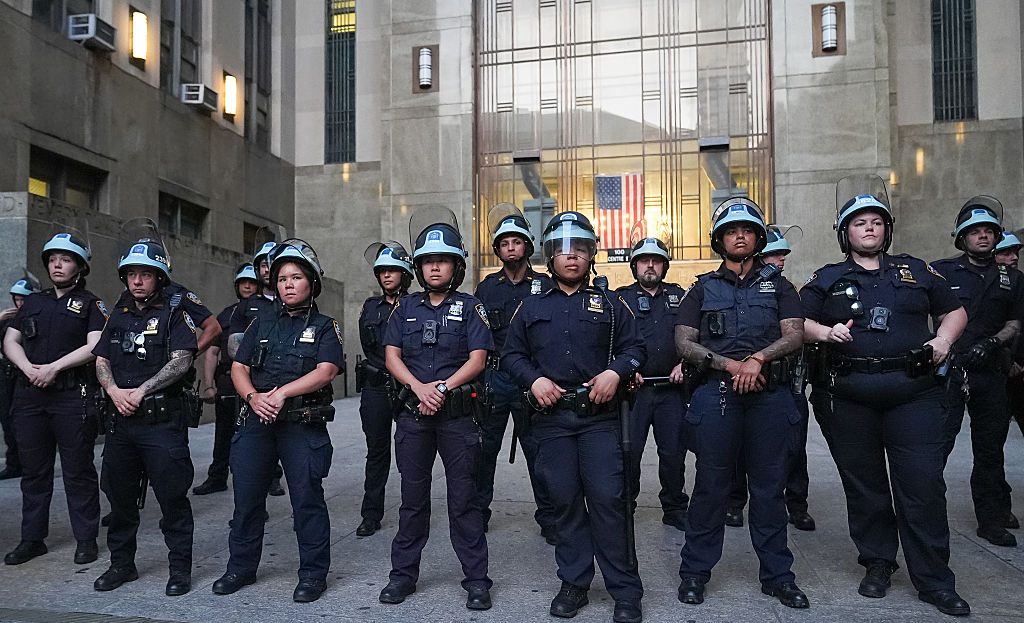
When I arrived in downtown New York in the late afternoon, NYPD officers vastly outnumbered the protesters. But within an hour, the crowd swelled to around 500, loudly chanting “ICE has no business here” and “NYPD to KKK.”

It was day two of the city’s anti-ICE protests, which began in Foley Square, where ICE agents had reportedly detained people — including children — attending immigration check-ins at a Lower Manhattan courthouse. The atmosphere was febrile, with protesters waving Mexican, Colombian and Palestinian flags. Many wore masks, and several had keffiyehs wrapped around their faces. The majority were young and white.

Unlike in LA, a rumoured agreement between Mayor Eric Adams and Trump meant that there was no National Guard presence in New York — at least for now. Yet the evening before had resulted in 82 arrests and became a mayoral talking point. Keen to demonstrate their anti-Trump credentials, all candidates criticised the heavy-handed response of the authorities. Frontrunner Andrew Cuomo, for example, accused Adams of “cooperating with ICE” while socialist contender Zohran Mamdani said New Yorkers need a mayor who will “stand up and fight back.”
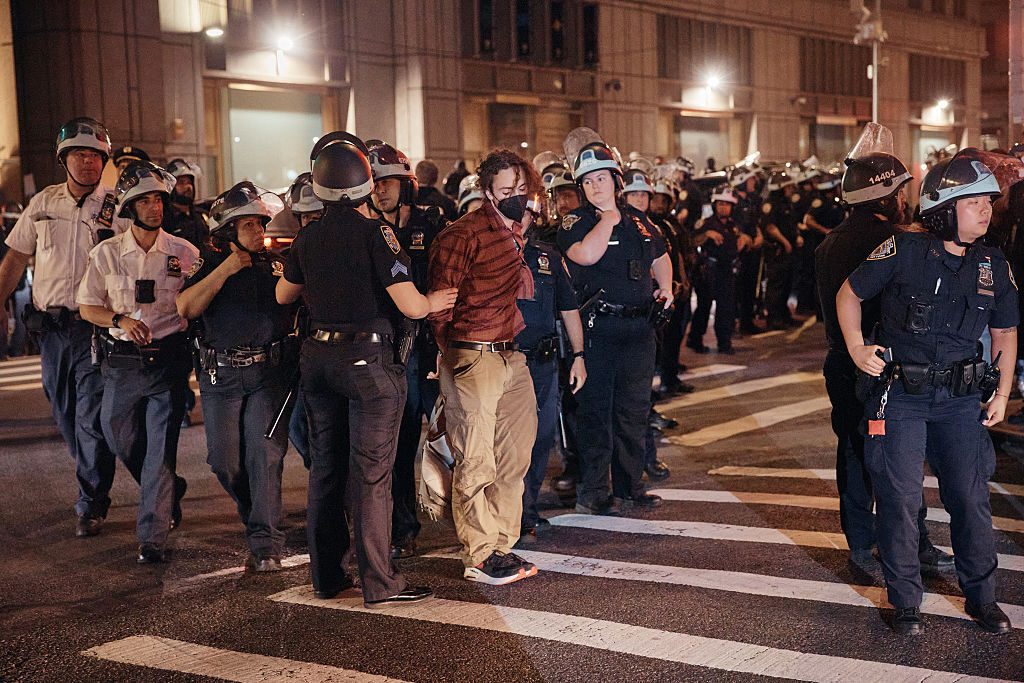
One of the night’s arrests. Credit: Getty

No candidate appeared at last night’s protests, but there was no shortage of drama. The first arrest happened at around 9pm after a man reached beyond the police barriers and was dragged into the street. Moments later, people in the crowd rushed toward the entrance of the federal immigration building. “An ICE van is leaving!” someone shouted, pointing at a white vehicle with agents inside as it pulled away. The chant that followed — “Intifada, people’s war!” — surged through the crowd, quickly joined by cries of “No cops, no KKK, no fascist USA!”

Amid the signs reading “No human is illegal”, “Don’t bite the hand that feeds us” and “Free Palestine, Fuck Trump, Fuck ICE, Fuck Netanyahu: it’s all connected”, I spoke to various protesters about why they were here. Carmen, a middle-aged woman from Peru, told me: “If we tolerate this, then we tolerate more and more abuse. I don’t care if they arrest me” while another, 19-year-old Rosina, told me: “I want to represent my brothers that got deported to Columbia. My homie had a son, he had a son, he’s separated from his child.”

Many protesters wore masks and keffiyehs. Credit: Lily Isaacs

Anna, a young woman from New Jersey, was more direct, pointing to the building which houses ICE: “What these guys are doing is shameful”. In Jersey, which houses a major ICE facility, people she knew are “scared to go outside speaking Spanish” in case someone called the authorities on them.

Shortly after, there was another arrest. A young person was dragged out into the street by police after reaching over the barrier. Then Nick Shirley, a YouTuber with over half a million subscribers, started provoking protesters and filming them, claiming that he wanted to “get to know people”. Eventually, the police moved him away.

As the night wore on, the atmosphere shifted. The crowd had thinned by 10pm, replaced by influencers filming the emptying streets. Two young men shouted about deportations and the Holocaust, pushing against the police line. Nearby, another man watched quietly and said: “You got no choice but to be out here.”

The mood had grown heavy. While the NYPD stood between protesters and the immigration building, it was clear they weren’t the ultimate focus of the crowd’s anger. It was ICE. Still, the crowd remained defiant. As Rosina put it: “The best I can do is fight for [my deported friend]. You spend a long time just watching, but at some point you have no choice left but to act.”


Lily Isaacs is an editorial assistant at UnHerd.


China is threatening America in the AI race

Reports sugget Zhipu AI  has released a new model that can rival leading US systems. Credit: Getty

Reports sugget Zhipu AI has released a new model that can rival leading US systems. Credit: Getty

1 July 2026 - 10:18am

China is trying to catch up with America on artificial intelligence. The Wall Street Journal has reported that Zhipu AI — one of China’s six “AI tiger” LLMs — has released a new model that can rival leading US systems, including Anthropic’s Mythos, in cybersecurity tasks such as pinpointing security bugs. While this marks a milestone in China’s drive to catch up with Western AI capabilities, strong performance on a single benchmark does not mean it has taken the lead. Chinese models still lag behind their Western counterparts in broader capabilities, such as autonomous operation. Skepticism is therefore warranted before resorting to hysterical conclusions, but complacency about the geopolitical implications of China’s AI advances would be an even greater mistake.

On the infrastructure side, Chinese AI is still constrained by access to advanced chips, with American labs way ahead in computing capacity as well as investment. Analysis from earlier this year suggests that Chinese models are likely to be at least a few months behind those in the US. But they are still continuing to make progress, or that the geopolitical importance of AI will be decided only by whose LLM has ventured deeper into the technological frontier. The practical applications of AI, countries’ to capture foreign markets, and the application of AI into the real economy will matter just as much.

Here, China may hold an advantage. As with its dominance across many critical supply chains, Beijing may not need to produce the most advanced AI systems — only those that are affordable and widely deployable. In doing so, it could consolidate global influence by supplying functional, low-cost AI at scale.

Beijing seems to be pursuing exactly that path, developing an AI “open-source” strategy that offers affordable, widely available AI models for companies and individuals to use and modify as they wish. The production of the DeepSeek AI model, which matched the performance of Silicon Valley tools such as ChatGPT at a fraction of the cost for users, created goodwill among Chinese models with developers.

The four most popular models on OpenRouter, an AI hardware platform for developers, are now all Chinese. The goal for China is not only to win the frontier-model race, but to make its systems the default layer of AI adoption across industries and global markets. For most economies, the choice is increasingly between an affordable tool they can deploy now and a more robust one that may be out of reach.

And while the countries adopting Chinese models may be exposed to political pressure and cyber threats from Beijing, safer and more capable alternatives matter little if they are unaffordable. American AI companies are already under pressure to monetize products whose operating costs are rising. If Chinese open-source models become the cheap default for startups, universities, governments and businesses across the developing world, then America’s AI lead will be eroded from below.

Perhaps more concerning for America in the long run is how AI can give Chinese manufacturing even more strength, through the ongoing integration of AI as a general-purpose technology. China’s new Five-Year Plan mentioned AI more than 50 times and includes an “AI+” action plan aimed at spreading AI across the economy.

Beijing has been pioneering automation of its critical infrastructure for years, with promising recent results in increasing warplane production capacity. In that regard, China’s open-model strategy and manufacturing dominance will reinforce each other. Cheap, adaptable models accelerate deployment across the real economy while those deployments generate real-world data and use cases that can feed back into further model improvement.

The United States should not dismiss the importance of its lead in the AI race. That lead worries Beijing, not least because a more automated Chinese economy would also become more vulnerable to AI-generated cyber threats. But nor should Washington assume that China cannot catch up with American capabilities over time.

This AI competition represents part of a broader struggle over tech supply chains and geopolitical influence. Decisions over whether to adopt US or Chinese models could produce a more fragmented global reality, with different regions relying on different cloud providers, chips and security structures. The result will likely be a global economy which is divided into competing spheres, rather than one which produces a single winner.


Miquel Vila is a political and geopolitical risk consultant focusing on industrial strategy, critical infrastructure and global supply chains.

miquelvilam