




X Close

In defence of the airport pint

Let the lads drink. Credit: Getty

Let the lads drink. Credit: Getty

7 June 2026 - 1:00pm

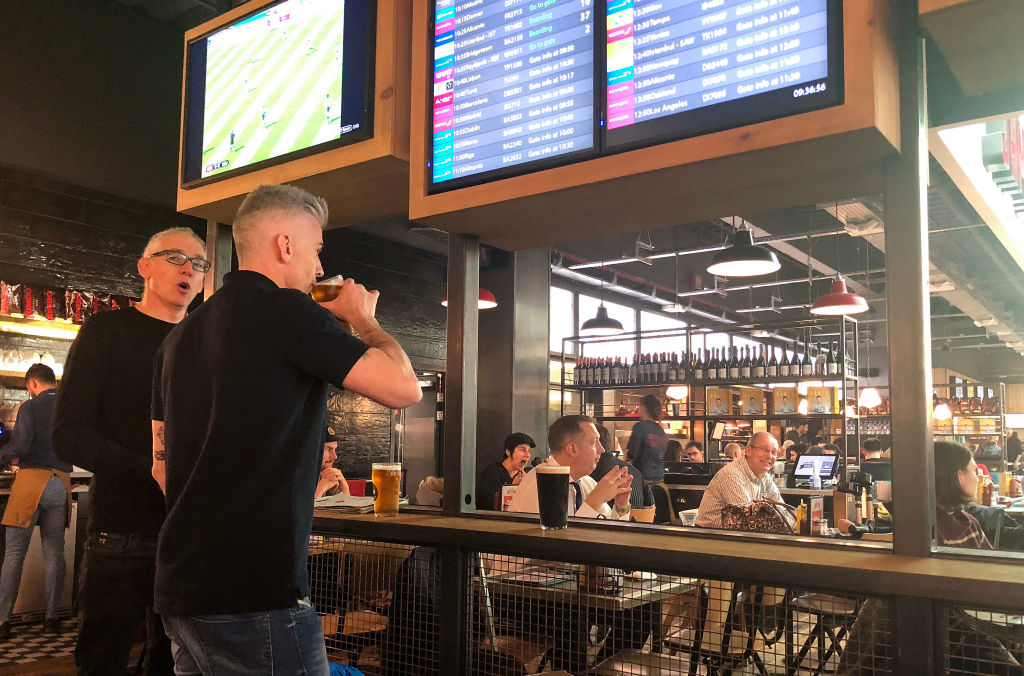
The Wall Street Journal has just discovered that the British like to have a pint or five before getting on a plane. Instead of their readers filing it under “eccentricities” like Morris dancing or sticking out a pinkie finger while drinking tea, the comments below the article are pretty brutal towards the Brits. Most agree with Ryanair boss Michael O’Leary that UK airports should stop selling alcohol in the mornings, or at least serve no more than two drinks to customers.

There is a certain Puritan snobbery coming from a country that briefly banned alcohol, but I suspect we Brits have enough snobbery on this subject ourselves.

In a poll of 14,500 Times readers, a 67% supermajority voted in favour of banning alcohol before morning flights. The paper’s readers are stereotypically affluent, Right-of-centre, and anti-nanny-state. I’m sure they would never be seen dead paying for a woo-woo in one of Gatwick’s nine pubs or bars, preferring to recline in one of Heathrow’s British Airways lounges and drink VSOP brandy for free.

Who might the drunken and yobbish offenders be in our mind’s eye: a hen do with penis straws, a benefits scrounger with a passport, or a family of professional plumbers off to Benidorm? Maybe some are nervous flyers who’ve already spent six hours getting airside, are already on Koh Samui time, and want to start spending the money they spent months saving.

The evidence, however, refuses to be so easily typecast; passengers in long-haul first class can be just as bad. A Delta passenger to Seattle rather memorably “attacked a flight attendant and a snack basket before being restrained”. Meanwhile, a woman travelling from Barbados shouted, “I hope this plane crashes”, after being moved from first class to economy because she was “loud and abusive”. Are these the kind of customers that O’Leary would prefer to have?

The airport pint is now as British as losing a fascinator in the mud at Ascot, or getting trapped in a Portaloo at Glastonbury. According to myth, it all started in 1783, when the first airborne bottle of champagne was popped open on a hot-air balloon. And the Royal Navy famously gave sailors overproof rum until 1970, because a sailor’s “only refuge from the savage world in which he found himself, was to fill himself with spirits.”

For my sins, I am guilty of indulging in the practice myself. If it’s from Heathrow Terminal 5, you will see me at the Fortnum and Mason champagne bar having a half bottle and smoked salmon. If that’s not available, well, I hear the bespoke carpets at Wetherspoons are nice. All a suggested ban on having more than two drinks will do is encourage people to find ways around the rules. I suggest we start doing the “O’Leary crawl”, having two drinks in each bar and then on the plane. That’ll show him.

But I have a newsflash: being drunk on a plane is already illegal. The problem is not a lack of rules; it’s a lack of enforcement. Airline staff, police and airport security already have ample powers to deal with disruptive passengers, yet the worst offenders still slip through the net.

In a sense, O’Leary is railing against a culture he helped create. He spent three decades making air travel cheap enough for the masses, and now seems horrified that the masses have arrived. That doesn’t mean we should tolerate passengers turning aircraft cabins into mobile nightclubs or lavatories into biohazards. But the freedom to sink a few pints before a flight is a great British tradition, and one worth defending against the po-faced busybodies forever looking for another excuse to tell everyone else how to behave.


Richard Crampton Platt is a former restaurateur. He writes on Substack and posts reels on Instagram (@thegreedydick) about London’s ever-changing food scene.


China is threatening America in the AI race

Reports sugget Zhipu AI  has released a new model that can rival leading US systems. Credit: Getty

Reports sugget Zhipu AI has released a new model that can rival leading US systems. Credit: Getty

1 July 2026 - 10:18am

China is trying to catch up with America on artificial intelligence. The Wall Street Journal has reported that Zhipu AI — one of China’s six “AI tiger” LLMs — has released a new model that can rival leading US systems, including Anthropic’s Mythos, in cybersecurity tasks such as pinpointing security bugs. While this marks a milestone in China’s drive to catch up with Western AI capabilities, strong performance on a single benchmark does not mean it has taken the lead. Chinese models still lag behind their Western counterparts in broader capabilities, such as autonomous operation. Skepticism is therefore warranted before resorting to hysterical conclusions, but complacency about the geopolitical implications of China’s AI advances would be an even greater mistake.

On the infrastructure side, Chinese AI is still constrained by access to advanced chips, with American labs way ahead in computing capacity as well as investment. Analysis from earlier this year suggests that Chinese models are likely to be at least a few months behind those in the US. But they are still continuing to make progress, or that the geopolitical importance of AI will be decided only by whose LLM has ventured deeper into the technological frontier. The practical applications of AI, countries’ to capture foreign markets, and the application of AI into the real economy will matter just as much.

Here, China may hold an advantage. As with its dominance across many critical supply chains, Beijing may not need to produce the most advanced AI systems — only those that are affordable and widely deployable. In doing so, it could consolidate global influence by supplying functional, low-cost AI at scale.

Beijing seems to be pursuing exactly that path, developing an AI “open-source” strategy that offers affordable, widely available AI models for companies and individuals to use and modify as they wish. The production of the DeepSeek AI model, which matched the performance of Silicon Valley tools such as ChatGPT at a fraction of the cost for users, created goodwill among Chinese models with developers.

The four most popular models on OpenRouter, an AI hardware platform for developers, are now all Chinese. The goal for China is not only to win the frontier-model race, but to make its systems the default layer of AI adoption across industries and global markets. For most economies, the choice is increasingly between an affordable tool they can deploy now and a more robust one that may be out of reach.

And while the countries adopting Chinese models may be exposed to political pressure and cyber threats from Beijing, safer and more capable alternatives matter little if they are unaffordable. American AI companies are already under pressure to monetize products whose operating costs are rising. If Chinese open-source models become the cheap default for startups, universities, governments and businesses across the developing world, then America’s AI lead will be eroded from below.

Perhaps more concerning for America in the long run is how AI can give Chinese manufacturing even more strength, through the ongoing integration of AI as a general-purpose technology. China’s new Five-Year Plan mentioned AI more than 50 times and includes an “AI+” action plan aimed at spreading AI across the economy.

Beijing has been pioneering automation of its critical infrastructure for years, with promising recent results in increasing warplane production capacity. In that regard, China’s open-model strategy and manufacturing dominance will reinforce each other. Cheap, adaptable models accelerate deployment across the real economy while those deployments generate real-world data and use cases that can feed back into further model improvement.

The United States should not dismiss the importance of its lead in the AI race. That lead worries Beijing, not least because a more automated Chinese economy would also become more vulnerable to AI-generated cyber threats. But nor should Washington assume that China cannot catch up with American capabilities over time.

This AI competition represents part of a broader struggle over tech supply chains and geopolitical influence. Decisions over whether to adopt US or Chinese models could produce a more fragmented global reality, with different regions relying on different cloud providers, chips and security structures. The result will likely be a global economy which is divided into competing spheres, rather than one which produces a single winner.


Miquel Vila is a political and geopolitical risk consultant focusing on industrial strategy, critical infrastructure and global supply chains.

miquelvilam