




X Close

Immigration debate dominates Germany ahead of election

AfD leader Alice Weidel. Credit: Getty

AfD leader Alice Weidel. Credit: Getty

February 23 2025 - 8:00am

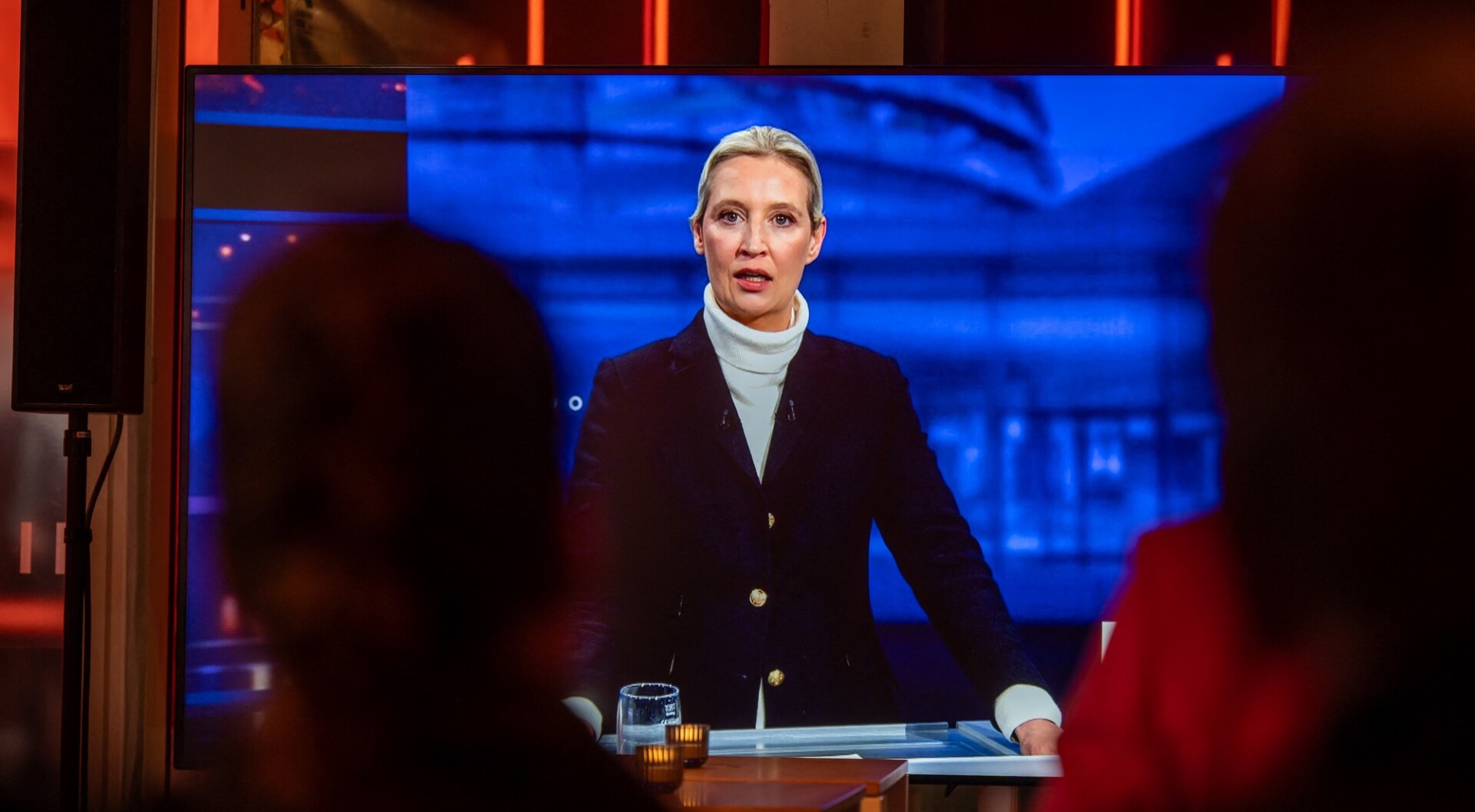
On the eve of the German election, private TV channel SAT1, known primarily for trashy reality and game shows, hosted a two-hour “Citizens’ Speed-Dating” program, where candidates chat one-on-one with voters over a particular issue. Weirdly, the CDU’s Friedrich Merz, forerunner and favorite to win the election, turned down the invitation, leaving the three parties who’ll be angling for a coalition with Merz to flog their wares.

The show was pre-recorded and over-edited but the intimacy of the format was a chance for incumbents Chancellor Olaf Scholz (SPD) and Economy Minister Robert Habeck (Greens), as well as Alice Weidel (AfD) to show their human, empathetic side, and for normal citizens to call bullshit with a refreshing authenticity. Given that 40% of Germans are still undecided on who to vote for in tomorrow’s election, this was a real opportunity for each one to make their case.

The whole gamut of problems facing Germany got screen time: from the stifling bureaucracy to the tiny pensions, from the crisis in the car industry to the sense that the influx of asylum seekers has eroded security on the streets. On Friday, yet another horrific incident shocked Germany: a 19-year-old Syrian stabbed a 30-year-old Spanish tourist at the Holocaust Memorial in Berlin, of all places (thankfully the Spaniard survived). The refugee’s plan had been to “kill Jewish people,” according to police. It was the latest in a slew of attacks by immigrants from the Middle East.

And yet the speed-dating highlighted all the complexity Germany faces on immigration. Confronted by a 54-year-old policeman concerned about immigration, Weidel promised to hermetically seal Germany’s nearly 4,000 kilometer border and push back all asylum seekers and illegal migrants. Merz has said he’ll do something similar, though with less vehemence. The policeman pushed back at Weidel, with the argument that such a closure was unrealistic, would require tens of thousands of new border police and cause chaos in the European Union. It was just a matter of “political will,” replied Weidel. She would step up deportations, get rid of the “tolerated” status many rejected asylum applicants are given. And negotiate with the Taliban to send back criminal Afghans.

Social Democrats and Greens have long since had the issue on their radar as a voter concern: Habeck pointed out that the traffic-light government had already sent a plane-load of Afghans convicted of serious crimes, which had been negotiated with the Taliban indirectly through a third party. Mostly though, when talking immigration, the Left-of-center says the asylum mess can only be solved together with the EU and points to the latest common asylum deal, agreed on but unimplemented.

Immigration was a theme throughout the debate, with Weidel stumbling over a question of German citizenship and remigration — a policy she backed at the AfD conference. When she was told by a 21-year-old named Kevin that his father had been an illegal immigrant from Nigeria, he added that “if you’d have been in power back then, I wouldn’t exist.” Weidel retorted that his father would have been able to apply for asylum or a work visa, before making an awkward compliment about Kevin’s appearance. Hardly a satisfying answer.

The vibes of this strange speed-dating exercise were pleasantly civil. Afterward the politicians had no other politicians to attack, but this resulted in a fake leveling out of the candidates. It seemed to take the edge off Weidel’s more radical stance on immigration, while making the Greens and Social Democrats look tougher on immigration than they actually are.

It also put in plain sight the vast range of individual concerns that preoccupy voters. And in doing so, did nothing to calm my fears that the centrist coalition that is going to emerge won’t be able to solve the problems facing ordinary Germans.


Maurice Frank co-founded the English magazine Exberliner and now co-writes the newsletter Update Germany.

mauricetfrank

China is threatening America in the AI race

Reports sugget Zhipu AI  has released a new model that can rival leading US systems. Credit: Getty

Reports sugget Zhipu AI has released a new model that can rival leading US systems. Credit: Getty

July 1 2026 - 10:18am

China is trying to catch up with America on artificial intelligence. The Wall Street Journal has reported that Zhipu AI — one of China’s six “AI tiger” LLMs — has released a new model that can rival leading US systems, including Anthropic’s Mythos, in cybersecurity tasks such as pinpointing security bugs. While this marks a milestone in China’s drive to catch up with Western AI capabilities, strong performance on a single benchmark does not mean it has taken the lead. Chinese models still lag behind their Western counterparts in broader capabilities, such as autonomous operation. Skepticism is therefore warranted before resorting to hysterical conclusions, but complacency about the geopolitical implications of China’s AI advances would be an even greater mistake.

On the infrastructure side, Chinese AI is still constrained by access to advanced chips, with American labs way ahead in computing capacity as well as investment. Analysis from earlier this year suggests that Chinese models are likely to be at least a few months behind those in the US. But they are still continuing to make progress, or that the geopolitical importance of AI will be decided only by whose LLM has ventured deeper into the technological frontier. The practical applications of AI, countries’ to capture foreign markets, and the application of AI into the real economy will matter just as much.

Here, China may hold an advantage. As with its dominance across many critical supply chains, Beijing may not need to produce the most advanced AI systems — only those that are affordable and widely deployable. In doing so, it could consolidate global influence by supplying functional, low-cost AI at scale.

Beijing seems to be pursuing exactly that path, developing an AI “open-source” strategy that offers affordable, widely available AI models for companies and individuals to use and modify as they wish. The production of the DeepSeek AI model, which matched the performance of Silicon Valley tools such as ChatGPT at a fraction of the cost for users, created goodwill among Chinese models with developers.

The four most popular models on OpenRouter, an AI hardware platform for developers, are now all Chinese. The goal for China is not only to win the frontier-model race, but to make its systems the default layer of AI adoption across industries and global markets. For most economies, the choice is increasingly between an affordable tool they can deploy now and a more robust one that may be out of reach.

And while the countries adopting Chinese models may be exposed to political pressure and cyber threats from Beijing, safer and more capable alternatives matter little if they are unaffordable. American AI companies are already under pressure to monetize products whose operating costs are rising. If Chinese open-source models become the cheap default for startups, universities, governments and businesses across the developing world, then America’s AI lead will be eroded from below.

Perhaps more concerning for America in the long run is how AI can give Chinese manufacturing even more strength, through the ongoing integration of AI as a general-purpose technology. China’s new Five-Year Plan mentioned AI more than 50 times and includes an “AI+” action plan aimed at spreading AI across the economy.

Beijing has been pioneering automation of its critical infrastructure for years, with promising recent results in increasing warplane production capacity. In that regard, China’s open-model strategy and manufacturing dominance will reinforce each other. Cheap, adaptable models accelerate deployment across the real economy while those deployments generate real-world data and use cases that can feed back into further model improvement.

The United States should not dismiss the importance of its lead in the AI race. That lead worries Beijing, not least because a more automated Chinese economy would also become more vulnerable to AI-generated cyber threats. But nor should Washington assume that China cannot catch up with American capabilities over time.

This AI competition represents part of a broader struggle over tech supply chains and geopolitical influence. Decisions over whether to adopt US or Chinese models could produce a more fragmented global reality, with different regions relying on different cloud providers, chips and security structures. The result will likely be a global economy which is divided into competing spheres, rather than one which produces a single winner.


Miquel Vila is a political and geopolitical risk consultant focusing on industrial strategy, critical infrastructure and global supply chains.

miquelvilam