




X Close

How Europe can outsmart Trump’s tariffs

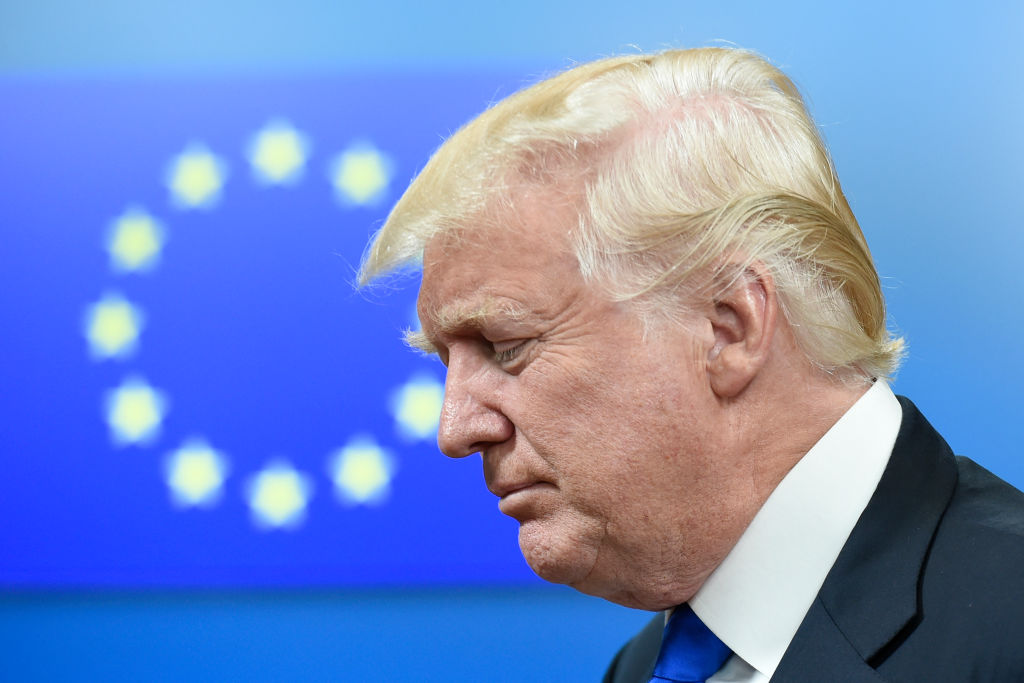
The US President is no fan of the EU. Credit: Getty

The US President is no fan of the EU. Credit: Getty

7 February 2025 - 7:00am

As Europe waits for US President Donald Trump’s tariffs, the European Union does not necessarily need to lie down and take it.

Some say that Donald Trump only cares about the optics; that he would accept any deal as long as it makes him look good. If one accepts that idea, it’s essentially an argument for continuing to underestimate him — and that has not worked so well in the past. In particular it would be a foolish misjudgement to equate America’s relationship with Mexico and Canada to that with the EU, and to extrapolate.

Here is how Europe could respond more effectively than through straight-forward retaliation. The most aggressive, and potentially also the most effective response, would be for the EU to revive Angela Merkel’s and Emmanuel Macron’s China Investment Agreement from five years ago, and to reaffirm the strategic partnership between the EU and China. That would probably create a bit of noise on the other side of the Atlantic, and would almost surely be accompanied by further threats. Should Trump choose to escalate, we should probably help ASML find business opportunities in China, maybe as a quid pro quo for Huawei helping us with our lagging 5G infrastructure. A co-operation agreement could extend to AI, an area that Europe has sadly neglected.

A less belligerent, but quite effective, response in the long run would be to fill the voids left open by the unwinding of some of the USAID programmes. To the extent that the US withdraws from international organisations, the EU could step up its involvement to form new strategic partnerships, especially in Africa and Latin America.

Internally, the most important response should be to address the deep causes of our dependency on the US, like our reliance on the US military for our security. Maybe we should switch from producing cars at scale to producing tanks and military aircraft. We should seek efficiency gains through reductions in the number of weapons systems and pooling of defence purchases, with a buy-European mandate.

Our commercial trade surpluses with the US reflect imbalances of domestic savings over investments. The capital markets union is the proverbial number ten bullet point on any EU politicians to-do-list. Put it right at the top, above Ukraine, above the Green Deal, because without it, there will not be enough money to go around for anything.

Deregulate the European tech sector, but maintain the current intrusive regime for imported tech services, to give global tech companies incentives to comply with European laws. Switch from data protection to data security. The overall point is that there is a menu of effective responses, but they all require unity, and a bit of gumption.

The worst thing — which is unfortunately what I expect to happen — would be a tit-for-tat trade war. The EU cannot win it. Do not repeat the mistakes by the Brexit doomsayers, who predicted that the UK would end in a massive black hole. It is the surplus countries that have more to lose from a trade war.

One of the lessons from history’s great military strategists is not to engage in your opponent’s war, but conduct your own. Don’t fall for Trump’s provocations. If the tariffs are wrong for the US, as I believe they are, they are wrong for Europe too. We need to play our own game.

This is an edited version of an article which originally appeared in the Eurointelligence newsletter.


Wolfgang Munchau is the Director of Eurointelligence and an UnHerd columnist.

EuroBriefing

China is threatening America in the AI race

Reports sugget Zhipu AI  has released a new model that can rival leading US systems. Credit: Getty

Reports sugget Zhipu AI has released a new model that can rival leading US systems. Credit: Getty

1 July 2026 - 10:18am

China is trying to catch up with America on artificial intelligence. The Wall Street Journal has reported that Zhipu AI — one of China’s six “AI tiger” LLMs — has released a new model that can rival leading US systems, including Anthropic’s Mythos, in cybersecurity tasks such as pinpointing security bugs. While this marks a milestone in China’s drive to catch up with Western AI capabilities, strong performance on a single benchmark does not mean it has taken the lead. Chinese models still lag behind their Western counterparts in broader capabilities, such as autonomous operation. Skepticism is therefore warranted before resorting to hysterical conclusions, but complacency about the geopolitical implications of China’s AI advances would be an even greater mistake.

On the infrastructure side, Chinese AI is still constrained by access to advanced chips, with American labs way ahead in computing capacity as well as investment. Analysis from earlier this year suggests that Chinese models are likely to be at least a few months behind those in the US. But they are still continuing to make progress, or that the geopolitical importance of AI will be decided only by whose LLM has ventured deeper into the technological frontier. The practical applications of AI, countries’ to capture foreign markets, and the application of AI into the real economy will matter just as much.

Here, China may hold an advantage. As with its dominance across many critical supply chains, Beijing may not need to produce the most advanced AI systems — only those that are affordable and widely deployable. In doing so, it could consolidate global influence by supplying functional, low-cost AI at scale.

Beijing seems to be pursuing exactly that path, developing an AI “open-source” strategy that offers affordable, widely available AI models for companies and individuals to use and modify as they wish. The production of the DeepSeek AI model, which matched the performance of Silicon Valley tools such as ChatGPT at a fraction of the cost for users, created goodwill among Chinese models with developers.

The four most popular models on OpenRouter, an AI hardware platform for developers, are now all Chinese. The goal for China is not only to win the frontier-model race, but to make its systems the default layer of AI adoption across industries and global markets. For most economies, the choice is increasingly between an affordable tool they can deploy now and a more robust one that may be out of reach.

And while the countries adopting Chinese models may be exposed to political pressure and cyber threats from Beijing, safer and more capable alternatives matter little if they are unaffordable. American AI companies are already under pressure to monetize products whose operating costs are rising. If Chinese open-source models become the cheap default for startups, universities, governments and businesses across the developing world, then America’s AI lead will be eroded from below.

Perhaps more concerning for America in the long run is how AI can give Chinese manufacturing even more strength, through the ongoing integration of AI as a general-purpose technology. China’s new Five-Year Plan mentioned AI more than 50 times and includes an “AI+” action plan aimed at spreading AI across the economy.

Beijing has been pioneering automation of its critical infrastructure for years, with promising recent results in increasing warplane production capacity. In that regard, China’s open-model strategy and manufacturing dominance will reinforce each other. Cheap, adaptable models accelerate deployment across the real economy while those deployments generate real-world data and use cases that can feed back into further model improvement.

The United States should not dismiss the importance of its lead in the AI race. That lead worries Beijing, not least because a more automated Chinese economy would also become more vulnerable to AI-generated cyber threats. But nor should Washington assume that China cannot catch up with American capabilities over time.

This AI competition represents part of a broader struggle over tech supply chains and geopolitical influence. Decisions over whether to adopt US or Chinese models could produce a more fragmented global reality, with different regions relying on different cloud providers, chips and security structures. The result will likely be a global economy which is divided into competing spheres, rather than one which produces a single winner.


Miquel Vila is a political and geopolitical risk consultant focusing on industrial strategy, critical infrastructure and global supply chains.

miquelvilam