








March 18 2025 - 4:45pm
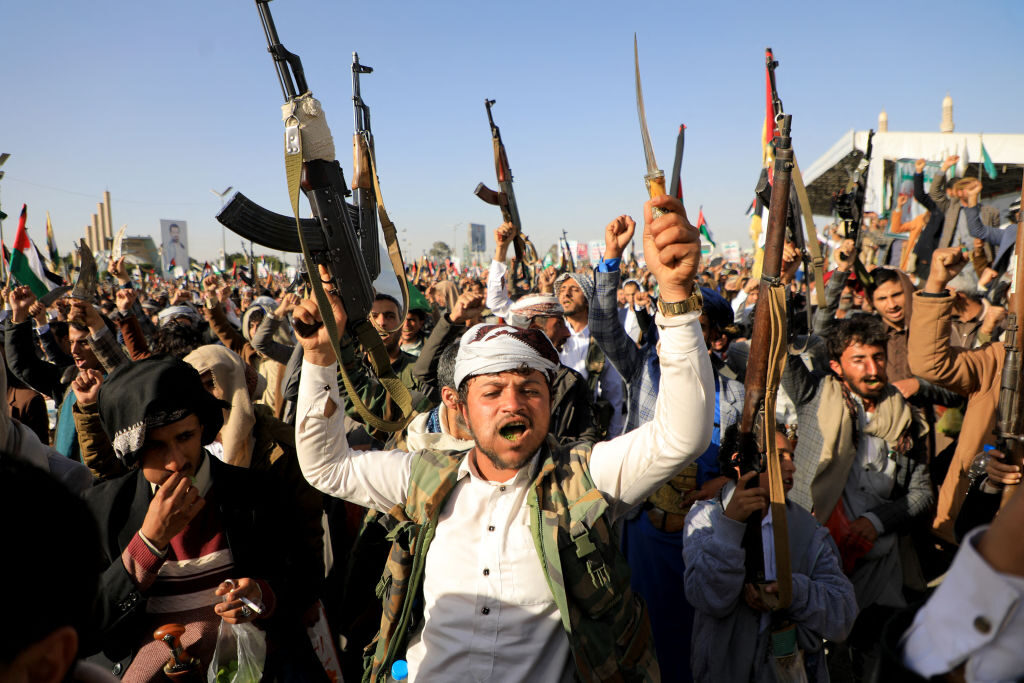
The new US strikes against the Houthis in Yemen have revealed some tensions on the Right. Many hawks have applauded these strikes against the militants who have been disrupting global trade since late 2023 by firing on ships in the Red Sea. Others are more skeptical.
American Conservative editor Curt Mills, one of the more prominent “restrainers”, asked in a viral post on X: “What exactly is the US national interest in striking Yemen? Not seeing anything related to America here.” Meanwhile, iconoclastic Kentucky Congressman Thomas Massie appeared to blame the strikes on the insatiable appetite of the “Military Industrial Complex”. Ann Coulter echoed these complaints by doubting the necessity of military action.
Among Republicans, this controversy taps into a broader debate between proponents of a Jacksonian rebalancing and supporters of a more comprehensive geopolitical restraint. While distrustful of idealistic “regime-change” endeavors, Jacksonians champion the targeted exertion of American power abroad to protect US prestige and national interests. Restrainers, on the other hand, are far more skeptical about the efficacy and sustainability of many forms of power-projection abroad.
The divide between these two factions can be seen in the military budget. Many Jacksonians have pushed for increased defense spending, but restrainers have suggested that even the Pentagon’s expense sheets should be trimmed. A populist hawk, Arkansas senator Tom Cotton has long pushed for boosting the defense budget, claiming that Joe Biden underinvested in the defense infrastructure. Secretary of State Marco Rubio and National Security Adviser Mike Waltz have long been advocates of an assertive defense position abroad. Even though he calls himself a “hawk”, the populist impresario Steve Bannon has floated cutting the defense budget as part of a bigger project of restraining government spending. Many restrainers see Director of National Intelligence Tulsi Gabbard as an important ally in the administration.
Unsurprisingly, these two groups see Trump’s strikes against the Houthis in diametrically opposed ways. Restrainers fear that these attacks could further risk conflict with Iran, one of the key backers of the Houthis. But Jacksonians instead see these strikes as valuable in part because they put pressure on the Iranian regime.
Yet one of Trump’s key traits — and, arguably, strengths — is that he is a man of no ideology or school. Rather than running foreign policy through the calculus of some ideology, he governs through a fusion of amour propre and an assessment of interest. From that perspective, the case for the Houthi strikes seems fairly straightforward. Pounding the Houthis seems a return to the “don’t poke the eagle, and let’s make a deal” approach to policymaking from his first term. In some respects, bombing the Houthis has echoes of Trump’s targeting of Qasem Soleimani in 2020. While the president has usually been averse to long-term “nation building” enterprises, he has long been willing to use American firepower to take out key adversaries, whether Soleimani, Isis or Houthi militants.
There’s a reason why US policymakers have for centuries prioritized free movement across the oceans; insecure access to commerce abroad threatens both US businesses and consumers. It’s clear that the Houthi attacks on container ships have helped drive up prices for global shipping, even for routes that do not traverse the Red Sea. Under Trump, the United States has tried to strengthen alliances with Saudi Arabia and Israel, both of which have tangled with the Houthis. Meanwhile, Trump has also begun a campaign of “maximum pressure” against Iran to try to get that country to sit down and make a deal on its nuclear program. Raining fire on the Houthis is likely part of that effort.
Hitting the Houthis may also be a way of putting pressure on China. As Lloyd’s List Intelligence reported late last year, Chinese ships seem to be mostly exempted from Houthi attacks. It is obviously a strategic advantage for the United States for its allies to be blocked in the Red Sea while Beijing gets a free pass, so knocking back Houthi militants at once checks Beijing and reasserts American geopolitical standing.
The spiraling chaos in the Middle East became a whirlpool that sucked in the Biden presidency, and the new administration seems to be trying to avoid the fate of its predecessor. Trump’s team may hope that more targeted strikes could help keep American rivals and competitors off balance, which could give more space for the forging of regional settlements that would preserve key US interests while also sharing the load with American allies or at least security partners.
While they may disagree on many issues, both Jacksonians and restrainers think that the US needs to reassess its strategy in a time of new geopolitical limits. Trump’s structural realpolitik may give something to both sides. This is the finest policy tightrope. America does have long-term and long-standing interests in being able to project power abroad, which incentivizes alliances as well as access to global commerce. At the same time, fiscal and geopolitical pressures offer new constraints; it’s not 1989 anymore. A successful rebalancing needs to take into account the reality of those constraints as well as imperatives of national greatness.
