



X Close

Headscarf debate illustrates France’s Rightward drift

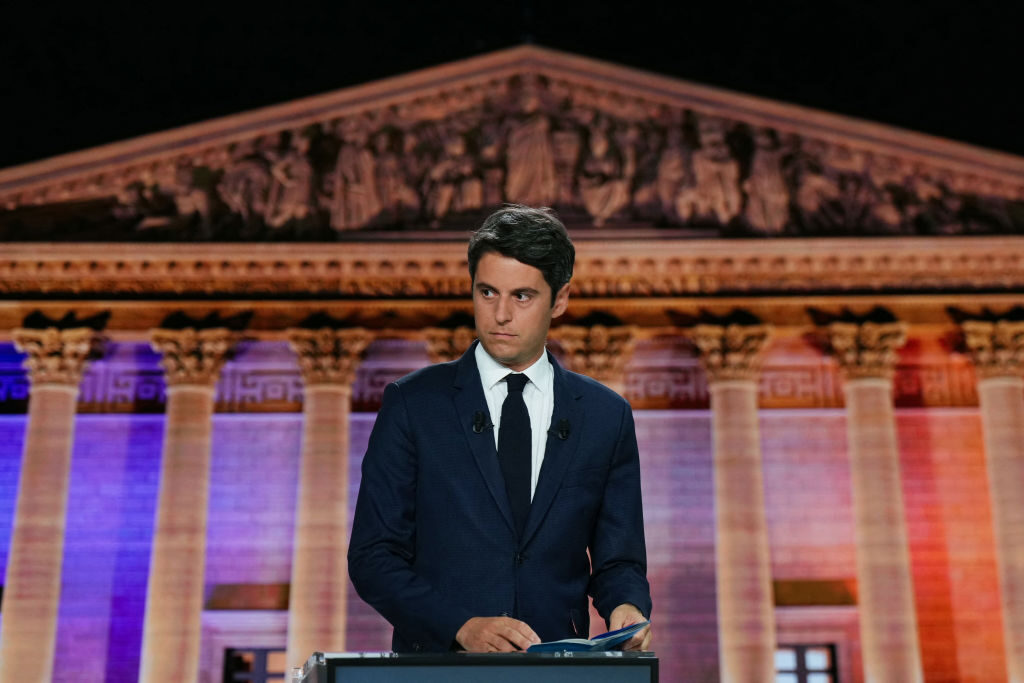
Gabriel Attal has been touted as Macron's successor. Credit: Getty

Gabriel Attal has been touted as Macron's successor. Credit: Getty

May 30 2025 - 12:30pm

The French are arguing about headscarves again. In their capacity as “conspicuous” religious symbols, these coverings were banned from schools in 2004. Now, there’s a serious proposal to prohibit under-15-year-olds from wearing headscarves in all public places. The most prominent advocate of the measure is Gabriel Attal — a former prime minister who currently leads Renaissance, the political party founded by Emmanuel Macron.

As expected, there’s a lot of opposition to the idea on the Left — and especially within Jean-Luc Mélenchon’s La France Insoumise party, which draws much of its support from the country’s Muslim population. However, the issue is also turning into a civil war across the center ground of French politics. François Bayrou, who is Macron’s current Prime Minister, this week intervened to pour scorn on Attal’s proposal: “Does it mean that, in the streets, police officers will tell young women, ‘Show me your ID so I can see if you’re old enough?’”

Bayrou, though part of the wider pro-Macron alliance, is not a member of Attal’s party. But Élisabeth Borne — another former prime minister — is a Renaissance member, and she has expressed her “greatest doubts as to the constitutionality of this measure”. So why is Attal — the poster boy of French liberalism and Macron’s political heir — alienating his centrist colleagues?

Ostensibly, the proposed ban is a response to a government report on the threat of Islamic fundamentalism. Attal can also appeal to the French tradition of laïcité (i.e. secularism with knobs on). The cynics, however, will say that his true motivation can be discerned in recent opinion polling for the next presidential election.

This reveals a Right-wing shift in French politics. For a start, the main candidate of the hard Right — Jordan Bardella (or Marine Le Pen if the courts let her run) — leads the first-round vote by a clear margin. Attal will also have an eye on the growth of support for other Right-leaning rivals.

Though not in the running for president, one might also mention Éric Ciotti, who last year led a breakaway faction of the Republicans into alliance with Le Pen, and Michel Barnier, the former anti-Brexit hero who went on to demand a referendum on immigration (one wonders where he got that idea from).

So with the Overton fenêtre moving fast, Attal must know that his best chance of getting through to the second round is to be the candidate who can compete with Bardella or Le Pen in the toughness stakes, while retaining enough liberal credibility to rally Leftish voters to his cause.

As things stand, the centrist — or conservative — most likely to make it to the final round is Édouard Philippe, whose popularity is based on upsetting as few people for as long as he can get away with it. But with the likes of Bruno Retailleau catching up, there may be enough angry French voters to put two controversial candidates into the run-off: an out-and-out Right-wing populist and a slightly less scary option. If Attal can persuade the pro-Macron parties that he is the best alternative, then he’s in with a shot.

The irony is that on the previous occasion that Attal and Bardella met in debate, it was the Right-wing populist who wanted to ban Islamic attire in public. How times change.


Peter Franklin is Associate Editor of UnHerd. He was previously a policy advisor and speechwriter on environmental and social issues.

peterfranklin_

China is threatening America in the AI race

Reports sugget Zhipu AI  has released a new model that can rival leading US systems. Credit: Getty

Reports sugget Zhipu AI has released a new model that can rival leading US systems. Credit: Getty

July 1 2026 - 10:18am

China is trying to catch up with America on artificial intelligence. The Wall Street Journal has reported that Zhipu AI — one of China’s six “AI tiger” LLMs — has released a new model that can rival leading US systems, including Anthropic’s Mythos, in cybersecurity tasks such as pinpointing security bugs. While this marks a milestone in China’s drive to catch up with Western AI capabilities, strong performance on a single benchmark does not mean it has taken the lead. Chinese models still lag behind their Western counterparts in broader capabilities, such as autonomous operation. Skepticism is therefore warranted before resorting to hysterical conclusions, but complacency about the geopolitical implications of China’s AI advances would be an even greater mistake.

On the infrastructure side, Chinese AI is still constrained by access to advanced chips, with American labs way ahead in computing capacity as well as investment. Analysis from earlier this year suggests that Chinese models are likely to be at least a few months behind those in the US. But they are still continuing to make progress, or that the geopolitical importance of AI will be decided only by whose LLM has ventured deeper into the technological frontier. The practical applications of AI, countries’ to capture foreign markets, and the application of AI into the real economy will matter just as much.

Here, China may hold an advantage. As with its dominance across many critical supply chains, Beijing may not need to produce the most advanced AI systems — only those that are affordable and widely deployable. In doing so, it could consolidate global influence by supplying functional, low-cost AI at scale.

Beijing seems to be pursuing exactly that path, developing an AI “open-source” strategy that offers affordable, widely available AI models for companies and individuals to use and modify as they wish. The production of the DeepSeek AI model, which matched the performance of Silicon Valley tools such as ChatGPT at a fraction of the cost for users, created goodwill among Chinese models with developers.

The four most popular models on OpenRouter, an AI hardware platform for developers, are now all Chinese. The goal for China is not only to win the frontier-model race, but to make its systems the default layer of AI adoption across industries and global markets. For most economies, the choice is increasingly between an affordable tool they can deploy now and a more robust one that may be out of reach.

And while the countries adopting Chinese models may be exposed to political pressure and cyber threats from Beijing, safer and more capable alternatives matter little if they are unaffordable. American AI companies are already under pressure to monetize products whose operating costs are rising. If Chinese open-source models become the cheap default for startups, universities, governments and businesses across the developing world, then America’s AI lead will be eroded from below.

Perhaps more concerning for America in the long run is how AI can give Chinese manufacturing even more strength, through the ongoing integration of AI as a general-purpose technology. China’s new Five-Year Plan mentioned AI more than 50 times and includes an “AI+” action plan aimed at spreading AI across the economy.

Beijing has been pioneering automation of its critical infrastructure for years, with promising recent results in increasing warplane production capacity. In that regard, China’s open-model strategy and manufacturing dominance will reinforce each other. Cheap, adaptable models accelerate deployment across the real economy while those deployments generate real-world data and use cases that can feed back into further model improvement.

The United States should not dismiss the importance of its lead in the AI race. That lead worries Beijing, not least because a more automated Chinese economy would also become more vulnerable to AI-generated cyber threats. But nor should Washington assume that China cannot catch up with American capabilities over time.

This AI competition represents part of a broader struggle over tech supply chains and geopolitical influence. Decisions over whether to adopt US or Chinese models could produce a more fragmented global reality, with different regions relying on different cloud providers, chips and security structures. The result will likely be a global economy which is divided into competing spheres, rather than one which produces a single winner.


Miquel Vila is a political and geopolitical risk consultant focusing on industrial strategy, critical infrastructure and global supply chains.

miquelvilam
