




X Close

Gaza is Macron’s last chance to prove himself on the world stage

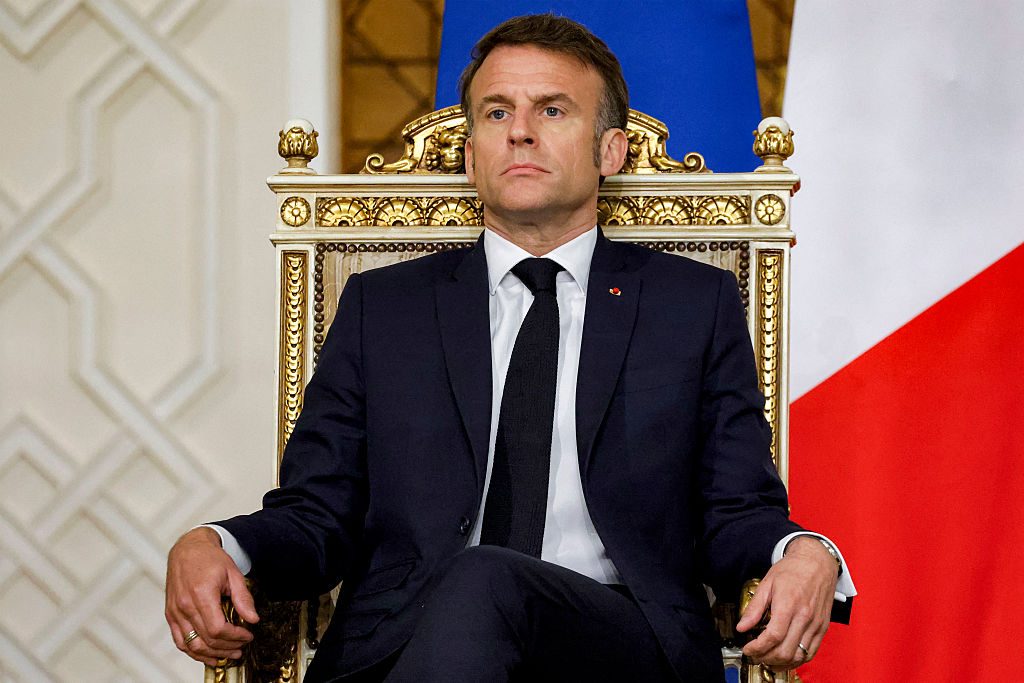
Macron has struggled to strike the right note on Gaza. Credit: Getty

Macron has struggled to strike the right note on Gaza. Credit: Getty

14 August 2025 - 10:00am

French President Emmanuel Macron has positioned his country at the forefront of a new diplomatic push on the Israeli–Palestinian conflict, announcing in July that Paris will formally recognise the State of Palestine at the UN General Assembly later this year. Building on that momentum, Macron this week condemned Israel’s plan to seize Gaza City and urged the creation of a UN-mandated peacekeeping mission to stabilise the territory and lay the foundations for a political settlement.

The situation in Gaza is more critical than ever. According to Gaza’s Hamas-affiliated health authorities, over 60,000 Palestinians have been killed and the region is suffering from acute malnutrition. With the stakes this high, France and Saudi Arabia have quietly worked with the Palestinian Authority to find a diplomatic solution. This initiative had been in the works for months, with an announcement originally planned for late June, until Israel’s strikes on Iran derailed the schedule. The ultimate declaration states that “following the ceasefire, a transitional administrative committee must be immediately established to operate in Gaza under the umbrella of the Palestinian Authority.” It also calls for the liberation of hostages and denounces acts of terrorism.

Like many of his predecessors, Macron has struggled to strike the right note on Gaza. After 1945, France was one of Israel’s staunchest partners, even joining Britain in the botched Suez Canal operation of 1956. But by the Sixties, postcolonial France no longer shared a common foe with Israel in Arab nationalism, and instead championed its politique arabe. For decades thereafter, France’s official stance was to support a two-state solution — albeit without formally recognising a Palestinian state.

But international policy is never far from domestic politics. The brutality of Hamas’s attack on 7 October 2023 evoked chilling memories of the 2015 Bataclan attack for much of the French population. It led Macron to call for the creation of an anti-Hamas coalition modelled after the one that had crippled Isis in Syria and Iraq. However, after several months of intense fighting in the Middle East, his tone shifted and he began advocating for a boycott of weapons sales to Israel.

Macron’s hesitations reflect the political divide in France. Marine Le Pen has maintained a firm stance, emphasising the link between “Islamist fundamentalism” in France and Hamas while aligning with the broader pro-Israel shift among Europe’s nationalist parties. On the Left, Jean-Luc Mélenchon’s La France Insoumise has propelled the relatively unknown Franco-Palestinian Rima Hassan into the spotlight for her strong condemnation of Israel. Public opinion remains divided: 22% support unilateral recognition of a Palestinian state, 47% want recognition conditioned on the release of hostages, and 31% oppose recognition altogether.

With no parliamentary majority and legislative deadlock, Macron’s attention is naturally turning towards the exclusive remit of any French president: international affairs. After eight years in office, he lacks a clear diplomatic success. For all the Trump-whispering, the endless meetings with Vladimir Putin, the efforts to bridge the relationship with Algeria, and involvement in the reconstruction of Lebanon, he has little to show for his time in power. As the presidents of Russia and America meet tomorrow to decide on the fate of Ukraine, Macron and his fellow European leaders can only look on helplessly.

The examples listed above were well-intentioned but bold attempts to break diplomatic and political deadlocks. They were perhaps all worth a shot, but ultimately delivered very little. Unfortunately, Macron’s efforts on Palestine are likely to face a similar fate.


François Valentin is a political analyst and co-host of the Uncommon Decency podcast.

Valen10Francois

China is threatening America in the AI race

Reports sugget Zhipu AI  has released a new model that can rival leading US systems. Credit: Getty

Reports sugget Zhipu AI has released a new model that can rival leading US systems. Credit: Getty

1 July 2026 - 10:18am

China is trying to catch up with America on artificial intelligence. The Wall Street Journal has reported that Zhipu AI — one of China’s six “AI tiger” LLMs — has released a new model that can rival leading US systems, including Anthropic’s Mythos, in cybersecurity tasks such as pinpointing security bugs. While this marks a milestone in China’s drive to catch up with Western AI capabilities, strong performance on a single benchmark does not mean it has taken the lead. Chinese models still lag behind their Western counterparts in broader capabilities, such as autonomous operation. Skepticism is therefore warranted before resorting to hysterical conclusions, but complacency about the geopolitical implications of China’s AI advances would be an even greater mistake.

On the infrastructure side, Chinese AI is still constrained by access to advanced chips, with American labs way ahead in computing capacity as well as investment. Analysis from earlier this year suggests that Chinese models are likely to be at least a few months behind those in the US. But they are still continuing to make progress, or that the geopolitical importance of AI will be decided only by whose LLM has ventured deeper into the technological frontier. The practical applications of AI, countries’ to capture foreign markets, and the application of AI into the real economy will matter just as much.

Here, China may hold an advantage. As with its dominance across many critical supply chains, Beijing may not need to produce the most advanced AI systems — only those that are affordable and widely deployable. In doing so, it could consolidate global influence by supplying functional, low-cost AI at scale.

Beijing seems to be pursuing exactly that path, developing an AI “open-source” strategy that offers affordable, widely available AI models for companies and individuals to use and modify as they wish. The production of the DeepSeek AI model, which matched the performance of Silicon Valley tools such as ChatGPT at a fraction of the cost for users, created goodwill among Chinese models with developers.

The four most popular models on OpenRouter, an AI hardware platform for developers, are now all Chinese. The goal for China is not only to win the frontier-model race, but to make its systems the default layer of AI adoption across industries and global markets. For most economies, the choice is increasingly between an affordable tool they can deploy now and a more robust one that may be out of reach.

And while the countries adopting Chinese models may be exposed to political pressure and cyber threats from Beijing, safer and more capable alternatives matter little if they are unaffordable. American AI companies are already under pressure to monetize products whose operating costs are rising. If Chinese open-source models become the cheap default for startups, universities, governments and businesses across the developing world, then America’s AI lead will be eroded from below.

Perhaps more concerning for America in the long run is how AI can give Chinese manufacturing even more strength, through the ongoing integration of AI as a general-purpose technology. China’s new Five-Year Plan mentioned AI more than 50 times and includes an “AI+” action plan aimed at spreading AI across the economy.

Beijing has been pioneering automation of its critical infrastructure for years, with promising recent results in increasing warplane production capacity. In that regard, China’s open-model strategy and manufacturing dominance will reinforce each other. Cheap, adaptable models accelerate deployment across the real economy while those deployments generate real-world data and use cases that can feed back into further model improvement.

The United States should not dismiss the importance of its lead in the AI race. That lead worries Beijing, not least because a more automated Chinese economy would also become more vulnerable to AI-generated cyber threats. But nor should Washington assume that China cannot catch up with American capabilities over time.

This AI competition represents part of a broader struggle over tech supply chains and geopolitical influence. Decisions over whether to adopt US or Chinese models could produce a more fragmented global reality, with different regions relying on different cloud providers, chips and security structures. The result will likely be a global economy which is divided into competing spheres, rather than one which produces a single winner.


Miquel Vila is a political and geopolitical risk consultant focusing on industrial strategy, critical infrastructure and global supply chains.

miquelvilam