




X Close

Firing RFK Jr would be dangerous for Trump

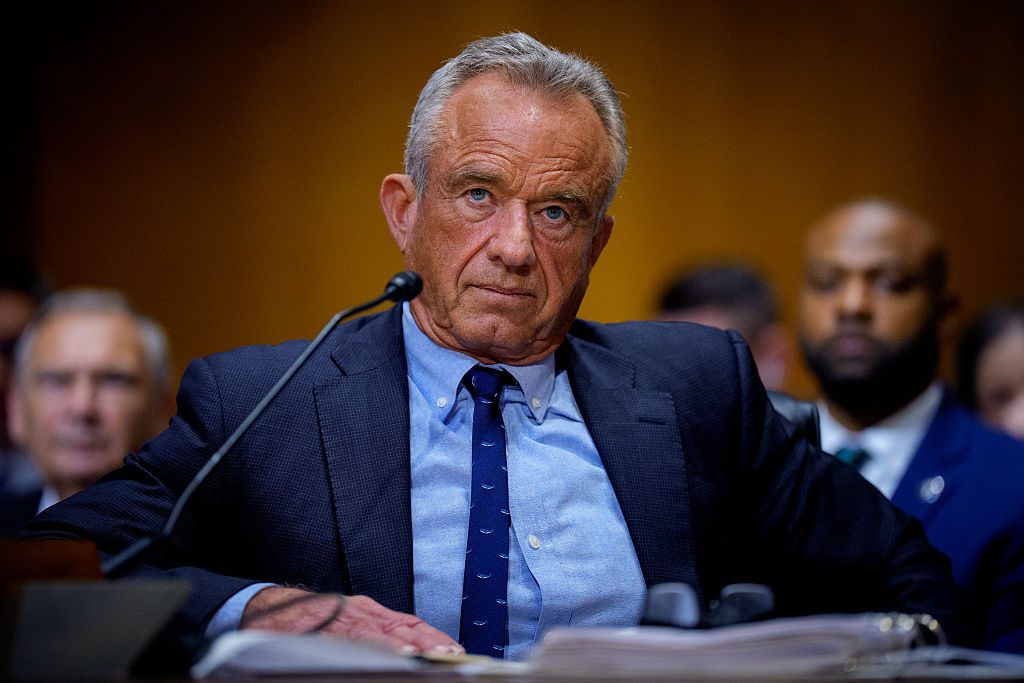
Kennedy appears in front of the Senate last week. Credit: Getty

Kennedy appears in front of the Senate last week. Credit: Getty

9 September 2025 - 6:30pm

Robert F. Kennedy Jr’s enemies smell blood in the water.

When Kennedy endorsed Donald Trump for president just over a year ago, Republicans in the midst of a tough election season rejoiced. The emergent “Make America Healthy Again” coalition could tip the scales for Trump and deliver a new GOP. But as a contentious Senate hearing last Thursday confirmed, after just six months of Kennedy’s tenure atop the Department of Health and Human Services the coalition is facing a major stress test.

A new Washington Post report notes that a handful of Republican senators and pharmaceutical lobbyists sense Kennedy is newly vulnerable, having played a role in the high-profile ouster of Centers for Disease Control and Prevention director Susan Monarez last week, cut mRNA research funding, and limited Covid vaccine access. The Post noted obvious scepticism from key Senate Republicans during Kennedy’s testimony last week, including from John Barrasso, Bill Cassidy, and Thom Tillis.

Cassidy only agreed to confirm Kennedy in February after the Secretary essentially agreed to carry on an “unprecedentedly close” relationship with the senator, who is a doctor and clearly reluctant about letting the fox into the henhouse. The rolling reports of personnel drama at HHS are undeniably reflective of this dynamic. Kennedy is having exactly the effect on entrenched bureaucracy one would expect, whether you hold him in high regard or not.

And that may actually be to his advantage — at least for now. So long as Kennedy’s detractors appear breathlessly defensive of the tragic status quo, which he correctly diagnoses as a disaster, he’ll have the upper hand with Trump.

But Big Pharma, according to the Post, is rolling out a new strategy to drive a wedge between Kennedy and the President, working with Republican senators to “[mount] a push to belatedly recognize Trump for his first administration’s coronavirus vaccine program — identifying it as a way to drive a wedge between the president and Kennedy, who has previously claimed that the shots are ‘the deadliest vaccine ever made’.”

Kennedy, of course, has a long history of accusing the government, corporations, and the medical establishment of prioritising profit and power over health. He’s perhaps best known for making this case about vaccines. Though Kennedy insists he’s not categorically against vaccines, he’s made comments including “There’s no vaccine that is safe and effective,” that put him at odds with the expert class and many voters.

Representatives from the firm of Trump pollster Tony Fabrizio reportedly “warned GOP lawmakers last week that overhauling vaccine policies is politically dangerous, citing data that nearly three-quarters of Trump voters believe vaccines save lives”. However that briefing came about, you can rest assured it was organised strategically by Kennedy’s critics.

Those critics are hoping the reality of chaos and cabinet-level vaccine scepticism shocks top Republicans, including Trump, in ways the mere expectation of Kennedy’s beliefs didn’t quite terrify them. But, just as in Kennedy’s confirmation hearing, Republicans are caught between a rock and a hard place, either upsetting dedicated, low-trust MAGA populists by undermining Kennedy or upsetting others closer to the centre who worry about outbreaks and the powerful interests which will lay any such cases directly at the Secretary’s feet.

A measles outbreak has produced 1,431 cases in 41 states and claimed the lives of two children in west Texas this year. According to Harvard, “this is the largest number of cases in a year since 2000, when the disease was declared eliminated in the U.S.” It’s easy to see Kennedy’s position becoming harder for Trump to defend if the outbreak continues and claims more lives around the country, giving serious ammunition to the Health Secretary’s enemies who can blame him for decreasing popular trust in these treatments.

On the other hand, firing Kennedy wouldn’t make Trump’s problems go away because Americans are increasingly aware that the expert class has failed on public health for decades. Hardcore MAHA influencers would likely be enraged, and it would be difficult for the President to find a trustworthy replacement who strikes a balance between Cassidy and Kennedy. Turning on RFK Jr is hardly an easy political solution for Republicans, as much as lobbyists may say it is. In fact, it could create just as many problems as they argue it would solve.


Emily Jashinsky is UnHerd‘s Washington correspondent.

emilyjashinsky

China is threatening America in the AI race

Reports sugget Zhipu AI  has released a new model that can rival leading US systems. Credit: Getty

Reports sugget Zhipu AI has released a new model that can rival leading US systems. Credit: Getty

1 July 2026 - 10:18am

China is trying to catch up with America on artificial intelligence. The Wall Street Journal has reported that Zhipu AI — one of China’s six “AI tiger” LLMs — has released a new model that can rival leading US systems, including Anthropic’s Mythos, in cybersecurity tasks such as pinpointing security bugs. While this marks a milestone in China’s drive to catch up with Western AI capabilities, strong performance on a single benchmark does not mean it has taken the lead. Chinese models still lag behind their Western counterparts in broader capabilities, such as autonomous operation. Skepticism is therefore warranted before resorting to hysterical conclusions, but complacency about the geopolitical implications of China’s AI advances would be an even greater mistake.

On the infrastructure side, Chinese AI is still constrained by access to advanced chips, with American labs way ahead in computing capacity as well as investment. Analysis from earlier this year suggests that Chinese models are likely to be at least a few months behind those in the US. But they are still continuing to make progress, or that the geopolitical importance of AI will be decided only by whose LLM has ventured deeper into the technological frontier. The practical applications of AI, countries’ to capture foreign markets, and the application of AI into the real economy will matter just as much.

Here, China may hold an advantage. As with its dominance across many critical supply chains, Beijing may not need to produce the most advanced AI systems — only those that are affordable and widely deployable. In doing so, it could consolidate global influence by supplying functional, low-cost AI at scale.

Beijing seems to be pursuing exactly that path, developing an AI “open-source” strategy that offers affordable, widely available AI models for companies and individuals to use and modify as they wish. The production of the DeepSeek AI model, which matched the performance of Silicon Valley tools such as ChatGPT at a fraction of the cost for users, created goodwill among Chinese models with developers.

The four most popular models on OpenRouter, an AI hardware platform for developers, are now all Chinese. The goal for China is not only to win the frontier-model race, but to make its systems the default layer of AI adoption across industries and global markets. For most economies, the choice is increasingly between an affordable tool they can deploy now and a more robust one that may be out of reach.

And while the countries adopting Chinese models may be exposed to political pressure and cyber threats from Beijing, safer and more capable alternatives matter little if they are unaffordable. American AI companies are already under pressure to monetize products whose operating costs are rising. If Chinese open-source models become the cheap default for startups, universities, governments and businesses across the developing world, then America’s AI lead will be eroded from below.

Perhaps more concerning for America in the long run is how AI can give Chinese manufacturing even more strength, through the ongoing integration of AI as a general-purpose technology. China’s new Five-Year Plan mentioned AI more than 50 times and includes an “AI+” action plan aimed at spreading AI across the economy.

Beijing has been pioneering automation of its critical infrastructure for years, with promising recent results in increasing warplane production capacity. In that regard, China’s open-model strategy and manufacturing dominance will reinforce each other. Cheap, adaptable models accelerate deployment across the real economy while those deployments generate real-world data and use cases that can feed back into further model improvement.

The United States should not dismiss the importance of its lead in the AI race. That lead worries Beijing, not least because a more automated Chinese economy would also become more vulnerable to AI-generated cyber threats. But nor should Washington assume that China cannot catch up with American capabilities over time.

This AI competition represents part of a broader struggle over tech supply chains and geopolitical influence. Decisions over whether to adopt US or Chinese models could produce a more fragmented global reality, with different regions relying on different cloud providers, chips and security structures. The result will likely be a global economy which is divided into competing spheres, rather than one which produces a single winner.


Miquel Vila is a political and geopolitical risk consultant focusing on industrial strategy, critical infrastructure and global supply chains.

miquelvilam