




X Close

‘Extremism’ label will only help the AfD

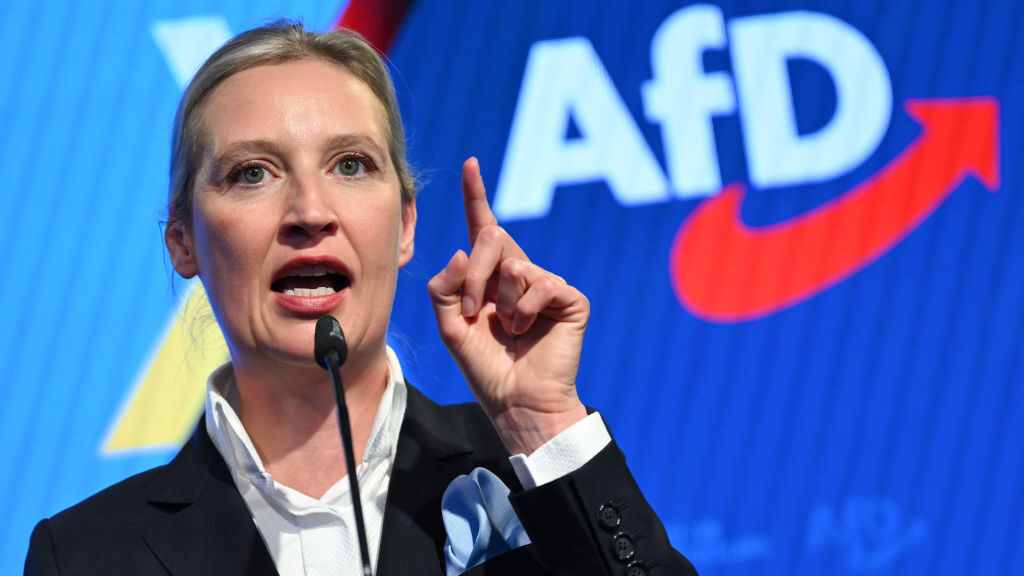
AfD co-leader and candidate for chancellor Alice Weidel. Credit: Getty

AfD co-leader and candidate for chancellor Alice Weidel. Credit: Getty

3 May 2025 - 7:00am

Germany’s Alternative für Deutschland (AfD) is a “Right-wing extremist” party, the country’s domestic intelligence service announced on Friday. This classification has few immediate legal consequences, but it carries enormous potential to backfire politically just as a new government sets out to win back public trust.

The decision to upgrade the AfD from its previous categorisation as a “suspected Right-wing extremist” party to a “confirmed” one has not come out of the blue. Reports indicated that the Federal Office for the Protection of the Constitution (BfV, by its German acronym) had planned to do this a few months ago but was deterred when a snap election was scheduled for February. It didn’t want to be seen to interfere with the voting.

Nonetheless, the news has fired up political debate in Berlin. Special live coverage ran on several media outlets, and politicians from all the major parties commented. The AfD called the classification “total nonsense” and “purely political”. The Greens said it confirmed that the AfD was “on the warpath against the liberal democratic order”. For the General Secretary of the centre-left SPD, Matthias Miersch, it showed that “what sounds like racism, what looks like racism, is in the end racism.”

These responses were as predictable as the BfV’s decision. The growing popularity of the AfD, which came second in February’s election and is now in first place in some polls, has long been watched with concern by the established parties, which don’t know what to do about it. As a result, they have focused on combatting the AfD itself rather than the issues underpinning its rise. Systematic exclusion of the AfD from certain parliamentary processes and offices, large street demonstrations against “the Right”, and calls for an AfD ban acted like paracetamol against a headache that refuses to go away.

So it’s hardly surprising that the new AfD classification is welcomed by those who feel helpless in tackling the party’s rise. What’s harder to predict is what will happen next. As a “suspected” case of extremism, the AfD was already under surveillance from the BfV, which is allowed to use methods including technological surveillance and undercover agents. These methods have to be proportional by law and that proportionality shifts with the upgraded categorisation, making it easier for the intelligence agency to go further.

The bigger consequences will be political. Those who have demanded excluding the AfD in the past feel emboldened even though, legally speaking, the BfV classification isn’t necessary for a ban. The process is entirely political, triggered either by the government or by one of the two chambers of parliament. The last time MPs tried this in the lower chamber, the Bundestag, only 124 of 735 deputies supported it and the matter was dropped.

That was in February. Due to the BfV ruling, people like SPD politician Georg Maier want to try again. “The evidence is overwhelming,” Maier said on Friday. “Now the time is ripe for a banning application.” Similar calls were made by figures across the political spectrum. The timing of the BfV announcement means that the launch of Germany’s new government next week may be overshadowed by the debate over whether to ban the largest opposition party, rather than feeling like a fresh start.

It also changes the dynamics of the coalition led by Friedrich Merz’s centre-right Christian Democratic Union, which won the election but can only reach a majority with SPD help since it has ruled out cooperating with the AfD. In the run-up to the election, Merz passed a motion to tighten immigration legislation with votes from the AfD, which caused much furore but reinforced a feeling that the SPD might not hold all the levers. With the AfD now officially labelled “Right-wing extremist”, the conservatives might feel the party is entirely untouchable.

The Greens alluded to this on Friday, arguing that the BfV decision was “a clear message in the direction of those who recently argued for a normalisation of the party”. This leaves Merz at the mercy of the SPD, potentially making the change he promised more difficult to enact in critical areas such as the economy and immigration.

Whatever happens next, it has already become harder for the two ruling parties to launch their newly elected government on a constructive and positive note next week. If anything, this is likely to give more, not less, political oxygen to the AfD.


Katja Hoyer is a German-British historian and writer. Her latest book Weimar: Life on the Edge of Catastrophe will be released in May 2026.

hoyer_kat

China is threatening America in the AI race

Reports sugget Zhipu AI  has released a new model that can rival leading US systems. Credit: Getty

Reports sugget Zhipu AI has released a new model that can rival leading US systems. Credit: Getty

1 July 2026 - 10:18am

China is trying to catch up with America on artificial intelligence. The Wall Street Journal has reported that Zhipu AI — one of China’s six “AI tiger” LLMs — has released a new model that can rival leading US systems, including Anthropic’s Mythos, in cybersecurity tasks such as pinpointing security bugs. While this marks a milestone in China’s drive to catch up with Western AI capabilities, strong performance on a single benchmark does not mean it has taken the lead. Chinese models still lag behind their Western counterparts in broader capabilities, such as autonomous operation. Skepticism is therefore warranted before resorting to hysterical conclusions, but complacency about the geopolitical implications of China’s AI advances would be an even greater mistake.

On the infrastructure side, Chinese AI is still constrained by access to advanced chips, with American labs way ahead in computing capacity as well as investment. Analysis from earlier this year suggests that Chinese models are likely to be at least a few months behind those in the US. But they are still continuing to make progress, or that the geopolitical importance of AI will be decided only by whose LLM has ventured deeper into the technological frontier. The practical applications of AI, countries’ to capture foreign markets, and the application of AI into the real economy will matter just as much.

Here, China may hold an advantage. As with its dominance across many critical supply chains, Beijing may not need to produce the most advanced AI systems — only those that are affordable and widely deployable. In doing so, it could consolidate global influence by supplying functional, low-cost AI at scale.

Beijing seems to be pursuing exactly that path, developing an AI “open-source” strategy that offers affordable, widely available AI models for companies and individuals to use and modify as they wish. The production of the DeepSeek AI model, which matched the performance of Silicon Valley tools such as ChatGPT at a fraction of the cost for users, created goodwill among Chinese models with developers.

The four most popular models on OpenRouter, an AI hardware platform for developers, are now all Chinese. The goal for China is not only to win the frontier-model race, but to make its systems the default layer of AI adoption across industries and global markets. For most economies, the choice is increasingly between an affordable tool they can deploy now and a more robust one that may be out of reach.

And while the countries adopting Chinese models may be exposed to political pressure and cyber threats from Beijing, safer and more capable alternatives matter little if they are unaffordable. American AI companies are already under pressure to monetize products whose operating costs are rising. If Chinese open-source models become the cheap default for startups, universities, governments and businesses across the developing world, then America’s AI lead will be eroded from below.

Perhaps more concerning for America in the long run is how AI can give Chinese manufacturing even more strength, through the ongoing integration of AI as a general-purpose technology. China’s new Five-Year Plan mentioned AI more than 50 times and includes an “AI+” action plan aimed at spreading AI across the economy.

Beijing has been pioneering automation of its critical infrastructure for years, with promising recent results in increasing warplane production capacity. In that regard, China’s open-model strategy and manufacturing dominance will reinforce each other. Cheap, adaptable models accelerate deployment across the real economy while those deployments generate real-world data and use cases that can feed back into further model improvement.

The United States should not dismiss the importance of its lead in the AI race. That lead worries Beijing, not least because a more automated Chinese economy would also become more vulnerable to AI-generated cyber threats. But nor should Washington assume that China cannot catch up with American capabilities over time.

This AI competition represents part of a broader struggle over tech supply chains and geopolitical influence. Decisions over whether to adopt US or Chinese models could produce a more fragmented global reality, with different regions relying on different cloud providers, chips and security structures. The result will likely be a global economy which is divided into competing spheres, rather than one which produces a single winner.


Miquel Vila is a political and geopolitical risk consultant focusing on industrial strategy, critical infrastructure and global supply chains.

miquelvilam