



X Close

EU inertia provides an opening for populists

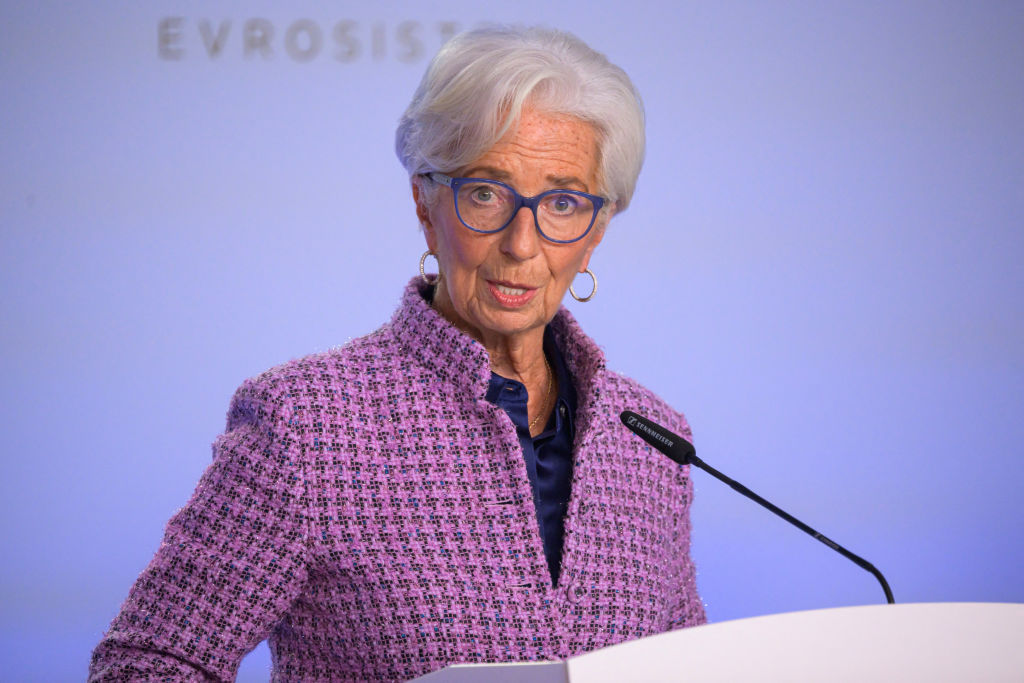
European Central Bank President Christine Lagarde speaks in Slovenia last week. Credit: Getty

European Central Bank President Christine Lagarde speaks in Slovenia last week. Credit: Getty

22 October 2024 - 10:00am

Last weekend Boštjan Vasle, Governor of the Bank of Slovenia, warned traders not to read too much into the European Central Bank’s recent back-to-back interest rate cuts. Amid investor expectations that interest rates will fall sharply, Vasle said the bank’s easing did “not automatically mean that we will now act at every meeting”.

His caution echoes similar statements by US Federal Reserve governors, who have also told markets not to get too excited about the future course of rate cuts. With the American economy still buoyant, too swift a fall in interest rates could further swell demand, leading to a resurgence of inflation. With investors anticipating an even steeper set of cuts than the Fed has signposted, dulling their ardour thus appears sensible.

Yet it sounds a bit odd coming from a European voice. The continental economy is anything but buoyant, making a resurgence of inflation seem a distant prospect. Although there are pockets of relative dynamism, particularly in Eastern Europe, the big anchor economies of Italy, France and Germany are all struggling, with the last of the three now in recession. Meanwhile, sandwiched as they are between an increasingly protectionist United States and an aggressively competitive China, its exporters are having a hard time holding onto global market share, making an export-led recovery seem a distant prospect, at least for now.

Nor is there any reason to think things might change much soon. Although Mario Draghi, formerly ECB chief and ex-Italian prime minister, produced an impressive report last month suggesting ways the EU could use industrial policy to revive the economy, it may sit on the desks of the major capitals. The two big beasts, France and Germany, are saddled with weak governments whose clock is running down, making it improbable anyone will want to pilot the Draghi proposals through the continent’s delicate diplomacy.

Further reinforcing the policy inertia is the rise of radical populist parties, which is slowing the pace of change. The need of increasingly fragile governments to keep the populists at bay is making them even more reluctant to make the sweeping economic reforms needed to revive growth. French President Emmanuel Macron tried creating a more business-friendly economy with some bold reforms. Look where it got him.

All told, there’s little reason to expect the sort of demand-led inflation that the Fed is concerned about could resurface in Europe in the foreseeable future. However, the risk may not lie in the economy but in the continent’s febrile politics. Indeed, it may be with one eye on the populists that Vasle has aired his concerns. Like almost all developed economies, Europe’s population is ageing — which means it relies on immigrants to supplement what would otherwise become a declining workforce. Restricting immigration, a non-negotiable for the populists, would thus slow and possibly reverse economic growth.

Yet rather than factor that into their political programmes, Europe’s new challengers tend to go the other way, promising even more generous welfare states and higher wages. Such fiscal largesse amid economic contraction would ultimately fuel inflation. Although we have not reached that tipping point, the ability of governments to keep their budgets in balance while fending off siren songs from the political fringes is looking increasingly doubtful. Where governments have kept spending under wraps, as in Germany, they’ve often done it by cutting investment so deeply the economy ends up worse off. Needless to say, that only strengthens the appeal of the populists.

Europe therefore seems to be caught between economic contraction and fiscal expansion. For as long as that tension persists, the ECB will feel the need for vigilance.


John Rapley is an author and academic who divides his time between London, Johannesburg and Ottawa. His books include Why Empires Fall: Rome, America and the Future of the West (with Peter Heather, Penguin, 2023) and Twilight of the Money Gods: Economics as a Religion (Simon & Schuster, 2017).

jarapley

China is threatening America in the AI race

Reports sugget Zhipu AI  has released a new model that can rival leading US systems. Credit: Getty

Reports sugget Zhipu AI has released a new model that can rival leading US systems. Credit: Getty

1 July 2026 - 10:18am

China is trying to catch up with America on artificial intelligence. The Wall Street Journal has reported that Zhipu AI — one of China’s six “AI tiger” LLMs — has released a new model that can rival leading US systems, including Anthropic’s Mythos, in cybersecurity tasks such as pinpointing security bugs. While this marks a milestone in China’s drive to catch up with Western AI capabilities, strong performance on a single benchmark does not mean it has taken the lead. Chinese models still lag behind their Western counterparts in broader capabilities, such as autonomous operation. Skepticism is therefore warranted before resorting to hysterical conclusions, but complacency about the geopolitical implications of China’s AI advances would be an even greater mistake.

On the infrastructure side, Chinese AI is still constrained by access to advanced chips, with American labs way ahead in computing capacity as well as investment. Analysis from earlier this year suggests that Chinese models are likely to be at least a few months behind those in the US. But they are still continuing to make progress, or that the geopolitical importance of AI will be decided only by whose LLM has ventured deeper into the technological frontier. The practical applications of AI, countries’ to capture foreign markets, and the application of AI into the real economy will matter just as much.

Here, China may hold an advantage. As with its dominance across many critical supply chains, Beijing may not need to produce the most advanced AI systems — only those that are affordable and widely deployable. In doing so, it could consolidate global influence by supplying functional, low-cost AI at scale.

Beijing seems to be pursuing exactly that path, developing an AI “open-source” strategy that offers affordable, widely available AI models for companies and individuals to use and modify as they wish. The production of the DeepSeek AI model, which matched the performance of Silicon Valley tools such as ChatGPT at a fraction of the cost for users, created goodwill among Chinese models with developers.

The four most popular models on OpenRouter, an AI hardware platform for developers, are now all Chinese. The goal for China is not only to win the frontier-model race, but to make its systems the default layer of AI adoption across industries and global markets. For most economies, the choice is increasingly between an affordable tool they can deploy now and a more robust one that may be out of reach.

And while the countries adopting Chinese models may be exposed to political pressure and cyber threats from Beijing, safer and more capable alternatives matter little if they are unaffordable. American AI companies are already under pressure to monetize products whose operating costs are rising. If Chinese open-source models become the cheap default for startups, universities, governments and businesses across the developing world, then America’s AI lead will be eroded from below.

Perhaps more concerning for America in the long run is how AI can give Chinese manufacturing even more strength, through the ongoing integration of AI as a general-purpose technology. China’s new Five-Year Plan mentioned AI more than 50 times and includes an “AI+” action plan aimed at spreading AI across the economy.

Beijing has been pioneering automation of its critical infrastructure for years, with promising recent results in increasing warplane production capacity. In that regard, China’s open-model strategy and manufacturing dominance will reinforce each other. Cheap, adaptable models accelerate deployment across the real economy while those deployments generate real-world data and use cases that can feed back into further model improvement.

The United States should not dismiss the importance of its lead in the AI race. That lead worries Beijing, not least because a more automated Chinese economy would also become more vulnerable to AI-generated cyber threats. But nor should Washington assume that China cannot catch up with American capabilities over time.

This AI competition represents part of a broader struggle over tech supply chains and geopolitical influence. Decisions over whether to adopt US or Chinese models could produce a more fragmented global reality, with different regions relying on different cloud providers, chips and security structures. The result will likely be a global economy which is divided into competing spheres, rather than one which produces a single winner.


Miquel Vila is a political and geopolitical risk consultant focusing on industrial strategy, critical infrastructure and global supply chains.

miquelvilam
