




X Close

Elite donors risk pushing Kamala Harris further Left

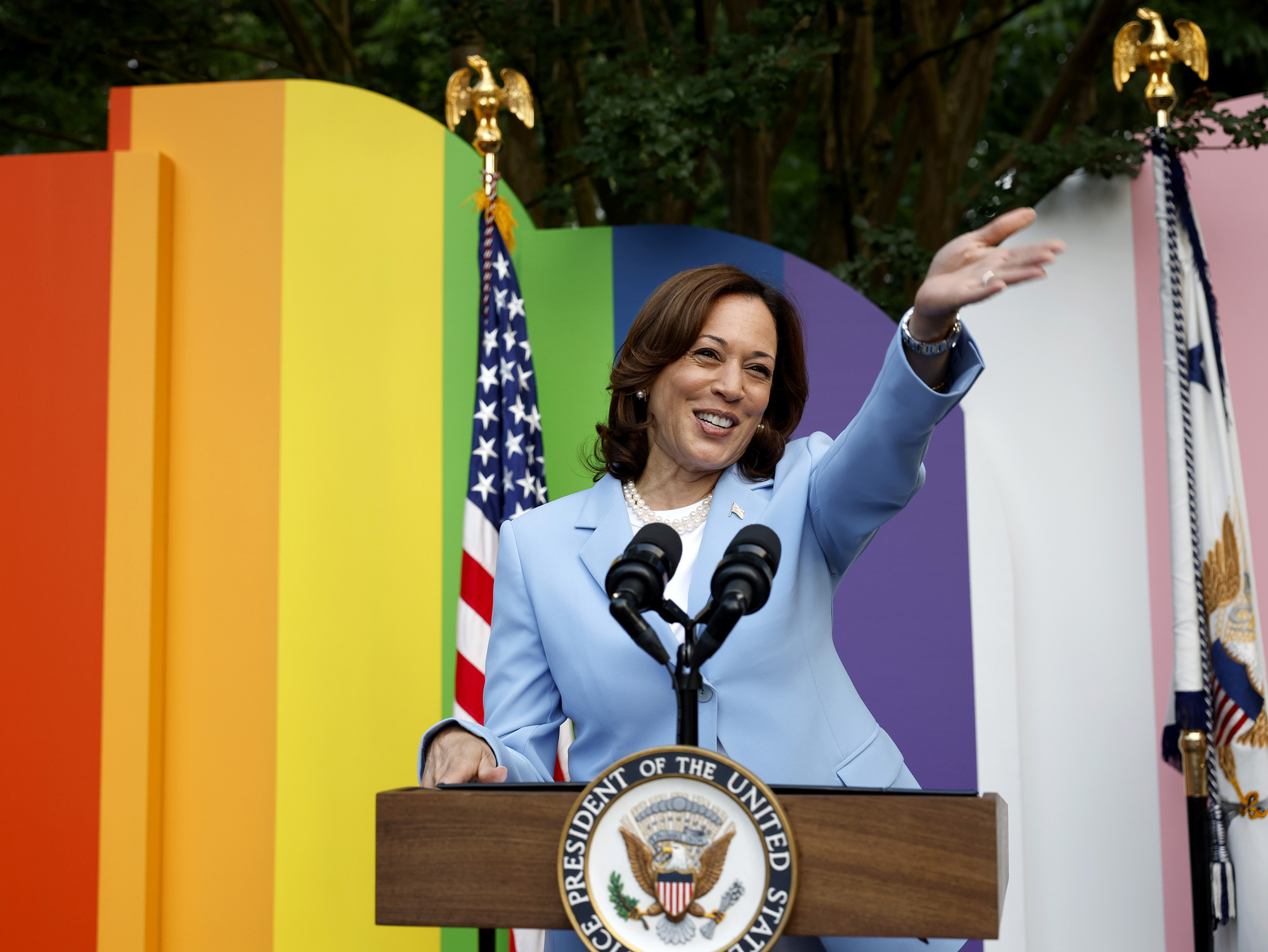
The Harris campaign has raised $200 million in its first week. Credit: Getty

The Harris campaign has raised $200 million in its first week. Credit: Getty

29 July 2024 - 8:30pm

Kamala Harris’s presidential bid has hit a sugar high. Her campaign announced that it has raised $200 million in its first week in existence. That’s an extraordinary sum, given that the Biden campaign and the Democratic National Committee combined raised $264 million between April and June of this year. A sign of grassroots engagement, this influx of donations aligns with recent polling by the Wall Street Journal which shows a surge in enthusiasm among Democratic voters now that Joe Biden has stepped aside.

Harris’s cash infusion didn’t fall out of a coconut tree. Like other parts of the Democratic establishment, elite donors had a marriage of convenience with Biden. When they thought that he was the most viable general election candidate against Donald Trump in 2020, they consolidated behind him. Those very same elites successfully discouraged any serious primary challenges to Biden in the 2024 cycle but broke with him after the June debate with Trump.

But this elite donor class now rallying around Harris could push her campaign in a direction that risks alienating working-class voters. These donors might, for instance, urge her to return to the “boardroom liberalism” of the Obama era by backing away from populist economics. The progressive economic analyst Matt Stoller has raised precisely this worry in a piece today for Compact, noting that major donors are pressing Harris to eliminate tariffs on goods from China as well as reverse the Biden administration’s aggressive approach to antitrust policy. A return to neoliberalism, Stoller warns, could “fracture the Democratic coalition”.

Elite donors could also raise risks for Harris on cultural politics. Essential for Biden’s victory in 2020 was his ability to seem at a distance from the vanguard of Left-wing identity politics. Harris ran well to the Left of Biden on social issues in the 2020 Democratic primary. In November 2020, she released a video dismissing “equality” and praising “equity”, which prompted Trump critic Andrew Sullivan to wonder whether she was endorsing “full-on Marxism”. Theoretically, she could try to reset her image on cultural issues for the 2024 election, but some major pro-Harris fundraising efforts have now tried to place her campaign firmly in the constellation of starry “wokeness”.

Consider, for instance, the gargantuan “White Women: Answer the Call” fundraising and organising Zoom event for Harris. This event’s organisers claim to have raised millions of dollars for her campaign and to have engaged thousands of volunteers. Saturated with invocations of “privilege”, the “patriarchy”, and “doing the work”, the event itself seemed like a re-education seminar from the summer of 2020. This kind of campaign might appeal to an NPR listener with a cultural studies degree, but it would seem obscure — maybe even weird — to a factory worker in Grand Rapids.

Working-class voters have shifted away from the Democratic Party over the past 30 years. In 1992, Democratic Congressional candidates handily won voters who had not graduated from college; by 2022, they lost that group by over 10 points. As the Democratic Party has increasingly become the redoubt of the educated elite, it has lost ground with the blue-collar voters who used to form the core of the party.

If it allows talking points about “privilege” and “the patriarchy” to supplant concrete proposals to improve the lives of working families, Harris’s campaign risks pushing those voters even further away.


Fred Bauer is a writer from New England.

fredbauerblog

China is threatening America in the AI race

Reports sugget Zhipu AI  has released a new model that can rival leading US systems. Credit: Getty

Reports sugget Zhipu AI has released a new model that can rival leading US systems. Credit: Getty

1 July 2026 - 10:18am

China is trying to catch up with America on artificial intelligence. The Wall Street Journal has reported that Zhipu AI — one of China’s six “AI tiger” LLMs — has released a new model that can rival leading US systems, including Anthropic’s Mythos, in cybersecurity tasks such as pinpointing security bugs. While this marks a milestone in China’s drive to catch up with Western AI capabilities, strong performance on a single benchmark does not mean it has taken the lead. Chinese models still lag behind their Western counterparts in broader capabilities, such as autonomous operation. Skepticism is therefore warranted before resorting to hysterical conclusions, but complacency about the geopolitical implications of China’s AI advances would be an even greater mistake.

On the infrastructure side, Chinese AI is still constrained by access to advanced chips, with American labs way ahead in computing capacity as well as investment. Analysis from earlier this year suggests that Chinese models are likely to be at least a few months behind those in the US. But they are still continuing to make progress, or that the geopolitical importance of AI will be decided only by whose LLM has ventured deeper into the technological frontier. The practical applications of AI, countries’ to capture foreign markets, and the application of AI into the real economy will matter just as much.

Here, China may hold an advantage. As with its dominance across many critical supply chains, Beijing may not need to produce the most advanced AI systems — only those that are affordable and widely deployable. In doing so, it could consolidate global influence by supplying functional, low-cost AI at scale.

Beijing seems to be pursuing exactly that path, developing an AI “open-source” strategy that offers affordable, widely available AI models for companies and individuals to use and modify as they wish. The production of the DeepSeek AI model, which matched the performance of Silicon Valley tools such as ChatGPT at a fraction of the cost for users, created goodwill among Chinese models with developers.

The four most popular models on OpenRouter, an AI hardware platform for developers, are now all Chinese. The goal for China is not only to win the frontier-model race, but to make its systems the default layer of AI adoption across industries and global markets. For most economies, the choice is increasingly between an affordable tool they can deploy now and a more robust one that may be out of reach.

And while the countries adopting Chinese models may be exposed to political pressure and cyber threats from Beijing, safer and more capable alternatives matter little if they are unaffordable. American AI companies are already under pressure to monetize products whose operating costs are rising. If Chinese open-source models become the cheap default for startups, universities, governments and businesses across the developing world, then America’s AI lead will be eroded from below.

Perhaps more concerning for America in the long run is how AI can give Chinese manufacturing even more strength, through the ongoing integration of AI as a general-purpose technology. China’s new Five-Year Plan mentioned AI more than 50 times and includes an “AI+” action plan aimed at spreading AI across the economy.

Beijing has been pioneering automation of its critical infrastructure for years, with promising recent results in increasing warplane production capacity. In that regard, China’s open-model strategy and manufacturing dominance will reinforce each other. Cheap, adaptable models accelerate deployment across the real economy while those deployments generate real-world data and use cases that can feed back into further model improvement.

The United States should not dismiss the importance of its lead in the AI race. That lead worries Beijing, not least because a more automated Chinese economy would also become more vulnerable to AI-generated cyber threats. But nor should Washington assume that China cannot catch up with American capabilities over time.

This AI competition represents part of a broader struggle over tech supply chains and geopolitical influence. Decisions over whether to adopt US or Chinese models could produce a more fragmented global reality, with different regions relying on different cloud providers, chips and security structures. The result will likely be a global economy which is divided into competing spheres, rather than one which produces a single winner.


Miquel Vila is a political and geopolitical risk consultant focusing on industrial strategy, critical infrastructure and global supply chains.

miquelvilam