




X Close

Don’t blame Trumponomics for US stock slump

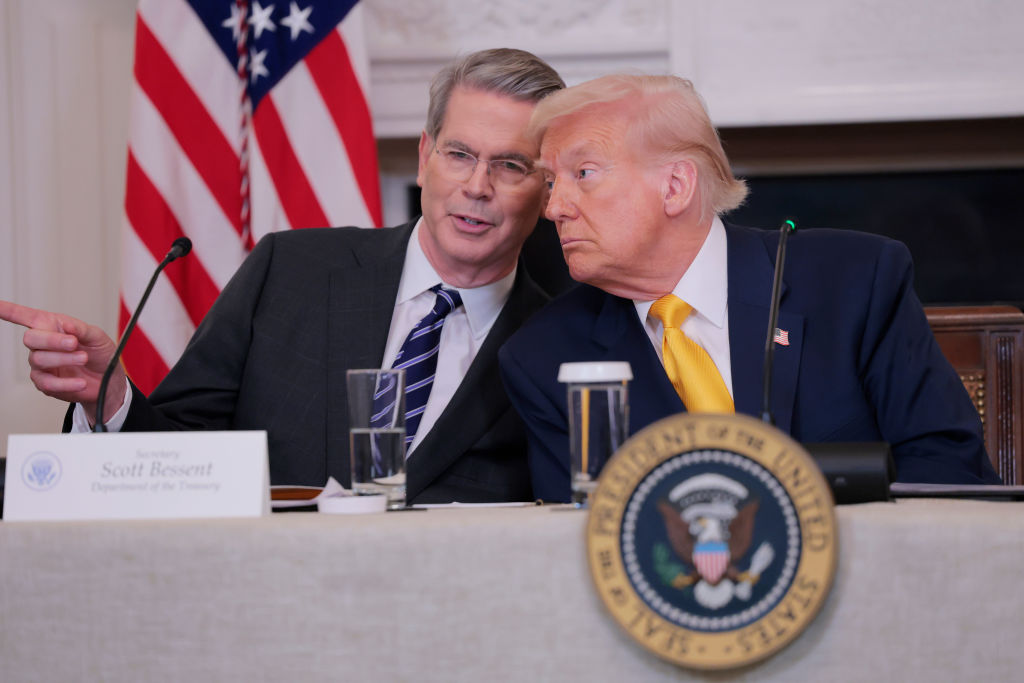
Trump with US Treasury Secretary Scott Bessent last week. Credit: Getty

Trump with US Treasury Secretary Scott Bessent last week. Credit: Getty

March 11 2025 - 1:15pm

The market slump at the beginning of this week came about, simply, because prices were unsustainable. Robert Shiller’s famous CAPE (Cyclically Adjusted Price Earnings) ratio was approaching its historic peak in December — almost as high as during the dot-com bubble, and already higher than during the crises of 1929, 1987, or 2008. This is the only reason why markets ever crash. Everything else is folklore, airtime filler for CNBC or Bloomberg.

Donald Trump plays into this to the extent that his policies will end the long and unsustainable era of massive monetary and fiscal expansion. Team Trump seems serious about cutting the deficit, with Treasury Secretary Scott Bessent providing a target reduction from 6% to 3%. His predecessor Janet Yellen, in contrast, said 6% was perfectly sustainable. When she was a central banker, she also advocated quantitative easing. The markets loved these reflationary policies, and hate it when they end.

Such policies fall into the sustainable-for-long-but-not-forever category, with which we Europeans are only too familiar. Into this box we can also place the vast majority of Angela Merkel’s policies during her time as German chancellor: the euro should it continue with a fiscal union forever, and transatlantic dependencies in security and economics. What makes these cases so treacherous is that the resulting delusions can be sustained for very long periods, as with Merkel’s 16-year term, and still prove unsustainable.

Markets remain a superior method of organizing capital allocation, but they are poor judges of sustainability. What’s more, they are prone to herd behavior. Take interest rate markets, which were optimistic in 2022 when rates started to rise, and over-optimistic on the way down. During both phases, they biased in favor of lower inflation and lower interest rates. The Harvard economist Jason Furman was therefore wrong to suggest yesterday that “if you are implementing a credible plan that entails short-term pain for long-term gain, the stock market will go up not down.”

By that definition, the markets should have reacted to quantitative easing with a downturn, on the grounds that these policies lead to inequality, political radicalization, the end of globalization, and possibly even the breakdown of NATO. At the time, however, markets were entirely unreceptive to any notion of negative long-term consequences from these policies.

Trump’s policies should then be seen as a trigger, not a cause. He is closer to the proverbial central banker who takes the punch bowl away before the party gets going, rather than the perpetrator of a wantonly reckless political act. Bessent’s four-year deficit reduction plan may well trigger a market crash, but ending an unsustainable policy is not unreasonable, even in these circumstances.

The jury on Elon Musk’s DOGE experiment is still out, but the forecasts that it would go up in smoke early on have clearly not been vindicated. Tariffs may be a crude way of addressing global imbalances, but it’s also true that nothing else has worked. The question which remains is whether the US President will fold. Trump said this week that he was willing to accept a recession and a one-off hike in import prices due to tariffs. This was an interesting comment, at least in how different it was to the politician to whom we’ve become accustomed over the last decade. Is it possible Trump recognized that, in order to implement his policies, he cannot just roll with the markets?

This is an edited version of an article which originally appeared in the Eurointelligence newsletter.


Wolfgang Munchau is the Director of Eurointelligence and an UnHerd columnist.

EuroBriefing

China is threatening America in the AI race

Reports sugget Zhipu AI  has released a new model that can rival leading US systems. Credit: Getty

Reports sugget Zhipu AI has released a new model that can rival leading US systems. Credit: Getty

July 1 2026 - 10:18am

China is trying to catch up with America on artificial intelligence. The Wall Street Journal has reported that Zhipu AI — one of China’s six “AI tiger” LLMs — has released a new model that can rival leading US systems, including Anthropic’s Mythos, in cybersecurity tasks such as pinpointing security bugs. While this marks a milestone in China’s drive to catch up with Western AI capabilities, strong performance on a single benchmark does not mean it has taken the lead. Chinese models still lag behind their Western counterparts in broader capabilities, such as autonomous operation. Skepticism is therefore warranted before resorting to hysterical conclusions, but complacency about the geopolitical implications of China’s AI advances would be an even greater mistake.

On the infrastructure side, Chinese AI is still constrained by access to advanced chips, with American labs way ahead in computing capacity as well as investment. Analysis from earlier this year suggests that Chinese models are likely to be at least a few months behind those in the US. But they are still continuing to make progress, or that the geopolitical importance of AI will be decided only by whose LLM has ventured deeper into the technological frontier. The practical applications of AI, countries’ to capture foreign markets, and the application of AI into the real economy will matter just as much.

Here, China may hold an advantage. As with its dominance across many critical supply chains, Beijing may not need to produce the most advanced AI systems — only those that are affordable and widely deployable. In doing so, it could consolidate global influence by supplying functional, low-cost AI at scale.

Beijing seems to be pursuing exactly that path, developing an AI “open-source” strategy that offers affordable, widely available AI models for companies and individuals to use and modify as they wish. The production of the DeepSeek AI model, which matched the performance of Silicon Valley tools such as ChatGPT at a fraction of the cost for users, created goodwill among Chinese models with developers.

The four most popular models on OpenRouter, an AI hardware platform for developers, are now all Chinese. The goal for China is not only to win the frontier-model race, but to make its systems the default layer of AI adoption across industries and global markets. For most economies, the choice is increasingly between an affordable tool they can deploy now and a more robust one that may be out of reach.

And while the countries adopting Chinese models may be exposed to political pressure and cyber threats from Beijing, safer and more capable alternatives matter little if they are unaffordable. American AI companies are already under pressure to monetize products whose operating costs are rising. If Chinese open-source models become the cheap default for startups, universities, governments and businesses across the developing world, then America’s AI lead will be eroded from below.

Perhaps more concerning for America in the long run is how AI can give Chinese manufacturing even more strength, through the ongoing integration of AI as a general-purpose technology. China’s new Five-Year Plan mentioned AI more than 50 times and includes an “AI+” action plan aimed at spreading AI across the economy.

Beijing has been pioneering automation of its critical infrastructure for years, with promising recent results in increasing warplane production capacity. In that regard, China’s open-model strategy and manufacturing dominance will reinforce each other. Cheap, adaptable models accelerate deployment across the real economy while those deployments generate real-world data and use cases that can feed back into further model improvement.

The United States should not dismiss the importance of its lead in the AI race. That lead worries Beijing, not least because a more automated Chinese economy would also become more vulnerable to AI-generated cyber threats. But nor should Washington assume that China cannot catch up with American capabilities over time.

This AI competition represents part of a broader struggle over tech supply chains and geopolitical influence. Decisions over whether to adopt US or Chinese models could produce a more fragmented global reality, with different regions relying on different cloud providers, chips and security structures. The result will likely be a global economy which is divided into competing spheres, rather than one which produces a single winner.


Miquel Vila is a political and geopolitical risk consultant focusing on industrial strategy, critical infrastructure and global supply chains.

miquelvilam