




X Close

Does Ahmed al-Sharaa control Syria?

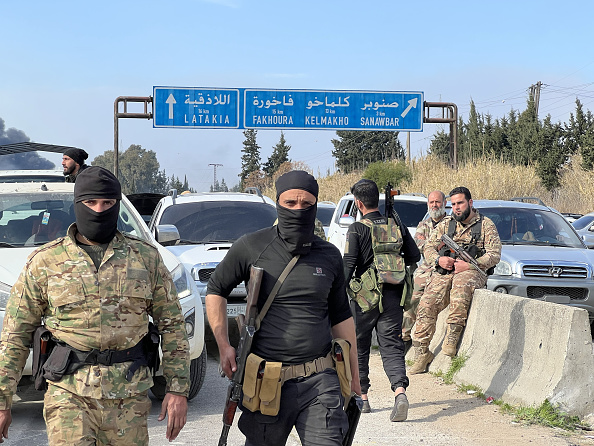
Widespread violence has returned to Syria. Credit: Getty

Widespread violence has returned to Syria. Credit: Getty

10 March 2025 - 2:00pm

With his planned limited offensive in northwestern Syria unexpectedly escalating to the seizure of Damascus, former al-Qaeda insurgent and aspiring technocrat Ahmed al-Sharaa may find that conquering Syria is an easier task than ruling it. At the time of the lightning HTS offensive last December, former president Bashar al-Assad’s security forces simply melted away without a fight, even in his ethnic Alawite heartlands of Latakia and Tartus. But when armed Alawite elements ambushed HTS security forces in Latakia late last week, it unlocked a cycle of ethnosectarian violence already casting a pall on the new regime’s international legitimacy.

The new government’s counterinsurgency efforts swiftly degenerated into sectarian reprisals, with more than 700 Alawite civilians reported dead and brutal footage of summary executions posted online by the perpetrators. Sunni Arab advocates for the revolution now find themselves watching footage of the government they support throwing unguided barrel bombs out of helicopters, just like the old regime they spent more than a decade railing against.

Yet despite the flood of journalists flocking into postwar Damascus to celebrate the new Syria, basic facts about the weekend’s events remain strikingly opaque. Firstly, how much control does the new government in Damascus actually wield over the security forces acting under its name in the northwest? And secondly, are the armed Alawite opposition really Assad loyalists, as claimed by government supporters, or do they represent Alawite ethnic mobilisation independent of the fallen regime? The answers to these questions will lead Western and regional powers to pursue very different attitudes to engagement with the new government.

If the perpetrators of these war crimes are acting under Sharaa’s sanction, then all the recent talk of humane and technocratic governance by the new regime rings hollow. Yet if the perpetrators are outside the Damascus government’s control, then Sharaa’s grip on power is surely weaker than many external observers assumed. Neither option bodes well for the new leader’s prospects of stable domestic rule or widespread international legitimacy.

Early indications are that, rather than HTS’s core security forces, the worst violence was carried out by foreign jihadist factions long taken under the group’s wing. Also involved were the predominantly ethnically Turkmen “Syrian National Army” militias armed and funded by Turkey, which control much of northern Syria and have a long and bloody record of human rights abuses. Either way, the massacre of Syrian minorities in the northwest will do little to persuade the autonomous Druze militias in the South and the Kurdish-led Syrian Democratic Forces in the northeast to disarm and fold themselves into Sharaa’s new regime.

For the European Union, whose overriding interest in Syria is in preventing a new flow of refugees towards the continent, and the return of those already here, humanitarian concerns appear best swept under the rug for now in the interests of stabilising the new government. But for the Trump administration, long sceptical of the Syrian rebels, the horror on the coast will do little to win the new regime recognition or sanctions relief. Israel, slowly occupying new areas of southern Syria and declaring a sphere of interest up to the suburbs of Damascus in the proclaimed interests of the Druze minority, will now likely be given an even freer hand by the US. Having condemned the atrocities on Sunday, asserting that “the United States stands with Syria’s religious and ethnic minorities”, Washington will join with Moscow to bring the matter to the UN Security Council later today.

Attempting to assert control over the lawless Turkish-backed SNA forces in the north, which significantly outnumber his own core HTS troops, Sharaa must also juggle the Israeli incursion in the south and the powerful and still-autonomous Kurdish-led forces in the northeast, which continues to host both American and Russian military missions.

Syria’s confessional and ethnic patchwork of peoples has always been a source of both national pride and political instability: the existence of the collapsed Baathist regime represented one brutal attempt to manage such a divided country. In consolidating power at the centre, Sharaa now finds himself, like many a Syrian ruler before him, struggling to manage the country’s diverse and heavily-armed periphery.


Aris Roussinos is an UnHerd columnist and a former war reporter.

arisroussinos

China is threatening America in the AI race

Reports sugget Zhipu AI  has released a new model that can rival leading US systems. Credit: Getty

Reports sugget Zhipu AI has released a new model that can rival leading US systems. Credit: Getty

1 July 2026 - 10:18am

China is trying to catch up with America on artificial intelligence. The Wall Street Journal has reported that Zhipu AI — one of China’s six “AI tiger” LLMs — has released a new model that can rival leading US systems, including Anthropic’s Mythos, in cybersecurity tasks such as pinpointing security bugs. While this marks a milestone in China’s drive to catch up with Western AI capabilities, strong performance on a single benchmark does not mean it has taken the lead. Chinese models still lag behind their Western counterparts in broader capabilities, such as autonomous operation. Skepticism is therefore warranted before resorting to hysterical conclusions, but complacency about the geopolitical implications of China’s AI advances would be an even greater mistake.

On the infrastructure side, Chinese AI is still constrained by access to advanced chips, with American labs way ahead in computing capacity as well as investment. Analysis from earlier this year suggests that Chinese models are likely to be at least a few months behind those in the US. But they are still continuing to make progress, or that the geopolitical importance of AI will be decided only by whose LLM has ventured deeper into the technological frontier. The practical applications of AI, countries’ to capture foreign markets, and the application of AI into the real economy will matter just as much.

Here, China may hold an advantage. As with its dominance across many critical supply chains, Beijing may not need to produce the most advanced AI systems — only those that are affordable and widely deployable. In doing so, it could consolidate global influence by supplying functional, low-cost AI at scale.

Beijing seems to be pursuing exactly that path, developing an AI “open-source” strategy that offers affordable, widely available AI models for companies and individuals to use and modify as they wish. The production of the DeepSeek AI model, which matched the performance of Silicon Valley tools such as ChatGPT at a fraction of the cost for users, created goodwill among Chinese models with developers.

The four most popular models on OpenRouter, an AI hardware platform for developers, are now all Chinese. The goal for China is not only to win the frontier-model race, but to make its systems the default layer of AI adoption across industries and global markets. For most economies, the choice is increasingly between an affordable tool they can deploy now and a more robust one that may be out of reach.

And while the countries adopting Chinese models may be exposed to political pressure and cyber threats from Beijing, safer and more capable alternatives matter little if they are unaffordable. American AI companies are already under pressure to monetize products whose operating costs are rising. If Chinese open-source models become the cheap default for startups, universities, governments and businesses across the developing world, then America’s AI lead will be eroded from below.

Perhaps more concerning for America in the long run is how AI can give Chinese manufacturing even more strength, through the ongoing integration of AI as a general-purpose technology. China’s new Five-Year Plan mentioned AI more than 50 times and includes an “AI+” action plan aimed at spreading AI across the economy.

Beijing has been pioneering automation of its critical infrastructure for years, with promising recent results in increasing warplane production capacity. In that regard, China’s open-model strategy and manufacturing dominance will reinforce each other. Cheap, adaptable models accelerate deployment across the real economy while those deployments generate real-world data and use cases that can feed back into further model improvement.

The United States should not dismiss the importance of its lead in the AI race. That lead worries Beijing, not least because a more automated Chinese economy would also become more vulnerable to AI-generated cyber threats. But nor should Washington assume that China cannot catch up with American capabilities over time.

This AI competition represents part of a broader struggle over tech supply chains and geopolitical influence. Decisions over whether to adopt US or Chinese models could produce a more fragmented global reality, with different regions relying on different cloud providers, chips and security structures. The result will likely be a global economy which is divided into competing spheres, rather than one which produces a single winner.


Miquel Vila is a political and geopolitical risk consultant focusing on industrial strategy, critical infrastructure and global supply chains.

miquelvilam