




X Close

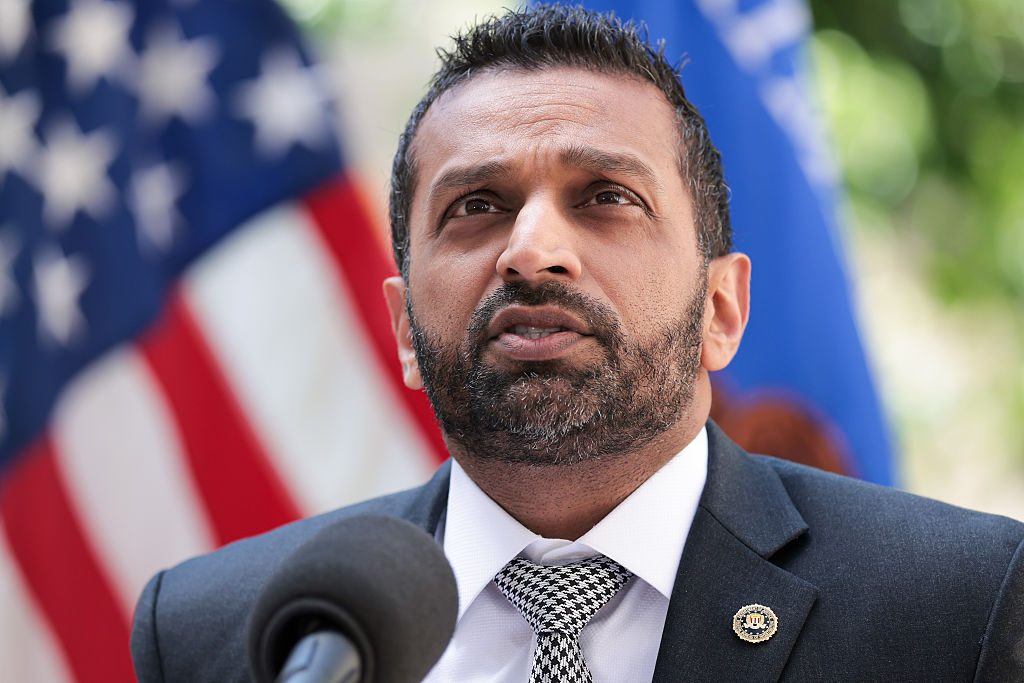
Did Epstein files turn Kash Patel into a ‘Deep State traitor’?

From conspiracy theorist to institutional loyalist. Credit: Getty

From conspiracy theorist to institutional loyalist. Credit: Getty

8 July 2025 - 5:30pm

Last month, Elon Musk lobbed what he called a “really big bomb” at Donald Trump in the midst of their ongoing public feud. The world’s richest man claimed the President was “in the Epstein files” and that this was “the real reason they have not been made public”. Within 48 hours, Musk had deleted the posts and several others calling for Trump’s impeachment. But the damage was done — not to Trump, but to the conspiracy theories which have swirled since Jeffrey Epstein’s death in 2019.

Trump’s Justice Department has now published a two-page memo stating conclusively that Epstein died by suicide. The document also maintained the financier had no “client list”, ran no blackmail operation, and wasn’t murdered by shadowy forces protecting the powerful. The administration even released enhanced surveillance footage showing no one entered Epstein’s cell the night he died.

What makes this official debunking so compelling isn’t the findings themselves, but who’s delivering them. FBI Director Kash Patel and Deputy Director Dan Bongino spent years building their brands as MAGA media stars by discussing these exact theories. Now these same men sit in the J. Edgar Hoover Building insisting there’s nothing to see. “I have seen the whole file. He killed himself,” Bongino told Fox News in May.

The reversal warrants attention, given what we know about Trump’s own relationship with Epstein. In recordings made by author Michael Wolff, Epstein claimed he was “Donald Trump’s closest friend for 10 years” before their friendship ended over a Palm Beach property dispute. Trump himself called Epstein a “terrific guy” in 2002, and they partied together at Mar-a-Lago throughout the Nineties.

Before joining the administration, Bongino played clips on his January 2024 podcast of journalists claiming Epstein was “100%” murdered “because he made his whole living blackmailing people”, telling his millions of listeners these claims were “super important”. Last February he promised: “I’m not ever gonna let this story go.”

Patel, meanwhile, appeared on pro-Trump influencer Benny Johnson’s YouTube show in 2023, demanding the FBI “put on your big-boy pants and let us know who the paedophiles are”. His books about “government gangsters” and appearances on Right-wing media circuits transformed him from an obscure National Security Council staffer into a MAGA celebrity earning substantial speaking fees and book advances.

Their sudden conversion has not gone unnoticed. InfoWars host Alex Jones fumed that they were “making fools out of themselves,” while Tucker Carlson wondered aloud: “What was that?!” Some popular far-Right figures now accuse Patel and Bongino of becoming “Deep State traitors”.

When Democrats demanded the Epstein files be released to prove or disprove Musk’s accusation about Trump, the administration responded with its definitive memo. Patel had promised Fox News in late May that he was “not going to withhold information from the American public, ever”. But he was also “not going to rush to get it out there in a format in which they can’t rely on it.” And there it was: we’ve reviewed the footage, and there’s nothing to see here.

This isn’t how Patel and Bongino talked when they were building their brands. As influencers, they understood that Epstein theories tied to Bill Clinton and other Left-leaning figures represented rocket fuel for audience engagement, much as tying Epstein to Right-wing figures had been for a “dirtbag Left” podcast such as TrueAnon. MAGA-aligned podcaster Tim Pool said the base feels “Dan and Kash aren’t doing the job, that they’re beholden to some unseen powers.”

The pair’s transformation from conspiracy promoters to institutional defenders reveals how thoroughly the system can digest even its fiercest critics. What served as political ammunition for outsiders became a liability once they stepped inside. Now, with official certainty from former conspiracy theorists themselves, the Trump administration can bring much of that inconvenient truth-seeking, along with criticism from the likes of Musk, to an end.


Oliver Bateman is a historian and journalist based in Pittsburgh. He blogs, vlogs, and podcasts at his Substack, Oliver Bateman Does the Work

MoustacheClubUS

China is threatening America in the AI race

Reports sugget Zhipu AI  has released a new model that can rival leading US systems. Credit: Getty

Reports sugget Zhipu AI has released a new model that can rival leading US systems. Credit: Getty

1 July 2026 - 10:18am

China is trying to catch up with America on artificial intelligence. The Wall Street Journal has reported that Zhipu AI — one of China’s six “AI tiger” LLMs — has released a new model that can rival leading US systems, including Anthropic’s Mythos, in cybersecurity tasks such as pinpointing security bugs. While this marks a milestone in China’s drive to catch up with Western AI capabilities, strong performance on a single benchmark does not mean it has taken the lead. Chinese models still lag behind their Western counterparts in broader capabilities, such as autonomous operation. Skepticism is therefore warranted before resorting to hysterical conclusions, but complacency about the geopolitical implications of China’s AI advances would be an even greater mistake.

On the infrastructure side, Chinese AI is still constrained by access to advanced chips, with American labs way ahead in computing capacity as well as investment. Analysis from earlier this year suggests that Chinese models are likely to be at least a few months behind those in the US. But they are still continuing to make progress, or that the geopolitical importance of AI will be decided only by whose LLM has ventured deeper into the technological frontier. The practical applications of AI, countries’ to capture foreign markets, and the application of AI into the real economy will matter just as much.

Here, China may hold an advantage. As with its dominance across many critical supply chains, Beijing may not need to produce the most advanced AI systems — only those that are affordable and widely deployable. In doing so, it could consolidate global influence by supplying functional, low-cost AI at scale.

Beijing seems to be pursuing exactly that path, developing an AI “open-source” strategy that offers affordable, widely available AI models for companies and individuals to use and modify as they wish. The production of the DeepSeek AI model, which matched the performance of Silicon Valley tools such as ChatGPT at a fraction of the cost for users, created goodwill among Chinese models with developers.

The four most popular models on OpenRouter, an AI hardware platform for developers, are now all Chinese. The goal for China is not only to win the frontier-model race, but to make its systems the default layer of AI adoption across industries and global markets. For most economies, the choice is increasingly between an affordable tool they can deploy now and a more robust one that may be out of reach.

And while the countries adopting Chinese models may be exposed to political pressure and cyber threats from Beijing, safer and more capable alternatives matter little if they are unaffordable. American AI companies are already under pressure to monetize products whose operating costs are rising. If Chinese open-source models become the cheap default for startups, universities, governments and businesses across the developing world, then America’s AI lead will be eroded from below.

Perhaps more concerning for America in the long run is how AI can give Chinese manufacturing even more strength, through the ongoing integration of AI as a general-purpose technology. China’s new Five-Year Plan mentioned AI more than 50 times and includes an “AI+” action plan aimed at spreading AI across the economy.

Beijing has been pioneering automation of its critical infrastructure for years, with promising recent results in increasing warplane production capacity. In that regard, China’s open-model strategy and manufacturing dominance will reinforce each other. Cheap, adaptable models accelerate deployment across the real economy while those deployments generate real-world data and use cases that can feed back into further model improvement.

The United States should not dismiss the importance of its lead in the AI race. That lead worries Beijing, not least because a more automated Chinese economy would also become more vulnerable to AI-generated cyber threats. But nor should Washington assume that China cannot catch up with American capabilities over time.

This AI competition represents part of a broader struggle over tech supply chains and geopolitical influence. Decisions over whether to adopt US or Chinese models could produce a more fragmented global reality, with different regions relying on different cloud providers, chips and security structures. The result will likely be a global economy which is divided into competing spheres, rather than one which produces a single winner.


Miquel Vila is a political and geopolitical risk consultant focusing on industrial strategy, critical infrastructure and global supply chains.

miquelvilam