




X Close

David Lammy cannot explain away two-tier policing

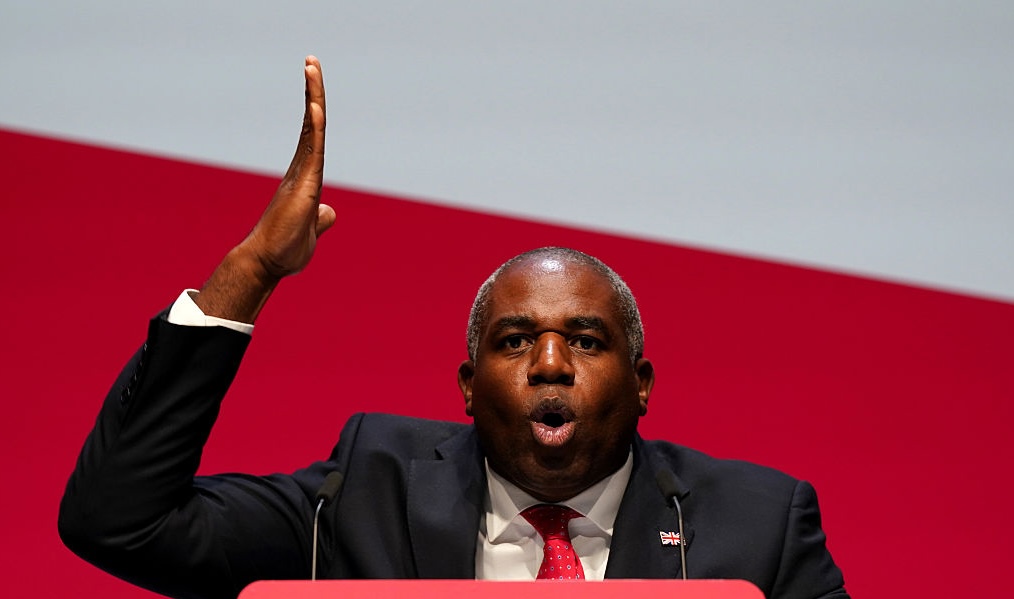
Lammy is ignoring the elephant in the room. Credit: Getty

Lammy is ignoring the elephant in the room. Credit: Getty

8 June 2026 - 7:00am

Deputy Prime Minister David Lammy’s contribution to the two-tier policing debate involved a typical lawyer’s answer: “Look, there are particular circumstances in which, of course, the police have to go a bit deeper than treating everybody equally,” he told the BBC. Lammy then suggested exempting an Orthodox Jew from attending a police interview on the sabbath as an example.

This was, at best, a facile attempt to distract attention from the elephant in the room: the large-scale adoption of critical race theory by British police forces. Lammy, a veteran antiracism campaigner, appears to be trapped in the “Equity Loop” — one that routinely mistakes what many would describe as “reasonableness” for naked impartiality. Given the broader issues raised by Henry Nowak’s murder, such as minor adjustments considering the sensitivities of religious minorities, are relative trifles by comparison.

As a former police officer, I hold unfashionable views on the issue of two-tier policing. As per my initial training, they’re influenced by Peelite principles, discretion and common sense. Sadly, thanks to critical race theory, policing by consent has been increasingly replaced by policing by diktat and fear — a semi-informal type of political control. Having spent five years investigating police wrongdoing, I watched the video of Henry Nowak’s arrest with interest. I would suggest that, despite the complexity of the situation faced by officers, there is evidence of confirmation bias on display. Where did the confirmation bias originate? Why did the officer who handcuffed Henry ignore his pleas that he’d been stabbed? Triage for stab injuries is a basic tenet of police Emergency Life Support training. These are entirely fair questions. It’s also an entirely different question from sparing Orthodox Jews police interviews on Saturdays.

This is where Lammy and his colleagues find themselves on the horns of a dilemma. Policing’s increasingly Leftward turn may have taken place under a hapless Conservative government, but it has been accelerated by the enthusiasm of Labour-aligned activists and public sector professionals. I have little doubt that David Lammy and other Labour ministers privately sympathise with the assumptions underlying critical race theory, which treats many social norms, institutions and categories as cultural constructs. For much of the modern Left, these ideas have become articles of faith. By acknowledging evidence of two-tier policing, Lammy would not merely be criticising the police; he would be challenging a worldview shared by many on his own side.

Expect to see British criminal justice elites circling wagons to protect the 30-year Macpherson project, one that saw police chiefs quite literally take the knee. Careers have been made and empires built in places like the Home Office and the College of Policing. With reputations at stake, chief officers will cite misunderstandings of police race action plans, order reviews of first aid training and launch e-learning packages covering initial investigation by first responders.

These are all perfectly valid concerns, along with the consequences of austerity on police recruitment, training and retention. Yet none of them address a wider issue, one brewing for a decade or more around the mounting sense of unevenness in policing towards white victims and protests. Instead, Labour accused critics of bad faith and racism, citing the interference of bogeymen like Elon Musk and JD Vance. And so, political vanity and hubris ensure the already battered reputation of British policing degrades even further.


Dominic Adler is a writer and former detective in the Metropolitan Police. He worked in counterterrorism, anticorruption and criminal intelligence, and now discusses policing on his Substack.

China is threatening America in the AI race

Reports sugget Zhipu AI  has released a new model that can rival leading US systems. Credit: Getty

Reports sugget Zhipu AI has released a new model that can rival leading US systems. Credit: Getty

1 July 2026 - 10:18am

China is trying to catch up with America on artificial intelligence. The Wall Street Journal has reported that Zhipu AI — one of China’s six “AI tiger” LLMs — has released a new model that can rival leading US systems, including Anthropic’s Mythos, in cybersecurity tasks such as pinpointing security bugs. While this marks a milestone in China’s drive to catch up with Western AI capabilities, strong performance on a single benchmark does not mean it has taken the lead. Chinese models still lag behind their Western counterparts in broader capabilities, such as autonomous operation. Skepticism is therefore warranted before resorting to hysterical conclusions, but complacency about the geopolitical implications of China’s AI advances would be an even greater mistake.

On the infrastructure side, Chinese AI is still constrained by access to advanced chips, with American labs way ahead in computing capacity as well as investment. Analysis from earlier this year suggests that Chinese models are likely to be at least a few months behind those in the US. But they are still continuing to make progress, or that the geopolitical importance of AI will be decided only by whose LLM has ventured deeper into the technological frontier. The practical applications of AI, countries’ to capture foreign markets, and the application of AI into the real economy will matter just as much.

Here, China may hold an advantage. As with its dominance across many critical supply chains, Beijing may not need to produce the most advanced AI systems — only those that are affordable and widely deployable. In doing so, it could consolidate global influence by supplying functional, low-cost AI at scale.

Beijing seems to be pursuing exactly that path, developing an AI “open-source” strategy that offers affordable, widely available AI models for companies and individuals to use and modify as they wish. The production of the DeepSeek AI model, which matched the performance of Silicon Valley tools such as ChatGPT at a fraction of the cost for users, created goodwill among Chinese models with developers.

The four most popular models on OpenRouter, an AI hardware platform for developers, are now all Chinese. The goal for China is not only to win the frontier-model race, but to make its systems the default layer of AI adoption across industries and global markets. For most economies, the choice is increasingly between an affordable tool they can deploy now and a more robust one that may be out of reach.

And while the countries adopting Chinese models may be exposed to political pressure and cyber threats from Beijing, safer and more capable alternatives matter little if they are unaffordable. American AI companies are already under pressure to monetize products whose operating costs are rising. If Chinese open-source models become the cheap default for startups, universities, governments and businesses across the developing world, then America’s AI lead will be eroded from below.

Perhaps more concerning for America in the long run is how AI can give Chinese manufacturing even more strength, through the ongoing integration of AI as a general-purpose technology. China’s new Five-Year Plan mentioned AI more than 50 times and includes an “AI+” action plan aimed at spreading AI across the economy.

Beijing has been pioneering automation of its critical infrastructure for years, with promising recent results in increasing warplane production capacity. In that regard, China’s open-model strategy and manufacturing dominance will reinforce each other. Cheap, adaptable models accelerate deployment across the real economy while those deployments generate real-world data and use cases that can feed back into further model improvement.

The United States should not dismiss the importance of its lead in the AI race. That lead worries Beijing, not least because a more automated Chinese economy would also become more vulnerable to AI-generated cyber threats. But nor should Washington assume that China cannot catch up with American capabilities over time.

This AI competition represents part of a broader struggle over tech supply chains and geopolitical influence. Decisions over whether to adopt US or Chinese models could produce a more fragmented global reality, with different regions relying on different cloud providers, chips and security structures. The result will likely be a global economy which is divided into competing spheres, rather than one which produces a single winner.


Miquel Vila is a political and geopolitical risk consultant focusing on industrial strategy, critical infrastructure and global supply chains.

miquelvilam