




X Close

Could lame-duck Biden derail Democrats’ campaign?

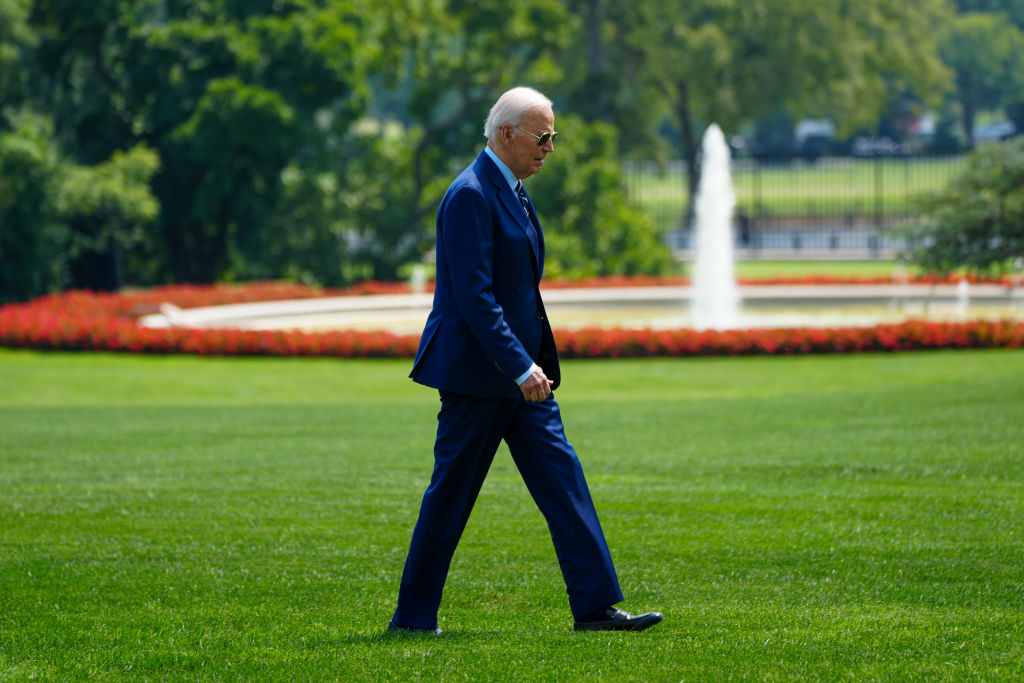
Damage limitation is the Democrats' tactic. Credit:   Getty

Damage limitation is the Democrats’ tactic. Credit: Getty

12 August 2024 - 3:30pm

Over the weekend, footage circulated that showed President Joe Biden stretched out in a chair on a Delaware beach. Since dropping his reelection bid, Biden has further withdrawn from the public eye. Democrats were clamouring for him to be more vigorous when he was still in the race for the White House, but many of them might be hoping that he stays on the beach now that he has become a lame duck.

Or is it maimed duck? Normally, a lame-duck president’s political party tries to gently usher him off the stage, but Biden’s exit has been much more abrupt. In one of the most ruthless displays of raw power-politics in recent American history, his fellow Democrats essentially ejected Biden from his own reelection bid. He groused on CBS’s Sunday Morning programme that it was indeed congressional Democrats who pushed him aside, and the fact that he has been defenestrated by his own party will shape the rest of his presidency.

Last week, CNN reported on what the Biden team projected would be the “four pillars” of the final months of his presidency: “[T]he continued implementation of key legislation; lowering costs and growing the economy through additional moves on student debt relief and efforts to bring down prescription drug prices; defending personal freedoms and civil rights by calling out hate and extremism; and ensuring US strength, security and leadership in the world.”

Both the overall contours and the particular details of this approach are revealing. Notice that the White House here is not talking about big, legislative wins. Instead, it’s focused on executive rule-making, messaging strategies, and foreign-policy endeavours.

The specific executive actions laid out by the administration correspond to two prongs of Harris’s campaign. Biden’s continued efforts to erase student-loan debt target the college-educated base of the Democratic Party (especially younger voters), and the populist proposal to bring down prescription drug prices echoes Harris’s own attacks on high medical costs. “Calling out hate and extremism” seems a continuation of the “soul of the nation” strategy that has shaped so much of Biden’s message as president. He even leaned into that theme in his Sunday Morning interview, saying that Trump was a “genuine danger to American security” and accusing “Maga Republicans” of having “little regard…for the political institutions” of American democracy. (Ironically, he lobbed this charge just after attacking the Supreme Court as “out of whack.”)

Chaos abroad has undermined Biden’s claim of a “return to normalcy,” and the Israel-Hamas war has divided the Democratic coalition. If Biden can achieve a breakthrough in Israel or Ukraine, that could theoretically help Harris. However, the Middle East in particular has often disappointed presidential legacy gambits, as Bill Clinton knows only too well (July 2000’s frantic Camp David Summit ended in frustration).

On many domestic issues, though, Democrats may hope that Biden provides messaging nudges at most — more to draw contrasts with Trump than to set the political agenda. Even more than most vice presidents who have seized their party’s presidential nomination, Harris has tried to distance herself from her former running mate. Part of Harris’s campaign reset involves positioning herself as a de facto non-incumbent in order to avoid being tied to Biden’s unpopular record.

If Biden dominates the headlines with some expansive executive action, that risks dragging Harris into a debate about whether she supports him or not. Already, Harris has endorsed Biden’s Supreme Court “reform” gesture — a move that might charge up the activist Left (which wants to take a wrecking ball to the courts) but could also drive away moderate voters wary of more radical disruption. Additional policy markers from Biden could present more political headaches for Harris.

Presidents conventionally use their lame-duck period as a time to try to solidify their legacy. Biden has defined his presidency in opposition to Trump, so his legacy is partly tied to November’s election results. His allies might view a Harris win as the ultimate vindication of the Biden years — and, now that Biden has dropped out, a Harris defeat could at least allow for the bitter balm of could have been (if only everyone had listened to Joe!). In the meantime, the waves keep lapping the shore of Rehoboth Beach, as the Biden presidency is slowly, inexorably swept out to sea.


Fred Bauer is a writer from New England.

fredbauerblog

China is threatening America in the AI race

Reports sugget Zhipu AI  has released a new model that can rival leading US systems. Credit: Getty

Reports sugget Zhipu AI has released a new model that can rival leading US systems. Credit: Getty

1 July 2026 - 10:18am

China is trying to catch up with America on artificial intelligence. The Wall Street Journal has reported that Zhipu AI — one of China’s six “AI tiger” LLMs — has released a new model that can rival leading US systems, including Anthropic’s Mythos, in cybersecurity tasks such as pinpointing security bugs. While this marks a milestone in China’s drive to catch up with Western AI capabilities, strong performance on a single benchmark does not mean it has taken the lead. Chinese models still lag behind their Western counterparts in broader capabilities, such as autonomous operation. Skepticism is therefore warranted before resorting to hysterical conclusions, but complacency about the geopolitical implications of China’s AI advances would be an even greater mistake.

On the infrastructure side, Chinese AI is still constrained by access to advanced chips, with American labs way ahead in computing capacity as well as investment. Analysis from earlier this year suggests that Chinese models are likely to be at least a few months behind those in the US. But they are still continuing to make progress, or that the geopolitical importance of AI will be decided only by whose LLM has ventured deeper into the technological frontier. The practical applications of AI, countries’ to capture foreign markets, and the application of AI into the real economy will matter just as much.

Here, China may hold an advantage. As with its dominance across many critical supply chains, Beijing may not need to produce the most advanced AI systems — only those that are affordable and widely deployable. In doing so, it could consolidate global influence by supplying functional, low-cost AI at scale.

Beijing seems to be pursuing exactly that path, developing an AI “open-source” strategy that offers affordable, widely available AI models for companies and individuals to use and modify as they wish. The production of the DeepSeek AI model, which matched the performance of Silicon Valley tools such as ChatGPT at a fraction of the cost for users, created goodwill among Chinese models with developers.

The four most popular models on OpenRouter, an AI hardware platform for developers, are now all Chinese. The goal for China is not only to win the frontier-model race, but to make its systems the default layer of AI adoption across industries and global markets. For most economies, the choice is increasingly between an affordable tool they can deploy now and a more robust one that may be out of reach.

And while the countries adopting Chinese models may be exposed to political pressure and cyber threats from Beijing, safer and more capable alternatives matter little if they are unaffordable. American AI companies are already under pressure to monetize products whose operating costs are rising. If Chinese open-source models become the cheap default for startups, universities, governments and businesses across the developing world, then America’s AI lead will be eroded from below.

Perhaps more concerning for America in the long run is how AI can give Chinese manufacturing even more strength, through the ongoing integration of AI as a general-purpose technology. China’s new Five-Year Plan mentioned AI more than 50 times and includes an “AI+” action plan aimed at spreading AI across the economy.

Beijing has been pioneering automation of its critical infrastructure for years, with promising recent results in increasing warplane production capacity. In that regard, China’s open-model strategy and manufacturing dominance will reinforce each other. Cheap, adaptable models accelerate deployment across the real economy while those deployments generate real-world data and use cases that can feed back into further model improvement.

The United States should not dismiss the importance of its lead in the AI race. That lead worries Beijing, not least because a more automated Chinese economy would also become more vulnerable to AI-generated cyber threats. But nor should Washington assume that China cannot catch up with American capabilities over time.

This AI competition represents part of a broader struggle over tech supply chains and geopolitical influence. Decisions over whether to adopt US or Chinese models could produce a more fragmented global reality, with different regions relying on different cloud providers, chips and security structures. The result will likely be a global economy which is divided into competing spheres, rather than one which produces a single winner.


Miquel Vila is a political and geopolitical risk consultant focusing on industrial strategy, critical infrastructure and global supply chains.

miquelvilam