




X Close

Corporate crypto rush is a recipe for bailouts

'The fact that the strategy has become a Hail Mary for companies in trouble doesn’t commend it as a dynamic approach.' Credit: Getty

‘The fact that the strategy has become a Hail Mary for companies in trouble doesn’t commend it as a dynamic approach.’ Credit: Getty

26 July 2025 - 1:00pm

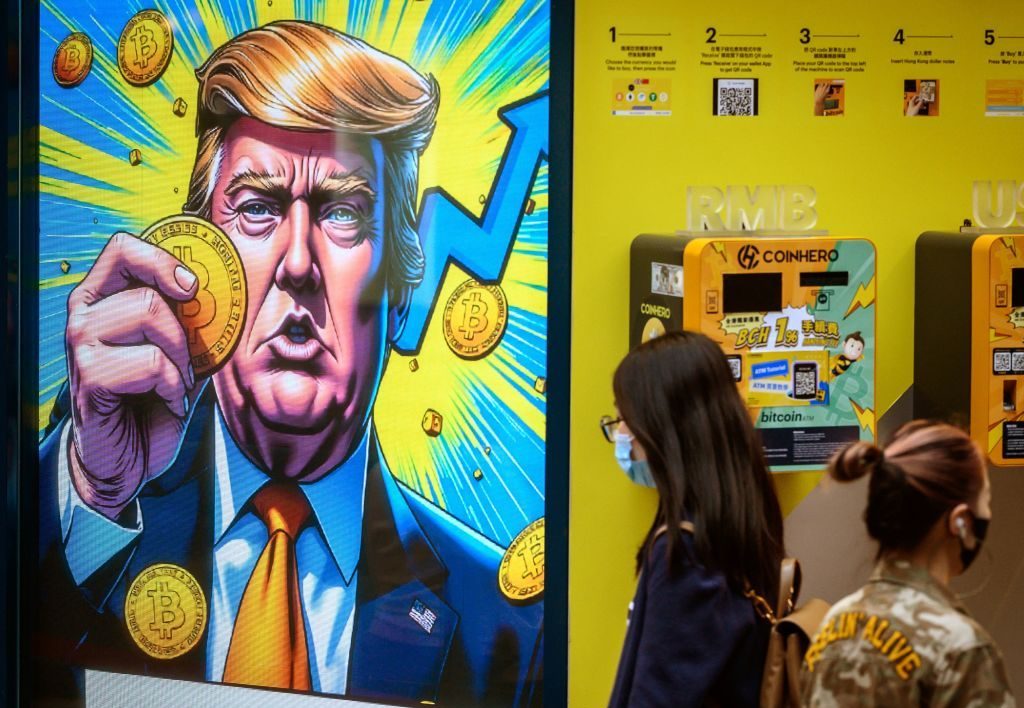
The corporate rush to crypto may be turning into a tsunami. Publicly listed companies which are struggling to turn a profit have now decided to emulate entrepreneur Michael Saylor’s successful strategy for reviving a dying company: loading up on cryptocurrency and riding the boom. It’s a form of circular investing, whereby a company issues shares to buy Bitcoin and then uses its increased holdings to boost share prices, allowing it to issue yet more shares. But what’s novel, and undeniably risky, about this current wave is that firms are eschewing Bitcoin to buy niche currencies or memecoins, such as Donald Trump’s own token, $TRUMP.

Of course, they may reckon they’re gambling with the bank’s money. The assumption driving these high-risk trades would seem to be that, should the market crash, the government will bail them out. Trump has repeatedly shown he’ll use his political power to bolster the fortunes of his friends while punishing his enemies, and his family, along with many of its close associates, would stand to lose a lot of money in a crypto crash. So, for now, this may well be a one-way bet.

Yet, as a comment on the state of the economy, this mania is a worrying sign. The fact that the strategy has become a Hail Mary for companies in trouble doesn’t commend it as a dynamic approach. However, it appears that making money in the real economy has become challenging. For all the hype about the US market setting new records every day, it’s almost entirely an AI story at this stage.

Most of the rapid increase in share values since the start of the year is due to the Magnificent Seven, which now account for nearly one-third of the total value of all publicly listed companies in America. The other 4,700 companies aren’t doing so well. The S&P Midcap 400 index, which provides a snapshot of the health of the companies that dot US high streets, is basically flat for the year and down since Trump took office. That squares with an increasing slew of reports pointing to an economy in which activity is slowing but prices are rising.

It also bears noting that the current rally is being driven almost entirely by retail investors. Over the last half year, institutional investors have been selling but retail investors have been buying the dips and turning handsome profits. But that may end in tears. Research from earlier this year has shown that when retail investors go to war with institutional investors, they usually end up losing big.

Barring a major breakthrough that widens the gains of AI beyond the narrow circle of the Magnificent Seven to the economy as a whole, the market and economy will eventually realign — and it will probably be the former which suffers. Given that even within the crypto sector the new rush to niche products is seen as a loser, it seems likely this sub-sector will be in the front line of the damage.

When that happens, the government and central bank will have to decide whether to let the free market rule, or to once again socialise investors’ losses as was done in 2008. Given that the bailouts back then drove the popular outrage which eventually led to Trump’s rise, it would be a supreme irony if when the moment comes, the President decides he is on the side of the establishment after all. But that’s the bet investors appear to have made.


John Rapley is an author and academic who divides his time between London, Johannesburg and Ottawa. His books include Why Empires Fall: Rome, America and the Future of the West (with Peter Heather, Penguin, 2023) and Twilight of the Money Gods: Economics as a Religion (Simon & Schuster, 2017).

jarapley

China is threatening America in the AI race

Reports sugget Zhipu AI  has released a new model that can rival leading US systems. Credit: Getty

Reports sugget Zhipu AI has released a new model that can rival leading US systems. Credit: Getty

1 July 2026 - 10:18am

China is trying to catch up with America on artificial intelligence. The Wall Street Journal has reported that Zhipu AI — one of China’s six “AI tiger” LLMs — has released a new model that can rival leading US systems, including Anthropic’s Mythos, in cybersecurity tasks such as pinpointing security bugs. While this marks a milestone in China’s drive to catch up with Western AI capabilities, strong performance on a single benchmark does not mean it has taken the lead. Chinese models still lag behind their Western counterparts in broader capabilities, such as autonomous operation. Skepticism is therefore warranted before resorting to hysterical conclusions, but complacency about the geopolitical implications of China’s AI advances would be an even greater mistake.

On the infrastructure side, Chinese AI is still constrained by access to advanced chips, with American labs way ahead in computing capacity as well as investment. Analysis from earlier this year suggests that Chinese models are likely to be at least a few months behind those in the US. But they are still continuing to make progress, or that the geopolitical importance of AI will be decided only by whose LLM has ventured deeper into the technological frontier. The practical applications of AI, countries’ to capture foreign markets, and the application of AI into the real economy will matter just as much.

Here, China may hold an advantage. As with its dominance across many critical supply chains, Beijing may not need to produce the most advanced AI systems — only those that are affordable and widely deployable. In doing so, it could consolidate global influence by supplying functional, low-cost AI at scale.

Beijing seems to be pursuing exactly that path, developing an AI “open-source” strategy that offers affordable, widely available AI models for companies and individuals to use and modify as they wish. The production of the DeepSeek AI model, which matched the performance of Silicon Valley tools such as ChatGPT at a fraction of the cost for users, created goodwill among Chinese models with developers.

The four most popular models on OpenRouter, an AI hardware platform for developers, are now all Chinese. The goal for China is not only to win the frontier-model race, but to make its systems the default layer of AI adoption across industries and global markets. For most economies, the choice is increasingly between an affordable tool they can deploy now and a more robust one that may be out of reach.

And while the countries adopting Chinese models may be exposed to political pressure and cyber threats from Beijing, safer and more capable alternatives matter little if they are unaffordable. American AI companies are already under pressure to monetize products whose operating costs are rising. If Chinese open-source models become the cheap default for startups, universities, governments and businesses across the developing world, then America’s AI lead will be eroded from below.

Perhaps more concerning for America in the long run is how AI can give Chinese manufacturing even more strength, through the ongoing integration of AI as a general-purpose technology. China’s new Five-Year Plan mentioned AI more than 50 times and includes an “AI+” action plan aimed at spreading AI across the economy.

Beijing has been pioneering automation of its critical infrastructure for years, with promising recent results in increasing warplane production capacity. In that regard, China’s open-model strategy and manufacturing dominance will reinforce each other. Cheap, adaptable models accelerate deployment across the real economy while those deployments generate real-world data and use cases that can feed back into further model improvement.

The United States should not dismiss the importance of its lead in the AI race. That lead worries Beijing, not least because a more automated Chinese economy would also become more vulnerable to AI-generated cyber threats. But nor should Washington assume that China cannot catch up with American capabilities over time.

This AI competition represents part of a broader struggle over tech supply chains and geopolitical influence. Decisions over whether to adopt US or Chinese models could produce a more fragmented global reality, with different regions relying on different cloud providers, chips and security structures. The result will likely be a global economy which is divided into competing spheres, rather than one which produces a single winner.


Miquel Vila is a political and geopolitical risk consultant focusing on industrial strategy, critical infrastructure and global supply chains.

miquelvilam