




X Close

Conservative victory in Poland humiliates Donald Tusk

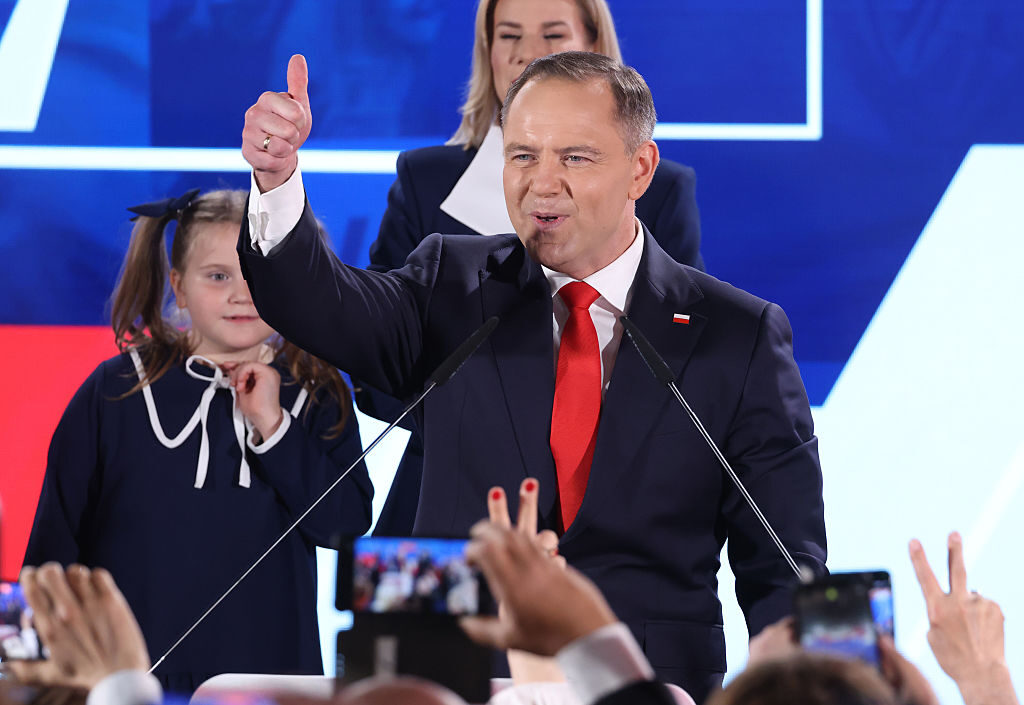
Karol Nawrocki addresses supporters following Poland's election run-off last night. Credit: Getty

Karol Nawrocki addresses supporters following Poland's election run-off last night. Credit: Getty

June 2 2025 - 8:00am

Warsaw

Liberal Warsaw’s sympathies weren’t hard to discern on Sunday night.

As the exit poll for Poland’s presidential election was published, showing Warsaw Mayor Rafal Trzaskowski ahead of his populist rival Karol Nawrocki by the thinnest of margins, a huge roar went up from the crowd assembled in front of the neoclassical presidential palace. “I am so relieved. Poland is a part of Europe and we need a pro-European government,” Martin Zielen, a programmer, told me.

But the euphoria didn’t last long. Two hours later, a more precise exit poll showed Nawrocki, a historian backed by the nationalist Law and Justice party (PiS), ahead. Official results trickled in throughout the night, confirming that Nawrocki would succeed Andrzej Duda, an ally of the same party.

The result means Prime Minister Donald Tusk’s centrist government will continue to be stymied. The presidency is a largely ceremonial role, but the president has crucial veto power over new legislation and can influence foreign policy as head of the armed forces during wartime.

Tusk unseated PiS two years ago in an election that liberals across Europe hoped would herald a retreat of the populist tide across the continent. But Duda used his powers to prevent the new government from implementing its agenda, including rolling back controversial judicial reforms and liberalizing abortion laws. Crucially, Tusk’s four-party coalition lacks the two-thirds majority to overturn the presidential veto.

Nawrocki, who was plucked from relative obscurity to be the PiS-backed candidate, brushed off a series of revelations about his private life during the campaign. These ranged from accusations that he helped arrange prostitutes for guests of a luxury hotel to his dubious acquisition of a flat from a pensioner.

His bitterly fought win guarantees that Tusk will continue to be frustrated for the remainder of his term in office. The president-elect has said his Catholic faith compels him to believe in life from “conception to natural death”, while he opposes the government’s plan to legalize civil partnerships between. Politicians from PiS — which remains the largest party in parliament — openly hope Tusk can be forced out of office, either through a snap election or by cajoling members of other parties to back the opposition.

Nawrocki’s victory is also a win for the international MAGA movement, after a string of recent electoral defeats for Donald Trump-aligned candidates in Australia, Canada and Romania. The final days of the campaign were rocked by the intervention of Kristi Noem, the US Secretary of Homeland Security. Five days before the vote, speaking at a Polish CPAC conference held near the border with Ukraine, Noem described Trzaskowski as a “hopeless leader” and tied the continuation of the US military presence in Poland to Nawrocki’s election.

On Sunday, at a polling station in Ursus, a district of Warsaw, Catholic hymns wafted out of an open window in a communist-era block of flats. Rafal Samojlik told me he was voting for Nawrocki because he is a patriot; Trzaskowski, meanwhile, is a “communist”. Samojlik’s wife Marta, a devout Catholic, said she opposed Trzaskowski’s Civic Coalition “removing religion from schools”.

Oxford-educated Trzaskowski sharply tacked to the Right during the election campaign, seeking to appeal to the conservative towns and villages where he is viewed as a big-city liberal. He pledged to crack down on immigration and courted the voters of far-Right candidate Slawomir Mentzen, who came third. But the strategy failed to pay off, costing him votes from both sides. Many younger voters in Warsaw who’d voted for the far-Left in the first round told me they were frustrated by Trzaskowski’s flip-flopping. In the end, the vast majority of Mentzen’s voters split for Nawrocki.

Tusk — the quintessential Brussels man, president of the EU Council from 2014 to 2019 — had hoped that his ally winning the presidency would finally allow Poland to make its voice heard as a major player in Brussels. Instead, it means the PM will now have to attend EU summits as a virtual lame duck. An added humiliation is that Nawrocki has taken a harsher line on Ukraine than his predecessor, with whom Tusk largely agreed on foreign policy. It seems the long-heralded eastern shift in the EU’s center of gravity will have to wait a little longer.


Ido Vock is a reporter and editor based in Berlin, specialising in Europe’s politics and economy. He was previously a senior journalist at the BBC and Europe correspondent at the New Statesman.

idvck

China is threatening America in the AI race

Reports sugget Zhipu AI  has released a new model that can rival leading US systems. Credit: Getty

Reports sugget Zhipu AI has released a new model that can rival leading US systems. Credit: Getty

July 1 2026 - 10:18am

China is trying to catch up with America on artificial intelligence. The Wall Street Journal has reported that Zhipu AI — one of China’s six “AI tiger” LLMs — has released a new model that can rival leading US systems, including Anthropic’s Mythos, in cybersecurity tasks such as pinpointing security bugs. While this marks a milestone in China’s drive to catch up with Western AI capabilities, strong performance on a single benchmark does not mean it has taken the lead. Chinese models still lag behind their Western counterparts in broader capabilities, such as autonomous operation. Skepticism is therefore warranted before resorting to hysterical conclusions, but complacency about the geopolitical implications of China’s AI advances would be an even greater mistake.

On the infrastructure side, Chinese AI is still constrained by access to advanced chips, with American labs way ahead in computing capacity as well as investment. Analysis from earlier this year suggests that Chinese models are likely to be at least a few months behind those in the US. But they are still continuing to make progress, or that the geopolitical importance of AI will be decided only by whose LLM has ventured deeper into the technological frontier. The practical applications of AI, countries’ to capture foreign markets, and the application of AI into the real economy will matter just as much.

Here, China may hold an advantage. As with its dominance across many critical supply chains, Beijing may not need to produce the most advanced AI systems — only those that are affordable and widely deployable. In doing so, it could consolidate global influence by supplying functional, low-cost AI at scale.

Beijing seems to be pursuing exactly that path, developing an AI “open-source” strategy that offers affordable, widely available AI models for companies and individuals to use and modify as they wish. The production of the DeepSeek AI model, which matched the performance of Silicon Valley tools such as ChatGPT at a fraction of the cost for users, created goodwill among Chinese models with developers.

The four most popular models on OpenRouter, an AI hardware platform for developers, are now all Chinese. The goal for China is not only to win the frontier-model race, but to make its systems the default layer of AI adoption across industries and global markets. For most economies, the choice is increasingly between an affordable tool they can deploy now and a more robust one that may be out of reach.

And while the countries adopting Chinese models may be exposed to political pressure and cyber threats from Beijing, safer and more capable alternatives matter little if they are unaffordable. American AI companies are already under pressure to monetize products whose operating costs are rising. If Chinese open-source models become the cheap default for startups, universities, governments and businesses across the developing world, then America’s AI lead will be eroded from below.

Perhaps more concerning for America in the long run is how AI can give Chinese manufacturing even more strength, through the ongoing integration of AI as a general-purpose technology. China’s new Five-Year Plan mentioned AI more than 50 times and includes an “AI+” action plan aimed at spreading AI across the economy.

Beijing has been pioneering automation of its critical infrastructure for years, with promising recent results in increasing warplane production capacity. In that regard, China’s open-model strategy and manufacturing dominance will reinforce each other. Cheap, adaptable models accelerate deployment across the real economy while those deployments generate real-world data and use cases that can feed back into further model improvement.

The United States should not dismiss the importance of its lead in the AI race. That lead worries Beijing, not least because a more automated Chinese economy would also become more vulnerable to AI-generated cyber threats. But nor should Washington assume that China cannot catch up with American capabilities over time.

This AI competition represents part of a broader struggle over tech supply chains and geopolitical influence. Decisions over whether to adopt US or Chinese models could produce a more fragmented global reality, with different regions relying on different cloud providers, chips and security structures. The result will likely be a global economy which is divided into competing spheres, rather than one which produces a single winner.


Miquel Vila is a political and geopolitical risk consultant focusing on industrial strategy, critical infrastructure and global supply chains.

miquelvilam