



X Close

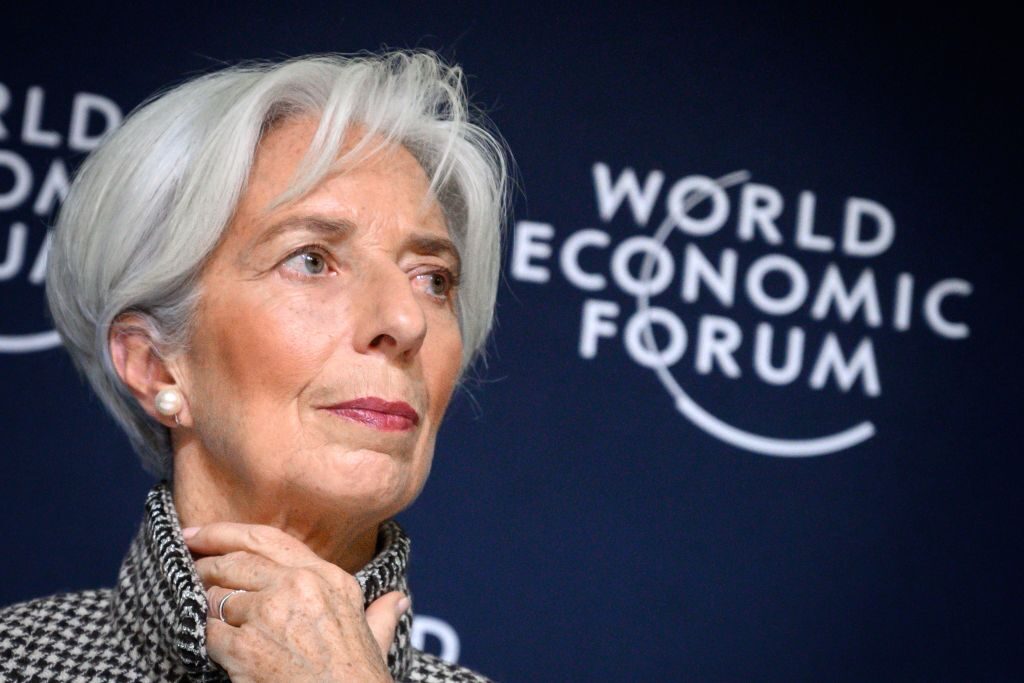
Christine Lagarde will keep WEF stuck in the past

The heir to Schwab? Credit: Getty

The heir to Schwab? Credit: Getty

29 May 2025 - 10:00am

After six years as head of the European Central Bank, Christine Lagarde appears to be failing upwards once again. Klaus Schwab, the founder and former head of the World Economic Forum, claimed yesterday that Lagarde has been in talks to take charge of the organisation, thus ending her career at the ECB two years earlier than expected. Although the ECB has said that Lagarde is “committed” to seeing out her term through 2027, the WEF already seems to be setting the stage for her arrival, reserving an apartment for her at its Villa Mundi complex overlooking Lake Geneva.

Having left his role at the WEF last month in the wake of alleged financial misconduct, Schwab has naturally been on the lookout for a full-time successor, and the fact he seems to have settled on Lagarde is no surprise — like attracts like, after all. Lagarde has been a mainstay of the European technocratic blob for years; and despite her incredibly mixed track record throughout her time at both the International Monetary Fund and the ECB, her place atop the continent’s bureaucratic elite and all it represents is what matters most. For Schwab as much as for Lagarde, institutional continuity is the ultimate end of the incestuousness of the European technocratic class, for whom the WEF is its holy grail.

Lagarde’s apparent selection may be an effort to get the WEF to catch up with the times. She has made some headline-grabbing yet largely cosmetic changes at the ECB, incorporating hot-button issues such as climate change research into the bank’s purview. Just a few days ago, she floated the idea of a “global euro moment” in response to the decline of the dollar brought on by Donald Trump’s tariffs. But despite having earned her stripes as an adaptable liberal, Lagarde remains as much of a gatekeeper of the top-down European economic order as Schwab and her ECB predecessor Mario Draghi, and will ensure that the Davos crowd stays happy and unencumbered by the rapid shifts in the world order happening all around them.

Lagarde’s seemingly inevitable move to the WEF will go ahead despite a long history of scandals, poor decisions, and a stunning lack of trust within the organisations she has run. According to a survey last month, 57% of ECB staff have “low or not trust at all” in Lagarde, while her time at the IMF included controversies around economic assistance for Greece, an enormously bloated loan for Argentina that ended up worsening its debt crisis, and a charge of negligence in connection with a payout to a French businessman. A track record like this wouldn’t lend itself to promotions in any other industry. But in the nebulous world which technocrats call home, these are mere footnotes to a career that has very much delivered on its raison d’être.

Even looking past both her failings and her ability to put up a façade of progress, Lagarde’s selection to head the WEF is emblematic of exactly what makes European organisations so intractable, and thus so unpopular among voters across the political spectrum. It reflects the continued instinct by the elites to look to one of their own in moments of turnover, to ensure that attitudes and policies that have been in place for decades — often with little meaningful internal pushback — remain as ironclad as ever.

On a changing continent, though, making room for new ideas is no longer a luxury but a necessity if institutions such as the WEF want to stay relevant. By choosing Lagarde, Schwab and his cadre have shown they are far from ready to rise to the occasion.


Michal Kranz is a freelance journalist reporting on politics, society and defence in Eastern Europe and the Middle East. He runs The Eastern Flank, a Substack newsletter focused on Eastern European geopolitics.
Michal_Kranz

China is threatening America in the AI race

Reports sugget Zhipu AI  has released a new model that can rival leading US systems. Credit: Getty

Reports sugget Zhipu AI has released a new model that can rival leading US systems. Credit: Getty

1 July 2026 - 10:18am

China is trying to catch up with America on artificial intelligence. The Wall Street Journal has reported that Zhipu AI — one of China’s six “AI tiger” LLMs — has released a new model that can rival leading US systems, including Anthropic’s Mythos, in cybersecurity tasks such as pinpointing security bugs. While this marks a milestone in China’s drive to catch up with Western AI capabilities, strong performance on a single benchmark does not mean it has taken the lead. Chinese models still lag behind their Western counterparts in broader capabilities, such as autonomous operation. Skepticism is therefore warranted before resorting to hysterical conclusions, but complacency about the geopolitical implications of China’s AI advances would be an even greater mistake.

On the infrastructure side, Chinese AI is still constrained by access to advanced chips, with American labs way ahead in computing capacity as well as investment. Analysis from earlier this year suggests that Chinese models are likely to be at least a few months behind those in the US. But they are still continuing to make progress, or that the geopolitical importance of AI will be decided only by whose LLM has ventured deeper into the technological frontier. The practical applications of AI, countries’ to capture foreign markets, and the application of AI into the real economy will matter just as much.

Here, China may hold an advantage. As with its dominance across many critical supply chains, Beijing may not need to produce the most advanced AI systems — only those that are affordable and widely deployable. In doing so, it could consolidate global influence by supplying functional, low-cost AI at scale.

Beijing seems to be pursuing exactly that path, developing an AI “open-source” strategy that offers affordable, widely available AI models for companies and individuals to use and modify as they wish. The production of the DeepSeek AI model, which matched the performance of Silicon Valley tools such as ChatGPT at a fraction of the cost for users, created goodwill among Chinese models with developers.

The four most popular models on OpenRouter, an AI hardware platform for developers, are now all Chinese. The goal for China is not only to win the frontier-model race, but to make its systems the default layer of AI adoption across industries and global markets. For most economies, the choice is increasingly between an affordable tool they can deploy now and a more robust one that may be out of reach.

And while the countries adopting Chinese models may be exposed to political pressure and cyber threats from Beijing, safer and more capable alternatives matter little if they are unaffordable. American AI companies are already under pressure to monetize products whose operating costs are rising. If Chinese open-source models become the cheap default for startups, universities, governments and businesses across the developing world, then America’s AI lead will be eroded from below.

Perhaps more concerning for America in the long run is how AI can give Chinese manufacturing even more strength, through the ongoing integration of AI as a general-purpose technology. China’s new Five-Year Plan mentioned AI more than 50 times and includes an “AI+” action plan aimed at spreading AI across the economy.

Beijing has been pioneering automation of its critical infrastructure for years, with promising recent results in increasing warplane production capacity. In that regard, China’s open-model strategy and manufacturing dominance will reinforce each other. Cheap, adaptable models accelerate deployment across the real economy while those deployments generate real-world data and use cases that can feed back into further model improvement.

The United States should not dismiss the importance of its lead in the AI race. That lead worries Beijing, not least because a more automated Chinese economy would also become more vulnerable to AI-generated cyber threats. But nor should Washington assume that China cannot catch up with American capabilities over time.

This AI competition represents part of a broader struggle over tech supply chains and geopolitical influence. Decisions over whether to adopt US or Chinese models could produce a more fragmented global reality, with different regions relying on different cloud providers, chips and security structures. The result will likely be a global economy which is divided into competing spheres, rather than one which produces a single winner.


Miquel Vila is a political and geopolitical risk consultant focusing on industrial strategy, critical infrastructure and global supply chains.

miquelvilam
