




X Close

Chinese influence is leaving California dangerously exposed

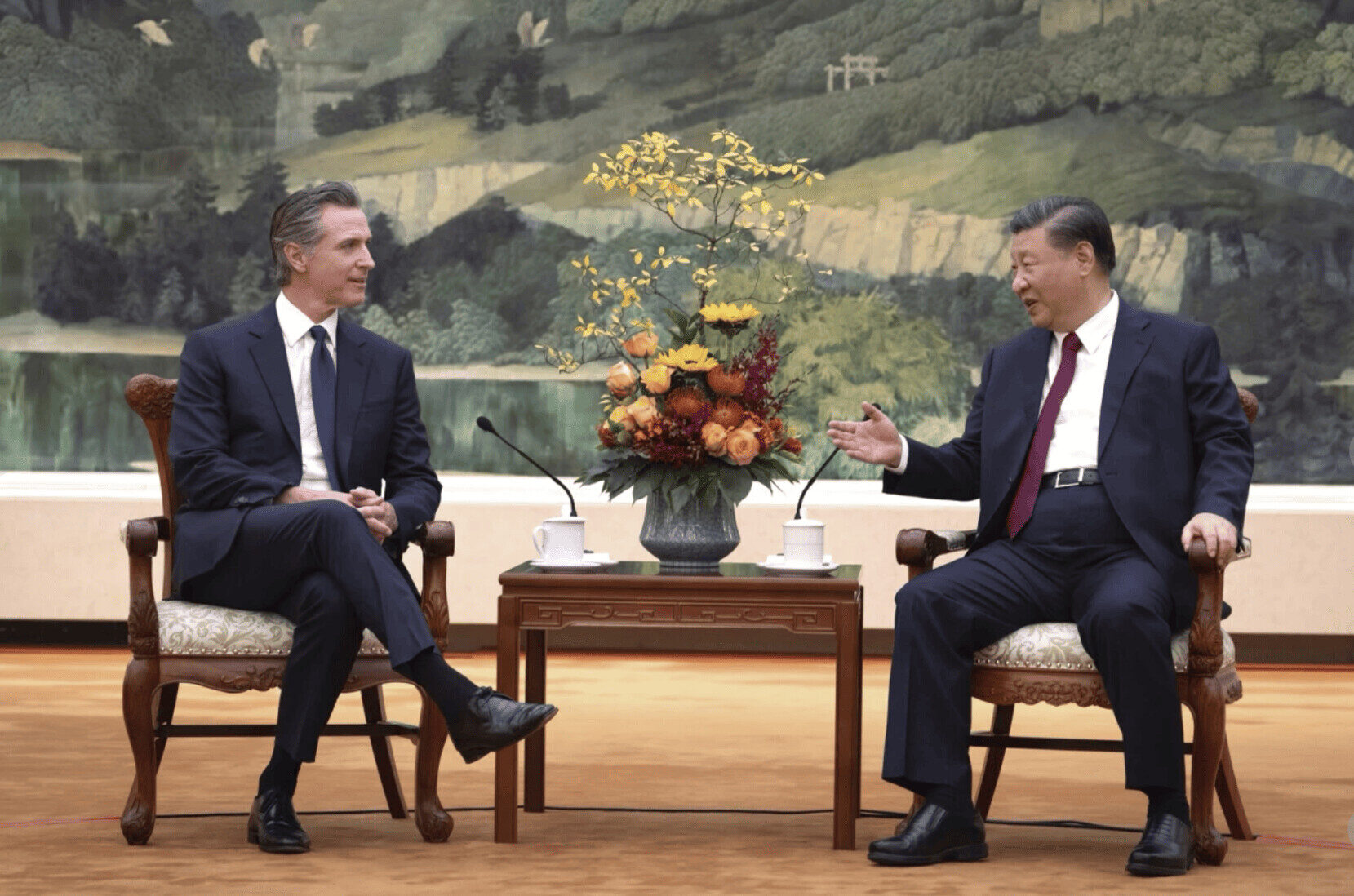
Newsom was the first US Governor to visit China in four years. Credit: Governor's Office

Newsom was the first US Governor to visit China in four years. Credit: Governor’s Office

5 May 2025 - 4:46pm

Recent revelations that the University of California received massive donations from organisations linked to China’s Communist Party — including a $220 million investment in Berkeley’s joint research project with Tsinghua University — may have elicited a harsh reaction from the Trump administration. But it should not come as a surprise to anyone who has followed the state’s increasingly dependent relationship with China.

For a generation, California’s political and economic elites have been eager to abase themselves for Chinese money. This started under Jerry Brown, who assiduously worked to maintain close ties, but his successor, Gavin Newsom, has gone further, welcoming links with groups controlled by the Communist Party.

Newsom, of course, was the first US Governor to visit China in four years. In 2023, the Governor went to Beijing to kiss the ring and explore “collaboration” with the Communist regime, pleading for statewide carveouts from China’s tariffs. Then a month later, Xi Jinping visited San Francisco, where Newsom and the rest of the state establishment gave him a standing ovation.

This royal treatment might seem odd considering how critical Newsom has been of other “dictators”. Over the last eight years, the California governor has repeatedly attacked Trump over his alleged threat to democracy. But he remains curiously silent on the world’s most powerful — and fascistic — authoritarian regime. To this day, the California Governor has continued to send fraternal missions to China, partnering with organisations controlled, like much of everything, by Communist Party operatives. Clearly, there are some double standards here.

Such subservience makes sense given an economic relationship that already resembles a classic colonial tie. China runs a roughly $107 billion trade surplus with California, and the disparities in such things as electronic machinery are immense. California fares better with services, notably software and other tech licenses as well as universities, but this only amounts to $5 billion.

This dependency may alarm some in Washington, but it conforms to the preferred style of many California progressives. Free trade plays to the state’s deindustrialisation and climate agendas, raising prices inexorably on California companies and households. Even during the Biden years, California greens opposed tariffs on Chinese EVs and some have sought to “take out” Tesla, the only EV-maker producing in the state.

Another concerning element is how Chinese political influence in California resembles patterns seen in places like Australia and Canada. The CCP got very close to the state’s leading politicians, including the late Dianne Feinstein, whose driver was reportedly an agent, and Congressman Eric Swalwell, who had a close connection with an alleged Chinese femme fatale agent. The rot, for all we know, could run much deeper.

California’s entanglement with China reflects a broader pattern of economic dependency and political accommodation that raises serious questions about the state’s values and strategic priorities. While California leaders often champion democratic ideals and environmental progressivism, their willingness to court and appease an authoritarian regime with an abysmal human rights record suggests a troubling double standard. As geopolitical tensions mount, the state may soon have to reckon with the consequences of its deepening ties to a government that views influence abroad as a tool for internal control at home.


Joel Kotkin is a Presidential Fellow in Urban Futures at Chapman University and a Senior Research Fellow at the Civitas Institute, the University of Texas at Austin.

joelkotkin

China is threatening America in the AI race

Reports sugget Zhipu AI  has released a new model that can rival leading US systems. Credit: Getty

Reports sugget Zhipu AI has released a new model that can rival leading US systems. Credit: Getty

1 July 2026 - 10:18am

China is trying to catch up with America on artificial intelligence. The Wall Street Journal has reported that Zhipu AI — one of China’s six “AI tiger” LLMs — has released a new model that can rival leading US systems, including Anthropic’s Mythos, in cybersecurity tasks such as pinpointing security bugs. While this marks a milestone in China’s drive to catch up with Western AI capabilities, strong performance on a single benchmark does not mean it has taken the lead. Chinese models still lag behind their Western counterparts in broader capabilities, such as autonomous operation. Skepticism is therefore warranted before resorting to hysterical conclusions, but complacency about the geopolitical implications of China’s AI advances would be an even greater mistake.

On the infrastructure side, Chinese AI is still constrained by access to advanced chips, with American labs way ahead in computing capacity as well as investment. Analysis from earlier this year suggests that Chinese models are likely to be at least a few months behind those in the US. But they are still continuing to make progress, or that the geopolitical importance of AI will be decided only by whose LLM has ventured deeper into the technological frontier. The practical applications of AI, countries’ to capture foreign markets, and the application of AI into the real economy will matter just as much.

Here, China may hold an advantage. As with its dominance across many critical supply chains, Beijing may not need to produce the most advanced AI systems — only those that are affordable and widely deployable. In doing so, it could consolidate global influence by supplying functional, low-cost AI at scale.

Beijing seems to be pursuing exactly that path, developing an AI “open-source” strategy that offers affordable, widely available AI models for companies and individuals to use and modify as they wish. The production of the DeepSeek AI model, which matched the performance of Silicon Valley tools such as ChatGPT at a fraction of the cost for users, created goodwill among Chinese models with developers.

The four most popular models on OpenRouter, an AI hardware platform for developers, are now all Chinese. The goal for China is not only to win the frontier-model race, but to make its systems the default layer of AI adoption across industries and global markets. For most economies, the choice is increasingly between an affordable tool they can deploy now and a more robust one that may be out of reach.

And while the countries adopting Chinese models may be exposed to political pressure and cyber threats from Beijing, safer and more capable alternatives matter little if they are unaffordable. American AI companies are already under pressure to monetize products whose operating costs are rising. If Chinese open-source models become the cheap default for startups, universities, governments and businesses across the developing world, then America’s AI lead will be eroded from below.

Perhaps more concerning for America in the long run is how AI can give Chinese manufacturing even more strength, through the ongoing integration of AI as a general-purpose technology. China’s new Five-Year Plan mentioned AI more than 50 times and includes an “AI+” action plan aimed at spreading AI across the economy.

Beijing has been pioneering automation of its critical infrastructure for years, with promising recent results in increasing warplane production capacity. In that regard, China’s open-model strategy and manufacturing dominance will reinforce each other. Cheap, adaptable models accelerate deployment across the real economy while those deployments generate real-world data and use cases that can feed back into further model improvement.

The United States should not dismiss the importance of its lead in the AI race. That lead worries Beijing, not least because a more automated Chinese economy would also become more vulnerable to AI-generated cyber threats. But nor should Washington assume that China cannot catch up with American capabilities over time.

This AI competition represents part of a broader struggle over tech supply chains and geopolitical influence. Decisions over whether to adopt US or Chinese models could produce a more fragmented global reality, with different regions relying on different cloud providers, chips and security structures. The result will likely be a global economy which is divided into competing spheres, rather than one which produces a single winner.


Miquel Vila is a political and geopolitical risk consultant focusing on industrial strategy, critical infrastructure and global supply chains.

miquelvilam