




X Close

China’s slowdown puts the world economy at risk

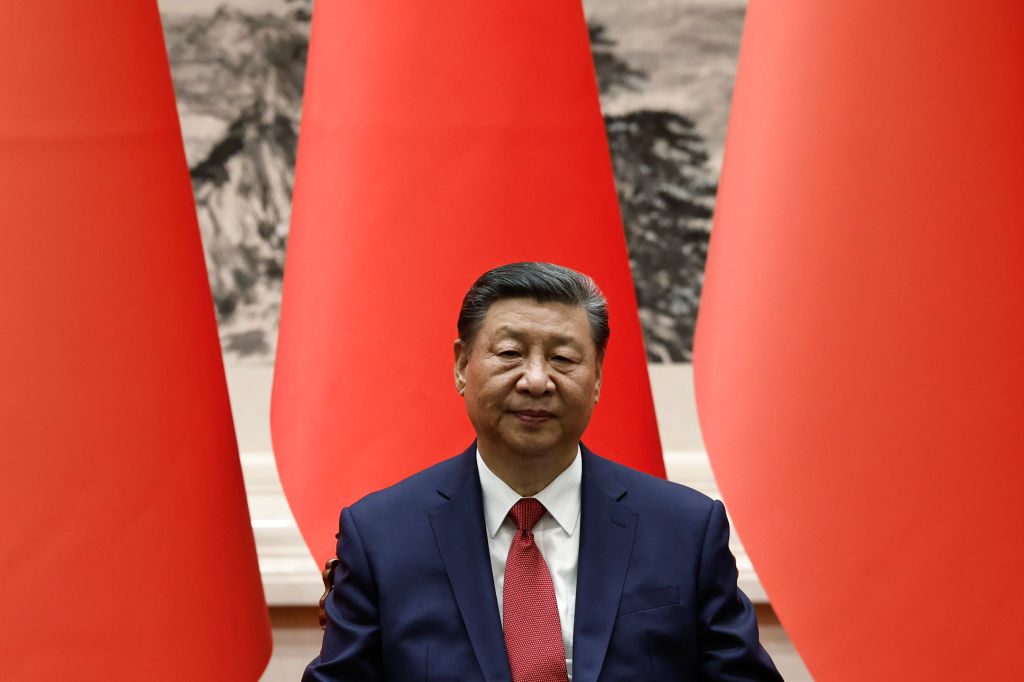
'We now live in a world where the US and Chinese economies are in various ways converging.' Credit: Getty

‘We now live in a world where the US and Chinese economies are in various ways converging.’ Credit: Getty

16 August 2025 - 1:30pm

China’s economy may be slowing again. While the country has weathered the storm of Donald Trump’s trade war better than the United States — thanks to a more diversified set of trade relationships — its domestic economy is beginning to sputter. Exports rose in the last quarter, even as American exports fell, but internal economic growth is less promising.

Industrial output grew 5.7% last month, which is robust by Western standards but still marks a significant reduction from June’s 6.8% rate. More worrying yet is that retail sales grew only 3.7%, sharply down from the previous month’s 4.8% pace.

This is particularly worrying because that 4.8% figure was already low. The basic problem with China’s economy is no secret: domestic consumption is inadequate for a country at its level of development. At barely half of total output, it falls well below the roughly 90% average seen in most developed economies, and this gap has widened as consumption has weakened following the collapse of the housing market. Since property investment is the main saving vehicle for most Chinese households, they have compensated for their losses by tightening their purse strings and boosting their savings.

Faced with inadequate demand, therefore, firms have taken to increasing their exports. That has swamped the world with inexpensive goods and drawn increasing ire from trading partners. If it hasn’t already done so, this export-oriented growth strategy is now finally approaching its limits.

The solution to China’s slowdown is, then, no mystery: reduce investment and increase consumption. Beijing has been trying to bring about a long-overdue rebalancing of the economy, and has enjoyed some recent success in the country’s major cities. There, housing has bottomed out, investment’s share of local output has decreased, and governments have steered what investment does take place towards high-quality, strategic industries.

Unfortunately, governments in smaller cities haven’t yet got the hang of this new approach. Faced with declining growth, they have tried to meet the national target of over 5% annual expansion by investing yet more. The result is excess capacity and output, unprofitable firms, and falling prices — all of which only compounds the downward spiral of Chinese firms.

To successfully rebalance the economy, the country would first need to reduce its excess capacity by allowing a lot of producers to go to the wall. One estimate is that as many as 80% of China’s existing property developers will have to go bust before the market completes its stabilisation. If not quite as dramatic a fall, the same will be true of other sectors, such as car manufacturing.

Then, those firms which survive any shakeout will need to spend more on compensation — whether on higher wages or more generous benefits — in order to facilitate the rise in consumption. That, however, would hit corporate margins, fundamentally challenging the existing model. Powerful interests on which the ruling party’s power rests will feel undermined — hence the struggle to reform.

China’s economic travails show that even autocracies struggle to make painful adjustments. But a curious outcome is that we now seem to live in a world where the US and Chinese economies are in various ways converging. The second Trump administration, which is using its political leverage to steer companies towards national goals and penalise those which resist, is starting to resemble Xi Jinping’s model of state guidance of a market economy. But the more worrying convergence is that both economies now appear to be slowing. The result is weakening demand for the rest of the world’s output.

In a world economy that is still struggling to recover from the pandemic recession, that will be a major concern to almost everyone.


John Rapley is an author and academic who divides his time between London, Johannesburg and Ottawa. His books include Why Empires Fall: Rome, America and the Future of the West (with Peter Heather, Penguin, 2023) and Twilight of the Money Gods: Economics as a Religion (Simon & Schuster, 2017).

jarapley

China is threatening America in the AI race

Reports sugget Zhipu AI  has released a new model that can rival leading US systems. Credit: Getty

Reports sugget Zhipu AI has released a new model that can rival leading US systems. Credit: Getty

1 July 2026 - 10:18am

China is trying to catch up with America on artificial intelligence. The Wall Street Journal has reported that Zhipu AI — one of China’s six “AI tiger” LLMs — has released a new model that can rival leading US systems, including Anthropic’s Mythos, in cybersecurity tasks such as pinpointing security bugs. While this marks a milestone in China’s drive to catch up with Western AI capabilities, strong performance on a single benchmark does not mean it has taken the lead. Chinese models still lag behind their Western counterparts in broader capabilities, such as autonomous operation. Skepticism is therefore warranted before resorting to hysterical conclusions, but complacency about the geopolitical implications of China’s AI advances would be an even greater mistake.

On the infrastructure side, Chinese AI is still constrained by access to advanced chips, with American labs way ahead in computing capacity as well as investment. Analysis from earlier this year suggests that Chinese models are likely to be at least a few months behind those in the US. But they are still continuing to make progress, or that the geopolitical importance of AI will be decided only by whose LLM has ventured deeper into the technological frontier. The practical applications of AI, countries’ to capture foreign markets, and the application of AI into the real economy will matter just as much.

Here, China may hold an advantage. As with its dominance across many critical supply chains, Beijing may not need to produce the most advanced AI systems — only those that are affordable and widely deployable. In doing so, it could consolidate global influence by supplying functional, low-cost AI at scale.

Beijing seems to be pursuing exactly that path, developing an AI “open-source” strategy that offers affordable, widely available AI models for companies and individuals to use and modify as they wish. The production of the DeepSeek AI model, which matched the performance of Silicon Valley tools such as ChatGPT at a fraction of the cost for users, created goodwill among Chinese models with developers.

The four most popular models on OpenRouter, an AI hardware platform for developers, are now all Chinese. The goal for China is not only to win the frontier-model race, but to make its systems the default layer of AI adoption across industries and global markets. For most economies, the choice is increasingly between an affordable tool they can deploy now and a more robust one that may be out of reach.

And while the countries adopting Chinese models may be exposed to political pressure and cyber threats from Beijing, safer and more capable alternatives matter little if they are unaffordable. American AI companies are already under pressure to monetize products whose operating costs are rising. If Chinese open-source models become the cheap default for startups, universities, governments and businesses across the developing world, then America’s AI lead will be eroded from below.

Perhaps more concerning for America in the long run is how AI can give Chinese manufacturing even more strength, through the ongoing integration of AI as a general-purpose technology. China’s new Five-Year Plan mentioned AI more than 50 times and includes an “AI+” action plan aimed at spreading AI across the economy.

Beijing has been pioneering automation of its critical infrastructure for years, with promising recent results in increasing warplane production capacity. In that regard, China’s open-model strategy and manufacturing dominance will reinforce each other. Cheap, adaptable models accelerate deployment across the real economy while those deployments generate real-world data and use cases that can feed back into further model improvement.

The United States should not dismiss the importance of its lead in the AI race. That lead worries Beijing, not least because a more automated Chinese economy would also become more vulnerable to AI-generated cyber threats. But nor should Washington assume that China cannot catch up with American capabilities over time.

This AI competition represents part of a broader struggle over tech supply chains and geopolitical influence. Decisions over whether to adopt US or Chinese models could produce a more fragmented global reality, with different regions relying on different cloud providers, chips and security structures. The result will likely be a global economy which is divided into competing spheres, rather than one which produces a single winner.


Miquel Vila is a political and geopolitical risk consultant focusing on industrial strategy, critical infrastructure and global supply chains.

miquelvilam