




X Close

China has embarrassed Labour over British Steel

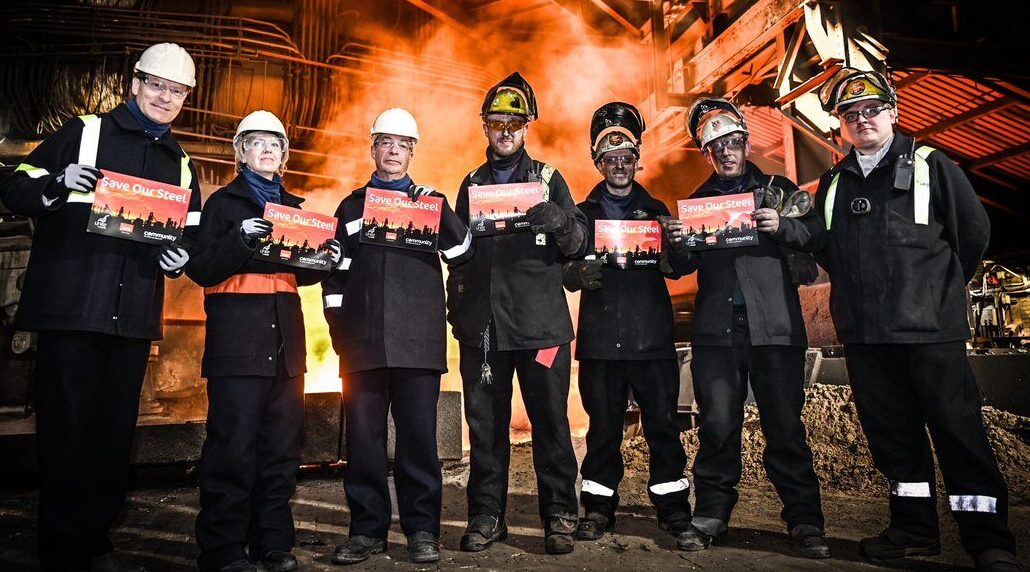
Nigel Farage visits British Steel in Scunthorpe this week. Credit: Nigel Farage/X

Nigel Farage visits British Steel in Scunthorpe this week. Credit: Nigel Farage/X

10 April 2025 - 7:00am

Imagine the embarrassment: you announce a national steel strategy and jump through all the approved hoops of public consultation to show you are taking a reasonable ministerial decision. Then, just days after the consultation period ends, the largest company in the sector — responsible for almost all UK production — announces it would rather close itself down.

That, broadly, is the position in which the Government finds itself. Jingye, the Chinese conglomerate that owns Scunthorpe-based British Steel, has in recent months been haggling about the taxpayer support it says it needs to bridge from blast-furnace production to greener electric arc furnaces. While the UK has offered £500 million, Jingye doesn’t think that’s adequate. It wants £1 billion, or else it plans to shut up shop.

The news leaves the Government pondering how to respond to this contemptuously flung-down gauntlet, with nationalisation one option. Business Secretary Jonathan Reynolds could of course call Jingye’s bluff, and some think he’d be a fool not to, given the downside of subsidising jobs in Scunthorpe. But this raises the question: why publish a steel strategy in the first place? If Reynolds’s own paper is to be believed, it’s not just about saving jobs, but also preserving industrial sovereignty at a time of disruptive change. Otherwise, why set aside £2.5 billion of public money to preserve steelmaking — or encourage public bodies to buy their steel domestically, even at higher cost?

Let Scunthorpe go and Britain will no longer have any primary steelmaking. The one other large plant — Tata’s at Port Talbot — is converting to electric furnaces and, when opened in 2027, will only be able to recycle scrap, which is not suitable for some grades of steel. The country will thus become ever more dependent on imports, just as we are poised to invest massively in energy infrastructure and our own defence — both heavy steel consumers. It’s hard to see how depending on China — as inevitably we will, assuming the world trading system doesn’t break down entirely — fits with the doctrine of “securonomics” that the Starmer administration so proudly endorses.

Yet if the Government is to save Scunthorpe, it might want to go about it differently. It’s hard to understand why Reynolds is thrusting hundreds of millions of pounds at Jingye so eagerly, and with so few strings attached. A glance at British Steel’s latest accounts suggests the Chinese company has just £100 million of equity at risk in the business. Most of its investment is through a £710-million intercompany loan — hardly a sign of commitment. There’s precious little indication of capital investment, despite all Jingye’s promises when it bought the business in 2020. Indeed, fixed assets have actually gone down under its ownership.

What’s more, there are questions about Jingye’s bona fides. A recent story suggested that bosses have been trying to recruit Scunthorpe workers to their new plant in northeast China, through which the company hopes to supply the UK.

If Britain is to have a national steel strategy costing billions, the public is entitled to more than (unenforceable) promises of jobs and the hoped-for goodwill of private beneficiaries. An equity stake at minimum, and even full nationalisation, should be on the table.

Granted, ownership would come at a cost: not just the acquisition of the equity interest, but — much more seriously — the funding of the ongoing losses which flow from Britain’s lack of industrial competitiveness. In British Steel’s case, these are running at £200-300 million a year. Some in the Treasury will doubtless argue against if nationalisation can be shown to add to the official public deficit, but it would be a mad world in which arbitrary ratios stood in the way of necessary investments in strategic industries.

If there’s one benefit of direct ownership, it’s that the Government might then think harder about why energy-intensive businesses such as steel, chemicals and cars are deserting the UK in droves, and the extent to which its own policies are contributing — for instance, those which leave British Steel paying 50% more for its electricity than competitors in France or Germany. If reflections on these points led Reynolds to axe some of his government’s own industry-killing rules and regulations, his blushes won’t have been in vain.


Jonathan Ford presents the podcast A Long Time in Finance and writes the Business Adventures Substack.

Grepsul

China is threatening America in the AI race

Reports sugget Zhipu AI  has released a new model that can rival leading US systems. Credit: Getty

Reports sugget Zhipu AI has released a new model that can rival leading US systems. Credit: Getty

1 July 2026 - 10:18am

China is trying to catch up with America on artificial intelligence. The Wall Street Journal has reported that Zhipu AI — one of China’s six “AI tiger” LLMs — has released a new model that can rival leading US systems, including Anthropic’s Mythos, in cybersecurity tasks such as pinpointing security bugs. While this marks a milestone in China’s drive to catch up with Western AI capabilities, strong performance on a single benchmark does not mean it has taken the lead. Chinese models still lag behind their Western counterparts in broader capabilities, such as autonomous operation. Skepticism is therefore warranted before resorting to hysterical conclusions, but complacency about the geopolitical implications of China’s AI advances would be an even greater mistake.

On the infrastructure side, Chinese AI is still constrained by access to advanced chips, with American labs way ahead in computing capacity as well as investment. Analysis from earlier this year suggests that Chinese models are likely to be at least a few months behind those in the US. But they are still continuing to make progress, or that the geopolitical importance of AI will be decided only by whose LLM has ventured deeper into the technological frontier. The practical applications of AI, countries’ to capture foreign markets, and the application of AI into the real economy will matter just as much.

Here, China may hold an advantage. As with its dominance across many critical supply chains, Beijing may not need to produce the most advanced AI systems — only those that are affordable and widely deployable. In doing so, it could consolidate global influence by supplying functional, low-cost AI at scale.

Beijing seems to be pursuing exactly that path, developing an AI “open-source” strategy that offers affordable, widely available AI models for companies and individuals to use and modify as they wish. The production of the DeepSeek AI model, which matched the performance of Silicon Valley tools such as ChatGPT at a fraction of the cost for users, created goodwill among Chinese models with developers.

The four most popular models on OpenRouter, an AI hardware platform for developers, are now all Chinese. The goal for China is not only to win the frontier-model race, but to make its systems the default layer of AI adoption across industries and global markets. For most economies, the choice is increasingly between an affordable tool they can deploy now and a more robust one that may be out of reach.

And while the countries adopting Chinese models may be exposed to political pressure and cyber threats from Beijing, safer and more capable alternatives matter little if they are unaffordable. American AI companies are already under pressure to monetize products whose operating costs are rising. If Chinese open-source models become the cheap default for startups, universities, governments and businesses across the developing world, then America’s AI lead will be eroded from below.

Perhaps more concerning for America in the long run is how AI can give Chinese manufacturing even more strength, through the ongoing integration of AI as a general-purpose technology. China’s new Five-Year Plan mentioned AI more than 50 times and includes an “AI+” action plan aimed at spreading AI across the economy.

Beijing has been pioneering automation of its critical infrastructure for years, with promising recent results in increasing warplane production capacity. In that regard, China’s open-model strategy and manufacturing dominance will reinforce each other. Cheap, adaptable models accelerate deployment across the real economy while those deployments generate real-world data and use cases that can feed back into further model improvement.

The United States should not dismiss the importance of its lead in the AI race. That lead worries Beijing, not least because a more automated Chinese economy would also become more vulnerable to AI-generated cyber threats. But nor should Washington assume that China cannot catch up with American capabilities over time.

This AI competition represents part of a broader struggle over tech supply chains and geopolitical influence. Decisions over whether to adopt US or Chinese models could produce a more fragmented global reality, with different regions relying on different cloud providers, chips and security structures. The result will likely be a global economy which is divided into competing spheres, rather than one which produces a single winner.


Miquel Vila is a political and geopolitical risk consultant focusing on industrial strategy, critical infrastructure and global supply chains.

miquelvilam