




X Close

Charlie Kirk’s death leaves a void in the GOP

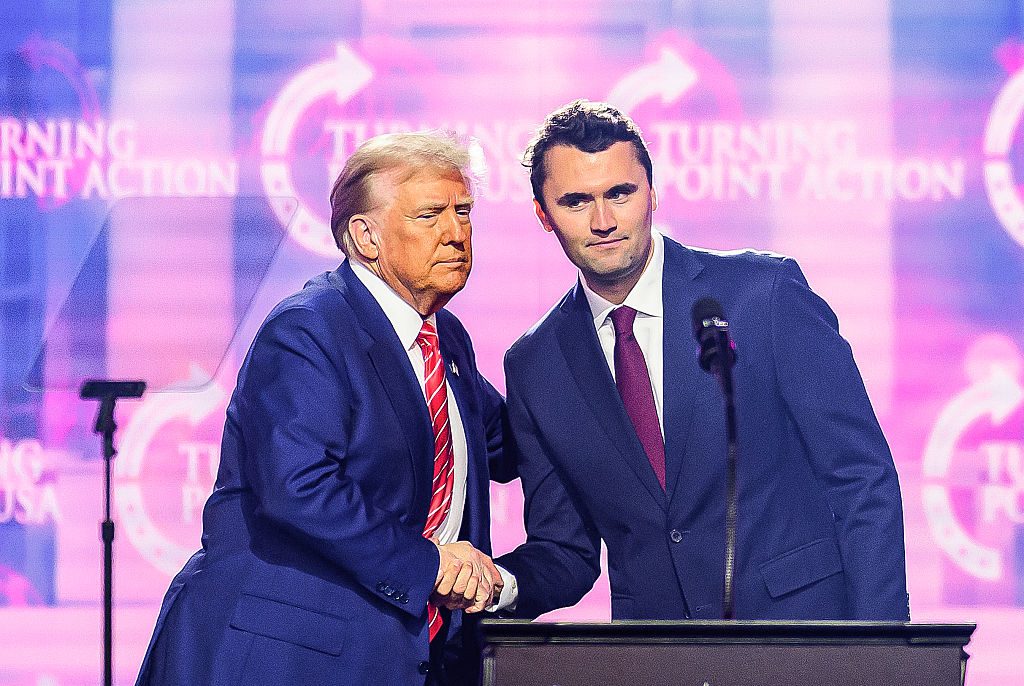
Charlie Kirk was Trump's bridge to the youth vote. Credit: Getty

Charlie Kirk was Trump’s bridge to the youth vote. Credit: Getty

11 September 2025 - 6:30pm

The manhunt continues in Utah for Charlie Kirk’s killer, but the Republican Party’s real reckoning has already begun. The 31-year-old founder of Turning Point USA wasn’t just another campus provocateur or podcast personality. He’d built something the GOP desperately needed and now suddenly doesn’t have: a functioning turnout operation that dozens of races were counting on for 2026, all centred around a charismatic frontman.

Kirk’s death is a tragedy for his family and friends, and will only exacerbate America’s political polarisation and febrile atmosphere. But, politically, it also matters because Turning Point Action, the political arm of his youth organisation, had become the de facto field operation for Republican state parties too weak or disorganised to run their own. With roughly $85 million in revenue flowing through Turning Point USA in 2024, Kirk commanded resources that dwarfed most state party budgets. More importantly, he’d shifted those resources from staging campus debates to the unglamorous work of ballot-chasing and precinct organisation. In doing so, he essentially headed much of Trump’s ground game in the previous election.

The group’s evolution into a political heavyweight happened quietly. While Kirk continued his usual media performances, Turning Point Action developed a dedicated app for canvassers, recruited precinct leaders, and pitched local GOP committees on adopting their “Chase the Vote” programme. Internal presentations obtained by the Associated Press show TPAction telling county officials they had Trump’s blessing to lead Republican turnout efforts. The pitch was blunt: use our infrastructure, or risk losing winnable races.

Arizona Republicans took the deal, where the New Yorker documented canvassers effectively using TPAction’s app to target low-propensity Republican voters. The results, by most accounts, exceeded expectations. Trump outperformed polling estimates in states where Turning Point concentrated its efforts. Local party officials admitted to me they’d have been lost without the external support.

Years of infighting, financial troubles, and leadership turnover left many state Republican parties hollowed out. Into that vacuum stepped Kirk, offering a turnkey solution that party officials could adopt wholesale rather than build from scratch. The model resembled less a traditional political operation than a franchise system. Turning Point Action provided the technology, training, and tactical guidance. Local parties provided the bodies and local knowledge. Kirk maintained control of the central apparatus while allowing enough flexibility for regional adaptation. It worked precisely because it didn’t require the creaking party machinery to reform itself.

Kirk’s proximity to Trump gave him unique leverage to impose this arrangement. A February profile in the New York Times Magazine detailed his unusual access to the President’s inner circle. Republican Senator Jim Banks was quoted as saying that Kirk had “done more than most members of Congress combined” for the party. Given the infrastructure Kirk had built, that now sounds like an understatement.

Analysts have noted how tightly Turning Point’s identity remained bound to its founder despite its massive growth. Unlike the Republican National Committee or state parties with formal succession procedures, Turning Point was essentially a projection of Kirk’s ambitions. He personally managed relationships with major donors, negotiated with state party chairs, and maintained Trump’s confidence that TPAction should lead Republican turnout efforts. What remains after his death is an organisation that may continue existing but likely won’t maintain its unique position as a bridge between Trump’s circle, major donors, and ground-level operations.

Trump ordered that flags be lowered to half-mast until Sunday evening, an extraordinary honour for a deceased American civilian. Better than most, the President understands what many observers miss: in modern American politics, the ability to identify and mobilise irregular voters matters more than winning cable news segments. Prior to his death, Kirk had even been working to mend the Republican rift on what some perceived as excessive support for Israel.

The Republican Party will endure, obviously. But its competitive position in 2026 just became considerably more precarious. Kirk was 31 years old. He might have spent several more decades building and refining his operations. Instead, the party that struggled for years to match Democratic organising prowess, especially among younger voters, has lost its most effective organiser just as his system was reaping dividends. The real tragedy here is that a wife has lost her husband and two children have lost their father. But his political value to the Republican party cannot be overstated.


Oliver Bateman is a historian and journalist based in Pittsburgh. He blogs, vlogs, and podcasts at his Substack, Oliver Bateman Does the Work

MoustacheClubUS

China is threatening America in the AI race

Reports sugget Zhipu AI  has released a new model that can rival leading US systems. Credit: Getty

Reports sugget Zhipu AI has released a new model that can rival leading US systems. Credit: Getty

1 July 2026 - 10:18am

China is trying to catch up with America on artificial intelligence. The Wall Street Journal has reported that Zhipu AI — one of China’s six “AI tiger” LLMs — has released a new model that can rival leading US systems, including Anthropic’s Mythos, in cybersecurity tasks such as pinpointing security bugs. While this marks a milestone in China’s drive to catch up with Western AI capabilities, strong performance on a single benchmark does not mean it has taken the lead. Chinese models still lag behind their Western counterparts in broader capabilities, such as autonomous operation. Skepticism is therefore warranted before resorting to hysterical conclusions, but complacency about the geopolitical implications of China’s AI advances would be an even greater mistake.

On the infrastructure side, Chinese AI is still constrained by access to advanced chips, with American labs way ahead in computing capacity as well as investment. Analysis from earlier this year suggests that Chinese models are likely to be at least a few months behind those in the US. But they are still continuing to make progress, or that the geopolitical importance of AI will be decided only by whose LLM has ventured deeper into the technological frontier. The practical applications of AI, countries’ to capture foreign markets, and the application of AI into the real economy will matter just as much.

Here, China may hold an advantage. As with its dominance across many critical supply chains, Beijing may not need to produce the most advanced AI systems — only those that are affordable and widely deployable. In doing so, it could consolidate global influence by supplying functional, low-cost AI at scale.

Beijing seems to be pursuing exactly that path, developing an AI “open-source” strategy that offers affordable, widely available AI models for companies and individuals to use and modify as they wish. The production of the DeepSeek AI model, which matched the performance of Silicon Valley tools such as ChatGPT at a fraction of the cost for users, created goodwill among Chinese models with developers.

The four most popular models on OpenRouter, an AI hardware platform for developers, are now all Chinese. The goal for China is not only to win the frontier-model race, but to make its systems the default layer of AI adoption across industries and global markets. For most economies, the choice is increasingly between an affordable tool they can deploy now and a more robust one that may be out of reach.

And while the countries adopting Chinese models may be exposed to political pressure and cyber threats from Beijing, safer and more capable alternatives matter little if they are unaffordable. American AI companies are already under pressure to monetize products whose operating costs are rising. If Chinese open-source models become the cheap default for startups, universities, governments and businesses across the developing world, then America’s AI lead will be eroded from below.

Perhaps more concerning for America in the long run is how AI can give Chinese manufacturing even more strength, through the ongoing integration of AI as a general-purpose technology. China’s new Five-Year Plan mentioned AI more than 50 times and includes an “AI+” action plan aimed at spreading AI across the economy.

Beijing has been pioneering automation of its critical infrastructure for years, with promising recent results in increasing warplane production capacity. In that regard, China’s open-model strategy and manufacturing dominance will reinforce each other. Cheap, adaptable models accelerate deployment across the real economy while those deployments generate real-world data and use cases that can feed back into further model improvement.

The United States should not dismiss the importance of its lead in the AI race. That lead worries Beijing, not least because a more automated Chinese economy would also become more vulnerable to AI-generated cyber threats. But nor should Washington assume that China cannot catch up with American capabilities over time.

This AI competition represents part of a broader struggle over tech supply chains and geopolitical influence. Decisions over whether to adopt US or Chinese models could produce a more fragmented global reality, with different regions relying on different cloud providers, chips and security structures. The result will likely be a global economy which is divided into competing spheres, rather than one which produces a single winner.


Miquel Vila is a political and geopolitical risk consultant focusing on industrial strategy, critical infrastructure and global supply chains.

miquelvilam