




X Close

Can Kemi Badenoch avoid the Tories’ identity politics trap?

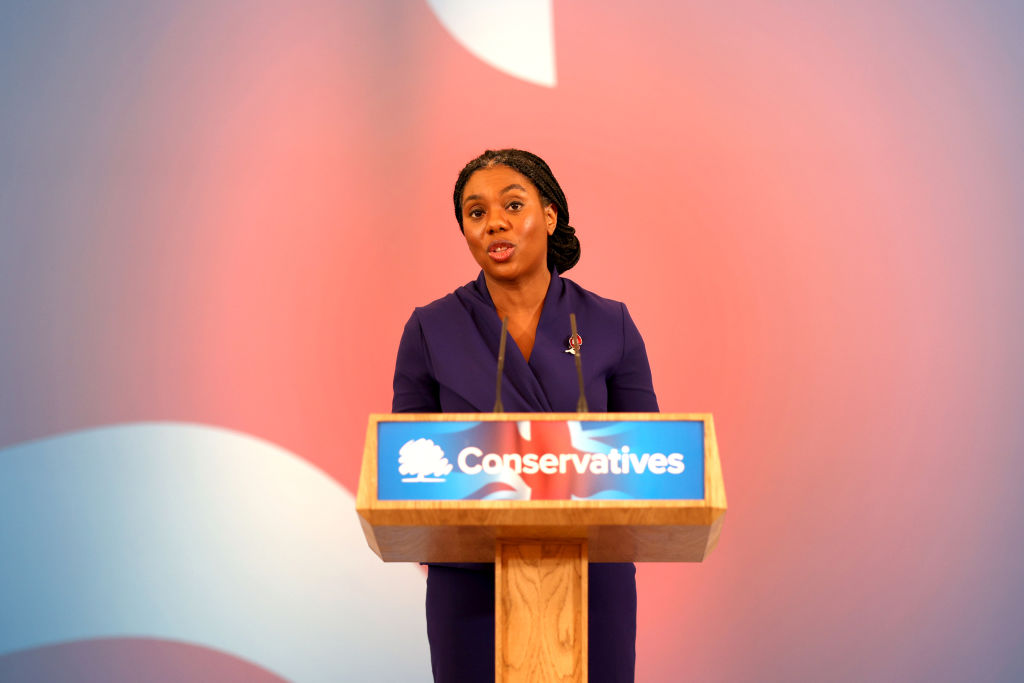
Kemi Badenoch speaks after winning the Tory leadership election on Saturday. Credit: Getty

Kemi Badenoch speaks after winning the Tory leadership election on Saturday. Credit: Getty

4 November 2024 - 1:00pm

Mummy won!” Conservative Party members seem pleased with their new leader, and determined to both notice and to not notice the fact that she is not a white man. Kemi Badenoch, meanwhile, has positioned herself as the candidate of sensible, equal-opportunities modern British conservatism, with no time for woke nonsense or transgender posturing.

She has promised to change the Equality Act to make clear that transgender-identified men can be excluded from women’s spaces. And following her election as leader she made what sounded like a firm stand for a colour-blind British politics, telling the BBC’s Laura Kuenssberg that she looks forward to a time when “the colour of your skin is no more remarkable than the colour of your eyes or the colour of your hair”.

What is less clear, though, is whether Badenoch really is the leader who will transcend identity politics — or if that’s even possible. For her election both affirms the pluralism of post-Blair, mass-migration Britain and also the fact that, by virtue of that pluralism, identity politics is now inevitable whatever we — or Kemi — would prefer.

To her credit, in her tenure as Equalities Minister Badenoch pushed new and somewhat saner schools guidance on transgender identity over the line. As an opponent of “woke” race politics, meanwhile, her track record is more ambivalent: as James McSweeney points out, a 2022 paper she championed as Equalities Minister entrenches DEI across the health service, as well as endorsing race-based loans and snooping on “hate speech” in private messages.

Is Badenoch not being transparent about her political stance against race-based quotas and “critical race theory”? Does she just not read the documents she endorses? Perhaps there’s a third possibility: that identity politics is just an unavoidable by-product of high-speed diversification. Britain has gone from an estimated 97% white British in 1971 to around 75% according to the 2021 census. It is a dramatic change, and one that has produced competing political priorities and confused responses. And the bitterest online Right-wing debates around Badenoch’s campaign were waged on the uncomfortable territory that has resulted.

Badenoch was born in London, grew up in Nigeria, and returned to the UK as a young adult. Is she British, or a foreigner? Opinions on the Right diverge sharply. Some both emphasised her Britishness while also highlighting her migrant status: a kind of Schrödinger’s identitarianism. On the one hand she was born in Britain, and therefore her childhood in Nigeria doesn’t matter; on the other hand her upbringing was the subject of Guardian headlines and represented a positive change. Which is it? Both, really.

Badenoch’s story makes her a Rorschach inkblot for the Right. It exposes deep divisions over whether — or how far — British conservatives embrace the American-style model of national belonging which aims at colour-blindness yet often fails, or one that retains an ethnocultural component. The anti-immigration faction made no bones about it: if you grow up somewhere else, you’re not one of us. This faction is usually kept out of the mainstream press, but denounced her online as an outsider with no right to lead a British political party. Others challenged this as unacceptable racism.

In turn, Badenoch’s campaign has attempted to communicate a post-identity “values”-based conservatism. But this overt aspiration to post-identitarian politics may be wishful thinking. For the more enthusiastically a polity tries to transcend ethnic identity, the less it emphasises integration or migration restrictionism, and the more pluralistic it becomes — and thus, inevitably, the more distinct interest groups will emerge.

I can think of no multiracial society that does not also feature racial politics. And yet it continues to be an aspiration of the liberal Right that we might one day attain such a polity, in which identities are pluralistic and yet also somehow irrelevant. If this never quite happens in practice, that is not Kemi Badenoch’s fault. But anyone who imagines her vocal disavowal of identity politics will deliver a Tory Party unburdened by such concerns may find themselves disappointed.


Mary Harrington is a contributing editor at UnHerd.

moveincircles

China is threatening America in the AI race

Reports sugget Zhipu AI  has released a new model that can rival leading US systems. Credit: Getty

Reports sugget Zhipu AI has released a new model that can rival leading US systems. Credit: Getty

1 July 2026 - 10:18am

China is trying to catch up with America on artificial intelligence. The Wall Street Journal has reported that Zhipu AI — one of China’s six “AI tiger” LLMs — has released a new model that can rival leading US systems, including Anthropic’s Mythos, in cybersecurity tasks such as pinpointing security bugs. While this marks a milestone in China’s drive to catch up with Western AI capabilities, strong performance on a single benchmark does not mean it has taken the lead. Chinese models still lag behind their Western counterparts in broader capabilities, such as autonomous operation. Skepticism is therefore warranted before resorting to hysterical conclusions, but complacency about the geopolitical implications of China’s AI advances would be an even greater mistake.

On the infrastructure side, Chinese AI is still constrained by access to advanced chips, with American labs way ahead in computing capacity as well as investment. Analysis from earlier this year suggests that Chinese models are likely to be at least a few months behind those in the US. But they are still continuing to make progress, or that the geopolitical importance of AI will be decided only by whose LLM has ventured deeper into the technological frontier. The practical applications of AI, countries’ to capture foreign markets, and the application of AI into the real economy will matter just as much.

Here, China may hold an advantage. As with its dominance across many critical supply chains, Beijing may not need to produce the most advanced AI systems — only those that are affordable and widely deployable. In doing so, it could consolidate global influence by supplying functional, low-cost AI at scale.

Beijing seems to be pursuing exactly that path, developing an AI “open-source” strategy that offers affordable, widely available AI models for companies and individuals to use and modify as they wish. The production of the DeepSeek AI model, which matched the performance of Silicon Valley tools such as ChatGPT at a fraction of the cost for users, created goodwill among Chinese models with developers.

The four most popular models on OpenRouter, an AI hardware platform for developers, are now all Chinese. The goal for China is not only to win the frontier-model race, but to make its systems the default layer of AI adoption across industries and global markets. For most economies, the choice is increasingly between an affordable tool they can deploy now and a more robust one that may be out of reach.

And while the countries adopting Chinese models may be exposed to political pressure and cyber threats from Beijing, safer and more capable alternatives matter little if they are unaffordable. American AI companies are already under pressure to monetize products whose operating costs are rising. If Chinese open-source models become the cheap default for startups, universities, governments and businesses across the developing world, then America’s AI lead will be eroded from below.

Perhaps more concerning for America in the long run is how AI can give Chinese manufacturing even more strength, through the ongoing integration of AI as a general-purpose technology. China’s new Five-Year Plan mentioned AI more than 50 times and includes an “AI+” action plan aimed at spreading AI across the economy.

Beijing has been pioneering automation of its critical infrastructure for years, with promising recent results in increasing warplane production capacity. In that regard, China’s open-model strategy and manufacturing dominance will reinforce each other. Cheap, adaptable models accelerate deployment across the real economy while those deployments generate real-world data and use cases that can feed back into further model improvement.

The United States should not dismiss the importance of its lead in the AI race. That lead worries Beijing, not least because a more automated Chinese economy would also become more vulnerable to AI-generated cyber threats. But nor should Washington assume that China cannot catch up with American capabilities over time.

This AI competition represents part of a broader struggle over tech supply chains and geopolitical influence. Decisions over whether to adopt US or Chinese models could produce a more fragmented global reality, with different regions relying on different cloud providers, chips and security structures. The result will likely be a global economy which is divided into competing spheres, rather than one which produces a single winner.


Miquel Vila is a political and geopolitical risk consultant focusing on industrial strategy, critical infrastructure and global supply chains.

miquelvilam