



X Close

Can Europe push Russia into recession?

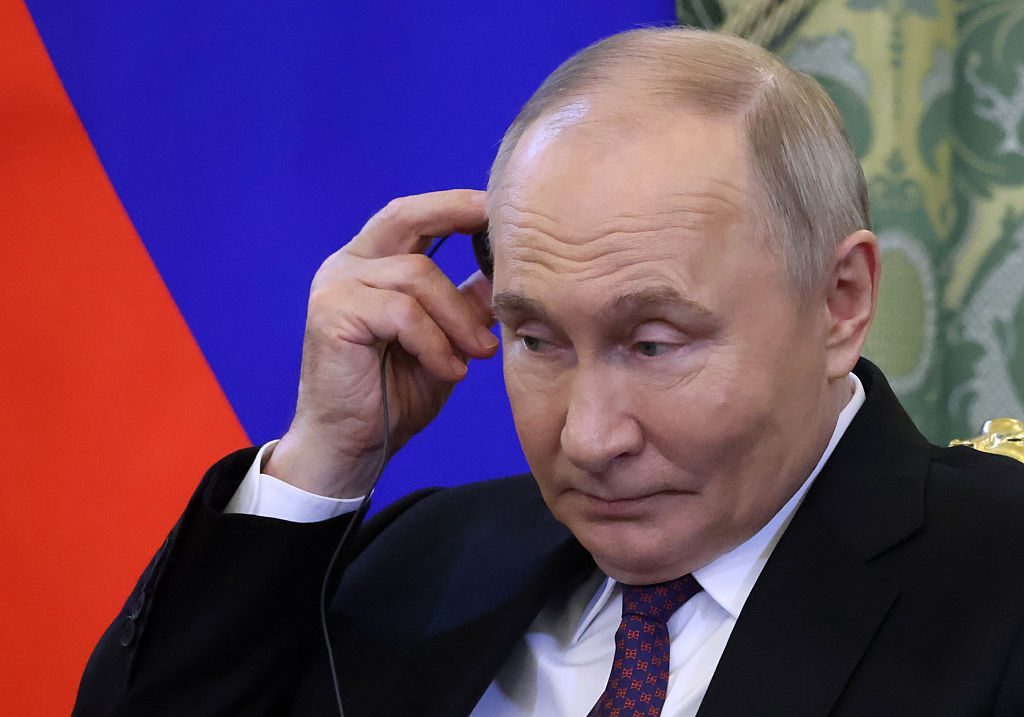
Putin finds himself in another war of attrition, this time economic. Credit: Getty

Putin finds himself in another war of attrition, this time economic. Credit: Getty

June 20 2025 - 11:00am

More than three years after Russia’s full-scale invasion of Ukraine and its ensuing economic war with the West, the Kremlin is finally starting to feel the fiscal pinch. Yesterday, Economy Minister Maxim Reshetnikov acknowledged that the country is “on the brink of a recession”.

These comments belie an ongoing conflict within the Kremlin. Earlier this month, Reshetnikov called for a lowering of the central bank interest rate to counter the trend. Central bank governor Elvira Nabiullina, whose steady management has long made her key to Russia’s war machine, has sought to maintain high rates to counter inflation that has persistently run at an annualized rate of 10% this year — far above the target of 4%. True consumer inflation is even higher, with the Kremlin managing the headline statistics through a series of changes to its consumer price index in recent years.

By weaponizing energy supplies following the 2022 invasion, Russia sent global oil and gas prices skyrocketing, while keeping wartime inflation in check. Yet the Kremlin’s coffers have increasingly been squeezed by the cut-off of gas sales to Europe, and Gazprom’s output has gone from being a major profit center to a source of substantial losses.

This has compounded the problems presented by Vladimir Putin’s expanding defense budgets, not to mention growing labor shortages in the wartime economy. Contracted soldiers are paid well by Russian standards and the country’s banks have been reoriented towards financing the conflict, putting a more positive spin on the state’s balance sheet.

Although Russia is now battling inflation, in recent months pressure has grown on Nabiullina to instead prioritize boosting growth. This effort has borne some success: the central bank decreased its base rate from 21% to 20% this month. Other Putin allies are now insisting that she go further, dropping the rate to below 15%, in order to maintain popular support as the war’s costs become harder to ignore.

The reality is that, while Russia is frequently dubbed the “most sanctioned country in the world”, its ultimate economic trajectory remains dependent on its global linkages. Gas profits may have evaporated, but the Kremlin’s global oil supplies continue to fuel its war machine, with 2024 export volumes above their pre-war level. The country is economically vulnerable, but a crisis is unlikely without a change in approach to sanctions.

So far, Western leaders have sought to target the price at which Russia sells its oil, rather than volumes. The key instrument for doing so is known as the G7+ Oil Price Cap, which bars companies using Western financial systems from involvement in transactions where Russian crude is sold above $60 per barrel.

However, this cap has largely failed, with China and India either ignoring or evading it. Meanwhile, Donald Trump has created doubt over US willingness to police Russian sanctions as tightly as under the previous administration. Europe and the UK have picked up the slack by sanctioning Russian “shadow fleet” vessels involved in evading the cap, but these measures have not yet had a demonstrable chilling effect.

Brussels officials last week proposed lowering the price cap to $45 a barrel, but that plan was put on hold shortly afterwards in the wake of oil price spikes caused by Israel’s attack on Iran. That same spike has also given Russia a potential get-out-of-jail-free card for its latest crisis.

If the West were serious about holding Putin to account and supporting Ukraine, it would switch from a policy of limiting Russian oil revenues to one of limiting the volumes of these sales. The problem with this, however, is that it would help sustain higher prices and therefore economic pain for Europe.

The economic war is, much like the battlefield in Ukraine, increasingly one of attrition. Such conflicts are won by the side willing to take more damage to achieve their aims. Russia may be on the brink of recession, but to capitalize on this the West must be willing to take a hit of its own.

Maximilian Hess is a Fellow at the Foreign Policy Research Institute.


China is threatening America in the AI race

Reports sugget Zhipu AI  has released a new model that can rival leading US systems. Credit: Getty

Reports sugget Zhipu AI has released a new model that can rival leading US systems. Credit: Getty

July 1 2026 - 10:18am

China is trying to catch up with America on artificial intelligence. The Wall Street Journal has reported that Zhipu AI — one of China’s six “AI tiger” LLMs — has released a new model that can rival leading US systems, including Anthropic’s Mythos, in cybersecurity tasks such as pinpointing security bugs. While this marks a milestone in China’s drive to catch up with Western AI capabilities, strong performance on a single benchmark does not mean it has taken the lead. Chinese models still lag behind their Western counterparts in broader capabilities, such as autonomous operation. Skepticism is therefore warranted before resorting to hysterical conclusions, but complacency about the geopolitical implications of China’s AI advances would be an even greater mistake.

On the infrastructure side, Chinese AI is still constrained by access to advanced chips, with American labs way ahead in computing capacity as well as investment. Analysis from earlier this year suggests that Chinese models are likely to be at least a few months behind those in the US. But they are still continuing to make progress, or that the geopolitical importance of AI will be decided only by whose LLM has ventured deeper into the technological frontier. The practical applications of AI, countries’ to capture foreign markets, and the application of AI into the real economy will matter just as much.

Here, China may hold an advantage. As with its dominance across many critical supply chains, Beijing may not need to produce the most advanced AI systems — only those that are affordable and widely deployable. In doing so, it could consolidate global influence by supplying functional, low-cost AI at scale.

Beijing seems to be pursuing exactly that path, developing an AI “open-source” strategy that offers affordable, widely available AI models for companies and individuals to use and modify as they wish. The production of the DeepSeek AI model, which matched the performance of Silicon Valley tools such as ChatGPT at a fraction of the cost for users, created goodwill among Chinese models with developers.

The four most popular models on OpenRouter, an AI hardware platform for developers, are now all Chinese. The goal for China is not only to win the frontier-model race, but to make its systems the default layer of AI adoption across industries and global markets. For most economies, the choice is increasingly between an affordable tool they can deploy now and a more robust one that may be out of reach.

And while the countries adopting Chinese models may be exposed to political pressure and cyber threats from Beijing, safer and more capable alternatives matter little if they are unaffordable. American AI companies are already under pressure to monetize products whose operating costs are rising. If Chinese open-source models become the cheap default for startups, universities, governments and businesses across the developing world, then America’s AI lead will be eroded from below.

Perhaps more concerning for America in the long run is how AI can give Chinese manufacturing even more strength, through the ongoing integration of AI as a general-purpose technology. China’s new Five-Year Plan mentioned AI more than 50 times and includes an “AI+” action plan aimed at spreading AI across the economy.

Beijing has been pioneering automation of its critical infrastructure for years, with promising recent results in increasing warplane production capacity. In that regard, China’s open-model strategy and manufacturing dominance will reinforce each other. Cheap, adaptable models accelerate deployment across the real economy while those deployments generate real-world data and use cases that can feed back into further model improvement.

The United States should not dismiss the importance of its lead in the AI race. That lead worries Beijing, not least because a more automated Chinese economy would also become more vulnerable to AI-generated cyber threats. But nor should Washington assume that China cannot catch up with American capabilities over time.

This AI competition represents part of a broader struggle over tech supply chains and geopolitical influence. Decisions over whether to adopt US or Chinese models could produce a more fragmented global reality, with different regions relying on different cloud providers, chips and security structures. The result will likely be a global economy which is divided into competing spheres, rather than one which produces a single winner.


Miquel Vila is a political and geopolitical risk consultant focusing on industrial strategy, critical infrastructure and global supply chains.

miquelvilam
