




X Close

Bolstered EU border force won’t keep Europe safe

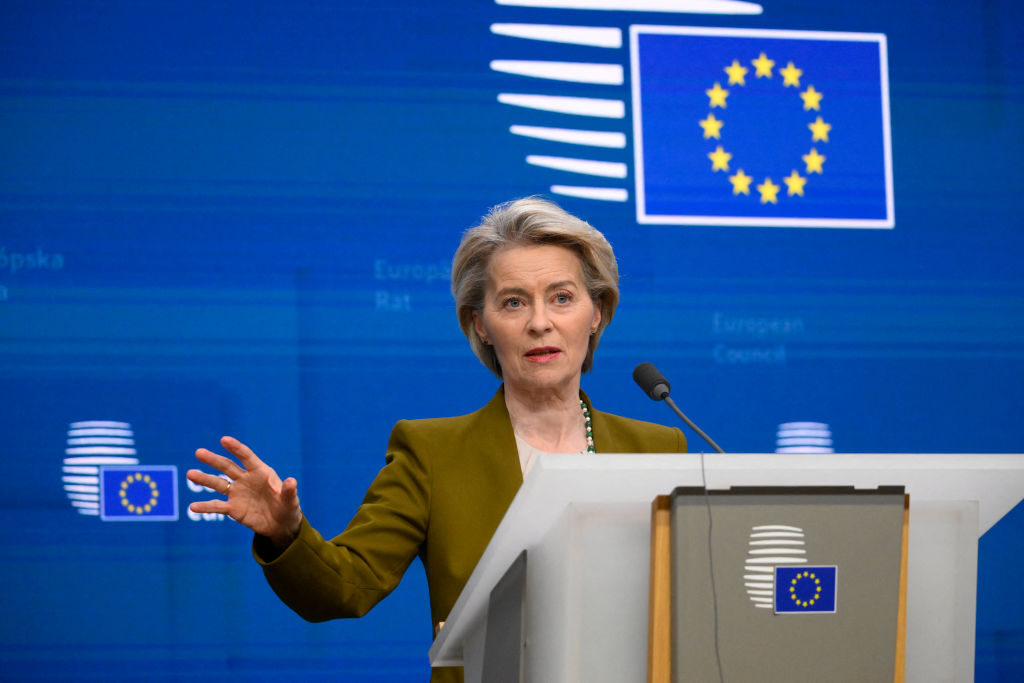
The Commission's latest plans should be read primarily as a power grab. Credit: Getty

The Commission’s latest plans should be read primarily as a power grab. Credit: Getty

4 April 2025 - 5:20pm

While the EU has denounced US President Donald Trump’s “Liberation Day” tariffs, it continues to quietly carve up the global economy on its own patch. The bloc has announced that it is beefing up its border security force Frontex, aiming to expand the continental body to 30,000 officers by 2027, up from 10,000 today. It is seen as part of a package to limit so-called “hybrid attacks” on the EU: which might encompass digital intrusions as much as penetrations of the porous borders on the Union’s outer rim.

Yet for all the clamour against Trumpian tariffs and portentous warnings about hybrid attacks from enemy states, it’s not clear that the EU’s larger border force will strengthen the bloc’s actual power. As ever, its policies are driven as much by managing its convoluted internal relations as they are any sober assessment of outside threats.

More than seeing this expansion as an effort to counter threats from hostile militaries, or vast people-smuggling networks, the expansion of Frontex should be viewed ultimately as a power-grab by the Commission. By strengthening the border force, the Commission is expanding the transnational gendarmerie directly under its control. In this increasingly tense geopolitical moment, member states are trying to strengthen their national borders. But the Commission wants to reassert its continued relevance, and through Frontex, the EU is staking its claim to defend its members from a dangerous world. Thus while criticising Trump’s efforts to reshape the global economy, the EU is at the same time constructing a regional fortress, tightening access to its internal markets under the auspices of protecting its citizens.

But however strong Frontex is, it will never be strong enough. This is not merely about numbers. The US Department of Homeland Security has over a quarter of a million employees working for it. The UK employs roughly 10,000 people in its Border Force for a population of just over 68 million (whereas the EU has a total population of roughly 450 million). On the face of it, with only 30,000 employees for a population six times larger than the UK, Frontex would look like the classical liberal ideal: a “night-watchman state”, limited to basic supervisory capacities.

“A national response is not enough,” is the standard EU refrain for legitimating the expansion of its bureaucratic powers, oversight and payroll. The EU may protect the external borders of the Union, but because it is not a sovereign state, whatever protections it may offer to the peoples of Europe will never translate into the kind of protections offered by a nation state. In a democratic nation state, control of national borders is tied to the people’s sovereign control over a particular territory and who governs it.

Europeans have no sovereignty over the EU, meaning that control over Europe’s borders can never be guaranteed by that transnational power. The more the EU asserts its power, the more it alienates the citizens of its member states.

Its lack of democratic legitimacy also means it can never extract the kind of loyalty from Europeans that would actually make it a global contender competing with great powers. The bloc hopes it can prove its strength by firming up its digital and physical battlements against a hostile outside world. But will Europeans accept that? One wonders how long they’ll prefer transnational protection to that offered by their own governments.


Philip Cunliffe is Associate Professor of International Relations at the Department of Risk and Disaster Reduction, University College London. He is the author of seven books, including, most recently: The National Interest: Politics after Globalization.

thephilippics

China is threatening America in the AI race

Reports sugget Zhipu AI  has released a new model that can rival leading US systems. Credit: Getty

Reports sugget Zhipu AI has released a new model that can rival leading US systems. Credit: Getty

1 July 2026 - 10:18am

China is trying to catch up with America on artificial intelligence. The Wall Street Journal has reported that Zhipu AI — one of China’s six “AI tiger” LLMs — has released a new model that can rival leading US systems, including Anthropic’s Mythos, in cybersecurity tasks such as pinpointing security bugs. While this marks a milestone in China’s drive to catch up with Western AI capabilities, strong performance on a single benchmark does not mean it has taken the lead. Chinese models still lag behind their Western counterparts in broader capabilities, such as autonomous operation. Skepticism is therefore warranted before resorting to hysterical conclusions, but complacency about the geopolitical implications of China’s AI advances would be an even greater mistake.

On the infrastructure side, Chinese AI is still constrained by access to advanced chips, with American labs way ahead in computing capacity as well as investment. Analysis from earlier this year suggests that Chinese models are likely to be at least a few months behind those in the US. But they are still continuing to make progress, or that the geopolitical importance of AI will be decided only by whose LLM has ventured deeper into the technological frontier. The practical applications of AI, countries’ to capture foreign markets, and the application of AI into the real economy will matter just as much.

Here, China may hold an advantage. As with its dominance across many critical supply chains, Beijing may not need to produce the most advanced AI systems — only those that are affordable and widely deployable. In doing so, it could consolidate global influence by supplying functional, low-cost AI at scale.

Beijing seems to be pursuing exactly that path, developing an AI “open-source” strategy that offers affordable, widely available AI models for companies and individuals to use and modify as they wish. The production of the DeepSeek AI model, which matched the performance of Silicon Valley tools such as ChatGPT at a fraction of the cost for users, created goodwill among Chinese models with developers.

The four most popular models on OpenRouter, an AI hardware platform for developers, are now all Chinese. The goal for China is not only to win the frontier-model race, but to make its systems the default layer of AI adoption across industries and global markets. For most economies, the choice is increasingly between an affordable tool they can deploy now and a more robust one that may be out of reach.

And while the countries adopting Chinese models may be exposed to political pressure and cyber threats from Beijing, safer and more capable alternatives matter little if they are unaffordable. American AI companies are already under pressure to monetize products whose operating costs are rising. If Chinese open-source models become the cheap default for startups, universities, governments and businesses across the developing world, then America’s AI lead will be eroded from below.

Perhaps more concerning for America in the long run is how AI can give Chinese manufacturing even more strength, through the ongoing integration of AI as a general-purpose technology. China’s new Five-Year Plan mentioned AI more than 50 times and includes an “AI+” action plan aimed at spreading AI across the economy.

Beijing has been pioneering automation of its critical infrastructure for years, with promising recent results in increasing warplane production capacity. In that regard, China’s open-model strategy and manufacturing dominance will reinforce each other. Cheap, adaptable models accelerate deployment across the real economy while those deployments generate real-world data and use cases that can feed back into further model improvement.

The United States should not dismiss the importance of its lead in the AI race. That lead worries Beijing, not least because a more automated Chinese economy would also become more vulnerable to AI-generated cyber threats. But nor should Washington assume that China cannot catch up with American capabilities over time.

This AI competition represents part of a broader struggle over tech supply chains and geopolitical influence. Decisions over whether to adopt US or Chinese models could produce a more fragmented global reality, with different regions relying on different cloud providers, chips and security structures. The result will likely be a global economy which is divided into competing spheres, rather than one which produces a single winner.


Miquel Vila is a political and geopolitical risk consultant focusing on industrial strategy, critical infrastructure and global supply chains.

miquelvilam