




X Close

Are Trump and Harris really so different on foreign policy?

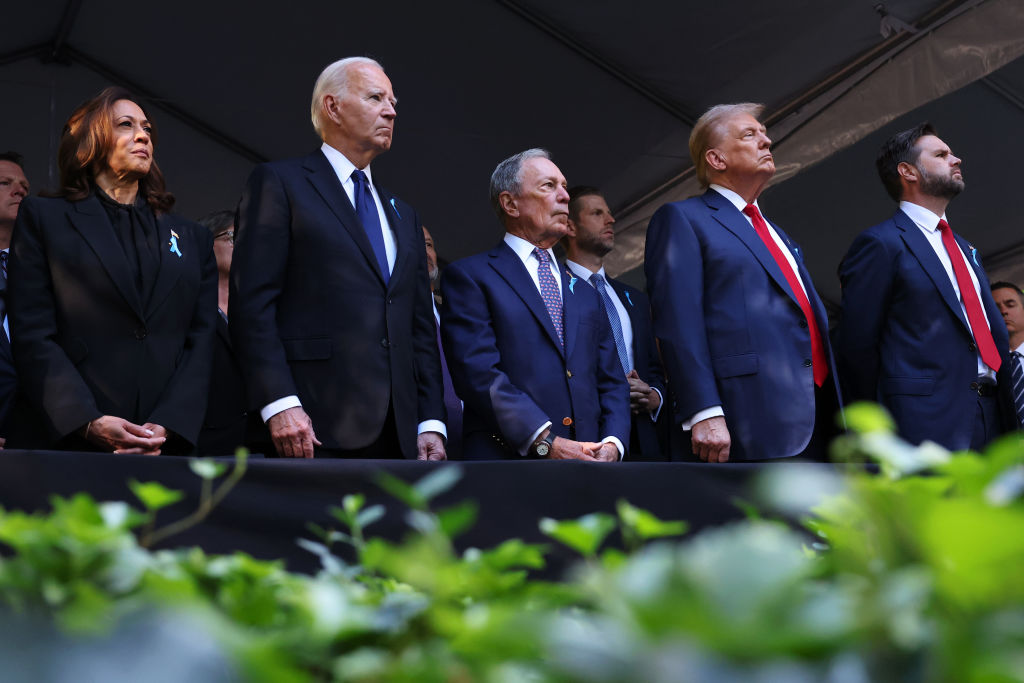
Kamala Harris, Joe Biden, Michael Bloomberg, Donald Trump and J.D. Vance attend the annual 9/11 Commemoration Ceremony on September 11, 2024 in New York City. Credit: Getty

Kamala Harris, Joe Biden, Michael Bloomberg, Donald Trump and J.D. Vance attend the annual 9/11 Commemoration Ceremony on September 11, 2024 in New York City. Credit: Getty

25 October 2024 - 2:00pm

As the 2024 presidential campaign enters the final stretch, Kamala Harris and Donald Trump have sought to underline their foreign policy differences. Some of the distinctions are clear. Harris, for instance, promises “unwavering” support to Washington’s treaty allies in Europe and East Asia, whereas Trump frequently criticises them for free-riding on American largesse. Then, of course, there is Ukraine, where Harris’s “stay the course” preference runs counter to Trump, who would like the war to end immediately even if it entails Kyiv having to agree to painful compromises.

That is as far as their differences go, however. Indeed, both candidates remain firmly attached to the idea of American hegemony. Take Trump: the former president promises to bring back a “peace through strength” doctrine, which ensures Washington remains atop the world hierarchy. For instance, when the European Union sought to build an independent military capability outside the US-dominated Nato framework, the Trump administration issued a letter to Brussels threatening consequences. And despite all the talk during his first term, Trump did not reduce US defence commitments in Europe, and in the end called for the redeployment of only 12,000 troops — many of whom would have moved from Germany to elsewhere in Europe.

Harris, meanwhile, is a liberal interventionist and an Atlanticist who has doubled down on America’s Nato commitments. She has represented the Joe Biden administration in various European security conferences with a consistent message in her back pocket: Washington is fully invested in the transatlantic alliance and wouldn’t dare leave European allies in the lurch.

The truth is that Trump and Harris have been frustratingly vague when it comes to the specific policies they would pursue abroad if elected. The former president casts himself as someone who will keep the United States out of war, even though he has flirted with bombing Mexico to take on the cartels, deepening US involvement in the Middle East by backing Israel unconditionally, and confronting China through exorbitant tariffs.

Based on what little she has said, Harris’s foreign policy looks nearly identical to her current boss, President Joe Biden. Despite her roots on the Left of the Democrats, she is pro-Israel; in Asia, she has been a strong supporter of multilateral groups such as ASEAN while favouring strong export controls to lock in US tech dominance. Although Trump was more sceptical of multilateral groupings in Asia and tended to disregard them as a waste of time, his policy on China shares the same aims as Harris’s.

Primacy has always been costly, but with new peer and near-peer competitors, the cost is rising further. Maintaining a global network of hundreds of military installations in 70 countries with well over 200,000 forces deployed at any given time is an expensive enterprise. When the goal is global dominance, every crisis becomes a priority, extending limited US military, economic and diplomatic resources around the world on behalf of allies and partners who eventually grow accustomed to the support and expect it to continue indefinitely. Add in the costs associated with developing advanced weapons systems and it’s no wonder defence spending is likely to reach $1 trillion in a few years.

Isolationists and pacifists suggest there is no need for this exorbitance, but Trump and Harris don’t have answers for these critiques. Neither has acknowledged the limits of US military resources or defined realistic foreign policy priorities that match ends with means. Similarly, neither seems likely to curtail the US defence budget or to downsize military commitments abroad. While they both want to move on from the legacies of wars in Iraq and Afghanistan, neither is ready to reduce the US military presence in the Middle East in a meaningful way. The same is true in Europe.

For Americans who increasingly favour a smaller US role in the world, this is bad news. At this point only a radical shift in US foreign policy can pull the country out of the expensive doom loop that decades of misguided policy have created. To engineer this shift, the next president will have to accept the increasingly multipolar world for what it is and adapt US policy accordingly.

Daniel R. DePetris is a fellow at Defense Priorities and a syndicated foreign affairs columnist for the Chicago Tribune. Jennifer Kavanagh is a senior fellow and director of military analysis at Defense Priorities.


China is threatening America in the AI race

Reports sugget Zhipu AI  has released a new model that can rival leading US systems. Credit: Getty

Reports sugget Zhipu AI has released a new model that can rival leading US systems. Credit: Getty

1 July 2026 - 10:18am

China is trying to catch up with America on artificial intelligence. The Wall Street Journal has reported that Zhipu AI — one of China’s six “AI tiger” LLMs — has released a new model that can rival leading US systems, including Anthropic’s Mythos, in cybersecurity tasks such as pinpointing security bugs. While this marks a milestone in China’s drive to catch up with Western AI capabilities, strong performance on a single benchmark does not mean it has taken the lead. Chinese models still lag behind their Western counterparts in broader capabilities, such as autonomous operation. Skepticism is therefore warranted before resorting to hysterical conclusions, but complacency about the geopolitical implications of China’s AI advances would be an even greater mistake.

On the infrastructure side, Chinese AI is still constrained by access to advanced chips, with American labs way ahead in computing capacity as well as investment. Analysis from earlier this year suggests that Chinese models are likely to be at least a few months behind those in the US. But they are still continuing to make progress, or that the geopolitical importance of AI will be decided only by whose LLM has ventured deeper into the technological frontier. The practical applications of AI, countries’ to capture foreign markets, and the application of AI into the real economy will matter just as much.

Here, China may hold an advantage. As with its dominance across many critical supply chains, Beijing may not need to produce the most advanced AI systems — only those that are affordable and widely deployable. In doing so, it could consolidate global influence by supplying functional, low-cost AI at scale.

Beijing seems to be pursuing exactly that path, developing an AI “open-source” strategy that offers affordable, widely available AI models for companies and individuals to use and modify as they wish. The production of the DeepSeek AI model, which matched the performance of Silicon Valley tools such as ChatGPT at a fraction of the cost for users, created goodwill among Chinese models with developers.

The four most popular models on OpenRouter, an AI hardware platform for developers, are now all Chinese. The goal for China is not only to win the frontier-model race, but to make its systems the default layer of AI adoption across industries and global markets. For most economies, the choice is increasingly between an affordable tool they can deploy now and a more robust one that may be out of reach.

And while the countries adopting Chinese models may be exposed to political pressure and cyber threats from Beijing, safer and more capable alternatives matter little if they are unaffordable. American AI companies are already under pressure to monetize products whose operating costs are rising. If Chinese open-source models become the cheap default for startups, universities, governments and businesses across the developing world, then America’s AI lead will be eroded from below.

Perhaps more concerning for America in the long run is how AI can give Chinese manufacturing even more strength, through the ongoing integration of AI as a general-purpose technology. China’s new Five-Year Plan mentioned AI more than 50 times and includes an “AI+” action plan aimed at spreading AI across the economy.

Beijing has been pioneering automation of its critical infrastructure for years, with promising recent results in increasing warplane production capacity. In that regard, China’s open-model strategy and manufacturing dominance will reinforce each other. Cheap, adaptable models accelerate deployment across the real economy while those deployments generate real-world data and use cases that can feed back into further model improvement.

The United States should not dismiss the importance of its lead in the AI race. That lead worries Beijing, not least because a more automated Chinese economy would also become more vulnerable to AI-generated cyber threats. But nor should Washington assume that China cannot catch up with American capabilities over time.

This AI competition represents part of a broader struggle over tech supply chains and geopolitical influence. Decisions over whether to adopt US or Chinese models could produce a more fragmented global reality, with different regions relying on different cloud providers, chips and security structures. The result will likely be a global economy which is divided into competing spheres, rather than one which produces a single winner.


Miquel Vila is a political and geopolitical risk consultant focusing on industrial strategy, critical infrastructure and global supply chains.

miquelvilam