






 Prefer us on Google

5 April 2025 - 7:15pm
The Democrats are at a historic ebb and now is a good time to examine what the party believes in, who its main protagonists are and what their agenda is. Amid the fraught divisions in the party, however, one faction is emerging strong: the Big Red One.
That the Left of the party is in the ascendancy is evident at both the local and national level. Rather than let the fallout of Donald Trump’s tariffs speak for itself, the new head of the Democratic National Committee engaged in mad fighting talk. Ken Martin said: “We’re coming. This is a new Democratic Party. We’re taking the gloves off.” Martin draws his support from the likes of prominent anti-Israel figure Attorney General Keith Ellison. He is also a close ally of Left-leaning Minnesota Governor and Kamala Harris running mate Tim Walz, who just released a textbook for students that echoes Critical Race Theory, including an attack on “racial capitalism”.
Martin’s elevation took place in an atmosphere that seemed to one veteran Democrat “like outtakes from a humanities seminar at a small liberal arts college”. And in place of the donor-dominated DNC leadership of the past, Martin has been lionised in the Leftist press, as a “pro-labor progressive” whose positions may offend the party’s donor base. The progressive stranglehold was made even more evident with the election of anti-gun activist David Hogg as Vice Chair of the DNC. Hogg has previously called for abolishing Immigration and Customs Enforcement (ICE), defunding police and has expressed hostility towards Israel. This will no doubt alienate more moderate Democrats.
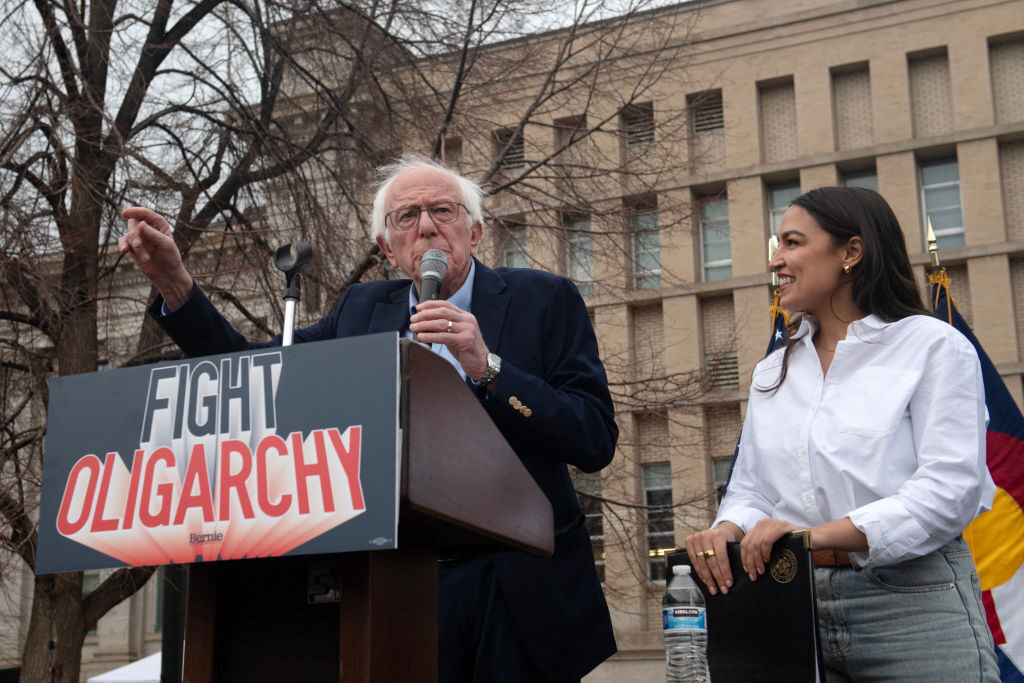
The true leaders of the Big Red One are not party apparatchiks, but populist firebrands like Bernie Sanders and Alexandria Ocasio-Cortez, who also tend to be those with far higher numbers of social media followers than more conventional party leaders. Last year, for example, AOC became the first politician to amass over a million followers on Bluesky, the liberal alternative to X.
The President’s alliance with Elon Musk and other libertarian tech bros no doubt bedevils Democrats of all stripes. But it plays into the hands of those on the Left like Sanders and AOC, who, as Vanity Fair notes, are “packing arenas” with their “oppose oligarchy tour”, where they accuse Trump-aligned oligarchs of being precursors to a new authoritarian, even fascist, regime. Some politicians feel safe enough to cheer Tesla’s decline while being reluctant to oppose the blowing up the cars among their own supporters.
The key threat to the Big Red One’s success will be at the local level. It is here — in Californian cities like San Francisco, Oakland and even Los Angeles — that moderate Democrats have scored wins against progressive regimes. But cities, and particularly their reliable Democratic primary voters, still favour the Left, as we can see in the rise of New York mayoral candidate Zohran Mamdami, who is a part of the Democratic Socialists of America (DSA). He has proposed massive expansion of the city’s welfare state.
Another Leftie, Ras Baraka, the Newark deputy mayor running for governor in New Jersey, has indulged in anti-Israel rhetoric and has links to the overtly antisemitic Nation of Islam leader Louis Farrakhan. Leticia James, New York’s firebrand Attorney General who won the civil lawsuit against Trump due to the overvaluation of his property, may also seek to win the governorship.
Leftist wannabes are particularly favoured in primaries. In California, if nothing-burger Kamala Harris stays out of the race, the leading candidates are on the Left. Notably former Congresswoman Katie Porter, a disciple of Elizabeth Warren, and Attorney General Rod Bonta, who both seem determined to seize the anti-Trump mantle from the vacillating Governor Gavin Newsom. Leftists are also on the rise on the Los Angeles City Council, which is increasingly dominated by the DSA. One newly elected member calls for the abolition, not just defunding, of police.
However, the biggest obstacle to the Democratic Left, even if they win primaries, may come at the general election. In recent years, to be sure, the Left’s share of the party has grown but moderates still represent a larger group, with most wanting the party to head back to the centre. Yet in primaries, moderate voters, according to Pew, seem far less engaged than the radical fringe.
The problem for progressives is that many of their views are shared by only a sliver of the electorate. Although their economic message may get some traction, they remain tethered by the laws of intersectionality to less popular notions such as transgenderism, racial quotas, reparations, anti-Israel sentiment and draconian climate policies, which could cost them the support of middle-class, middle-of-the-road voters. Progressives may be out of sync with the public, but their views are still cherished among some urban hipsters, powerful unions, academia and the media.
The Big Red One may have some momentum for now, but its own positions on cultural and climate issues could prove the biggest obstacle to national ascent. Trump may be wearing out his welcome in record time, yet it’s not clear if the Democrats will recover enough sanity to present a winning message.
Joel Kotkin is a Presidential Fellow in Urban Futures at Chapman University and a Senior Research Fellow at the Civitas Institute, the University of Texas at Austin.
 joelkotkin