




X Close

Arab Americans are drifting back to the Republicans

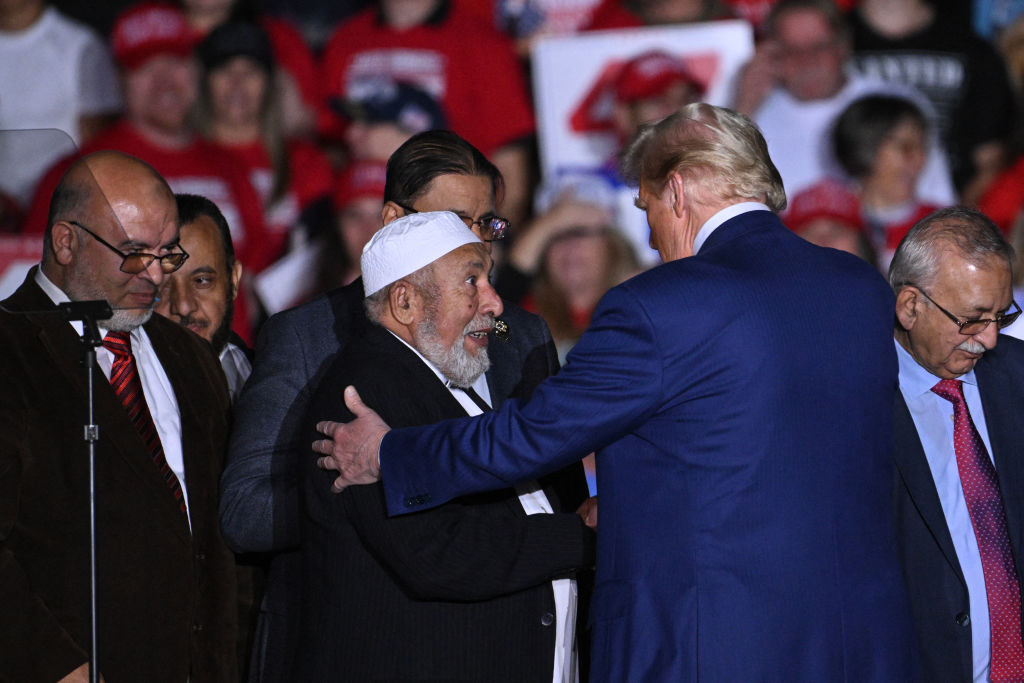
Donald Trump greets local leaders of the Muslim community who endorsed him at a rally in Michigan. Credit: Getty

Donald Trump greets local leaders of the Muslim community who endorsed him at a rally in Michigan. Credit: Getty

28 October 2024 - 1:00pm

Selling out Madison Square Garden may not have been Donald Trump’s most encouraging moment of the weekend. At a rally in Michigan, several Muslim and Arab Americans were invited on stage to endorse the Republican nominee. Community leader Imam Belal Alzuhair said: “Muslims stand with president Trump because he promises peace.”

This explicit endorsement is backed up by a recent poll which suggests that the ongoing war in Gaza is accelerating the decade-long trend of Arab Americans shifting toward the Republican Party. This week, Arab News and YouGov found Trump winning 45% to 43% among Arab Americans, marking a ten-point rise in support for the Republican nominee compared to the previous presidential election and a 23-point increase for the GOP since 2008.

This voting bloc leaned Republican prior to the 9/11 attacks, when George W. Bush won about 45% of the vote in 2000, but that dynamic drastically changed in the years that followed, with Democrat John Kerry winning the support of 76% of Arab Americans in 2004.

But more recently, Arab Americans have gradually drifted back to the Right, rising from 22% support for Republican John McCain in 2008 to 35% for Trump in 2020. Donald Trump’s ban on travel from some Muslim-majority countries may have slowed the movement of this demographic toward the GOP, but nonetheless his support with this group recovered from 26% in 2016 to its current high of 45%.

The GOP’s realignment on foreign policy and Trump’s criticism of the war in Iraq likely played a role, as did the Democrats’ embrace of progressive stances on issues of gender and sexuality. For instance, Arab and Muslim parents played a significant role in protests against LGBT-focused school curriculum in 2022.

However, the 10-point jump over the past election cycle is an outlier, indicating that recent events in the Middle East — and Democrats’ support for Israel — intensified Arab Americans’ Rightward drift. While both Kamala Harris and Trump support Israel, Democrats have occupied the White House over the past year while the US has funded Israel’s military operations in Gaza and Lebanon, landing both Harris and President Joe Biden directly in the crosshairs of pro-Palestine activists.

Faisal J. Abbas, editor-in-chief of Arab News, the outlet behind the newest poll, attributed the drift of the Arab American vote to the Gaza conflict. “What happens in the Middle East clearly doesn’t stay in the Middle East,” he said. “While most of us here in the Arab world might be indifferent, and don’t have a say anyway, as to which candidate ends up winning, clearly Arab voters in America feel strongly about the handling of the Gaza crisis since it erupted last Oct. 7.”

Amer Ghalib, the mayor of Hamtramck, Michigan, offered a window into the realignment earlier this year. He endorsed Trump in September, citing the conflict in the Middle East. “He assured [me] that his goal is to end the chaos in the Middle East and elsewhere. He doesn’t want wars,” Ghalib said. Hamtramck became the first Muslim majority city in the US in 2013, and Ghalib, who migrated there from Yemen, was the town’s first Muslim mayor. He previously made headlines for banning LGBT pride flags from city property.

The Uncommitted movement, a pro-Palestine group in Michigan that’s pressuring Harris to stop supporting Israel, recently came out against Trump and third party candidates but has yet to endorse Harris. Earlier this year, they encouraged voters to decline to vote for Biden in the primaries as a symbolic protest.

The latest polling marks a considerable escalation of the Rightward drift compared to the past few elections, and a downturn for Democrats which could have major implications in Michigan, a pivotal swing state. In the spring, the Arab American Institute found Trump winning among Arab Americans. James Zogby, president of the AAI, said Arab Americans are “still seething over the pain of Gaza […] and they’re not willing to put that away”.


is UnHerd’s US correspondent.

laureldugg

China is threatening America in the AI race

Reports sugget Zhipu AI  has released a new model that can rival leading US systems. Credit: Getty

Reports sugget Zhipu AI has released a new model that can rival leading US systems. Credit: Getty

1 July 2026 - 10:18am

China is trying to catch up with America on artificial intelligence. The Wall Street Journal has reported that Zhipu AI — one of China’s six “AI tiger” LLMs — has released a new model that can rival leading US systems, including Anthropic’s Mythos, in cybersecurity tasks such as pinpointing security bugs. While this marks a milestone in China’s drive to catch up with Western AI capabilities, strong performance on a single benchmark does not mean it has taken the lead. Chinese models still lag behind their Western counterparts in broader capabilities, such as autonomous operation. Skepticism is therefore warranted before resorting to hysterical conclusions, but complacency about the geopolitical implications of China’s AI advances would be an even greater mistake.

On the infrastructure side, Chinese AI is still constrained by access to advanced chips, with American labs way ahead in computing capacity as well as investment. Analysis from earlier this year suggests that Chinese models are likely to be at least a few months behind those in the US. But they are still continuing to make progress, or that the geopolitical importance of AI will be decided only by whose LLM has ventured deeper into the technological frontier. The practical applications of AI, countries’ to capture foreign markets, and the application of AI into the real economy will matter just as much.

Here, China may hold an advantage. As with its dominance across many critical supply chains, Beijing may not need to produce the most advanced AI systems — only those that are affordable and widely deployable. In doing so, it could consolidate global influence by supplying functional, low-cost AI at scale.

Beijing seems to be pursuing exactly that path, developing an AI “open-source” strategy that offers affordable, widely available AI models for companies and individuals to use and modify as they wish. The production of the DeepSeek AI model, which matched the performance of Silicon Valley tools such as ChatGPT at a fraction of the cost for users, created goodwill among Chinese models with developers.

The four most popular models on OpenRouter, an AI hardware platform for developers, are now all Chinese. The goal for China is not only to win the frontier-model race, but to make its systems the default layer of AI adoption across industries and global markets. For most economies, the choice is increasingly between an affordable tool they can deploy now and a more robust one that may be out of reach.

And while the countries adopting Chinese models may be exposed to political pressure and cyber threats from Beijing, safer and more capable alternatives matter little if they are unaffordable. American AI companies are already under pressure to monetize products whose operating costs are rising. If Chinese open-source models become the cheap default for startups, universities, governments and businesses across the developing world, then America’s AI lead will be eroded from below.

Perhaps more concerning for America in the long run is how AI can give Chinese manufacturing even more strength, through the ongoing integration of AI as a general-purpose technology. China’s new Five-Year Plan mentioned AI more than 50 times and includes an “AI+” action plan aimed at spreading AI across the economy.

Beijing has been pioneering automation of its critical infrastructure for years, with promising recent results in increasing warplane production capacity. In that regard, China’s open-model strategy and manufacturing dominance will reinforce each other. Cheap, adaptable models accelerate deployment across the real economy while those deployments generate real-world data and use cases that can feed back into further model improvement.

The United States should not dismiss the importance of its lead in the AI race. That lead worries Beijing, not least because a more automated Chinese economy would also become more vulnerable to AI-generated cyber threats. But nor should Washington assume that China cannot catch up with American capabilities over time.

This AI competition represents part of a broader struggle over tech supply chains and geopolitical influence. Decisions over whether to adopt US or Chinese models could produce a more fragmented global reality, with different regions relying on different cloud providers, chips and security structures. The result will likely be a global economy which is divided into competing spheres, rather than one which produces a single winner.


Miquel Vila is a political and geopolitical risk consultant focusing on industrial strategy, critical infrastructure and global supply chains.

miquelvilam