




X Close

Anti-abortion activists are not free speech martyrs

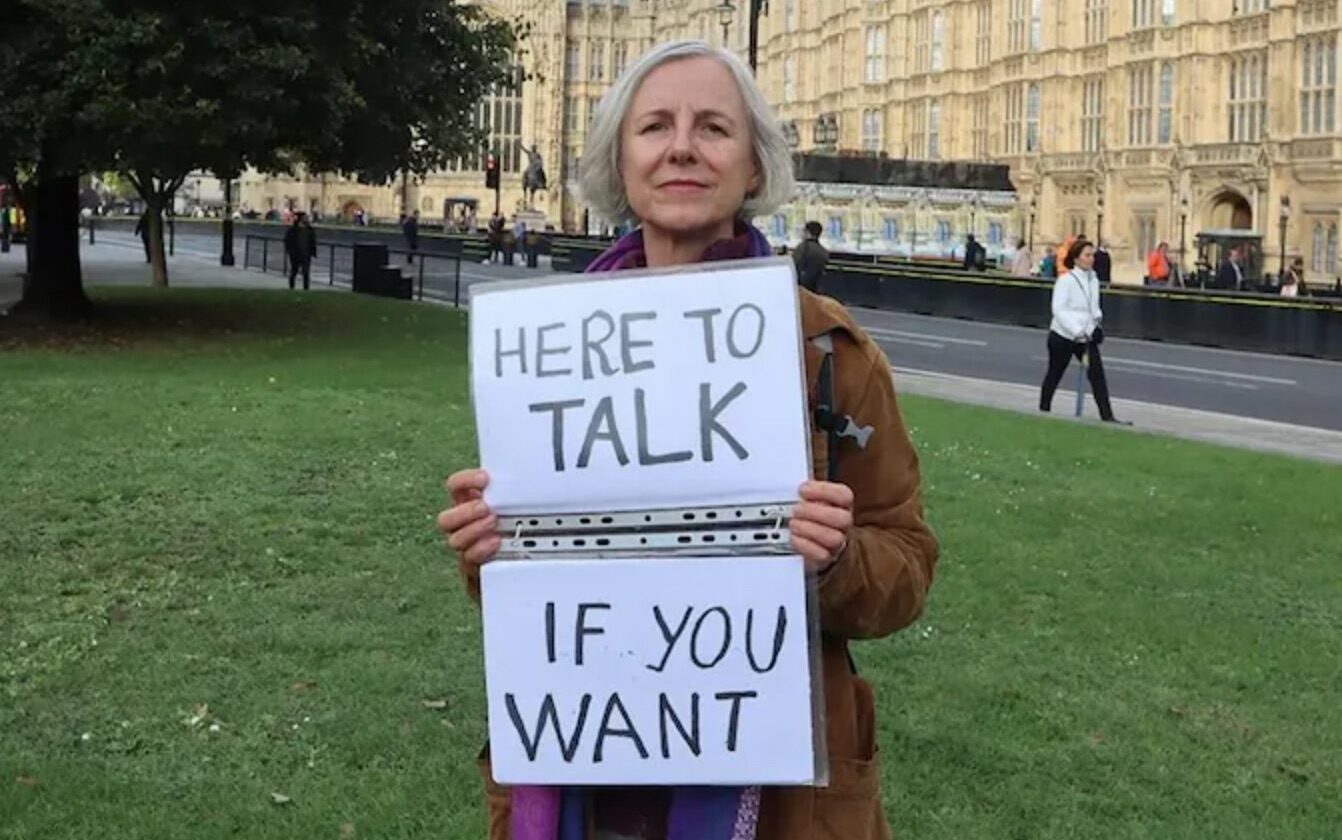
Livia Tossici-Bolt has declared herself a victim of censorship. Credit: ADF International

Livia Tossici-Bolt has declared herself a victim of censorship. Credit: ADF International

2 April 2025 - 7:00am

Does anyone have the right to feel harassed by a sign that says “here to talk if you want to”? When 40 Days for Life campaigner Livia Tossici-Bolt held up her sign while standing opposite an abortion clinic two years ago, she certainly wished to make a point. But it’s unlikely that she realised just how far things would go.

Tossici-Bolt now faces prosecution for breaching the required protection zones around abortion clinics, which were brought in to prevent the harassment of women on their way to procedures. More than that, her case has now been picked up by the US State Department, which has issued a statement of concern “about freedom of expression in the United Kingdom”, even suggesting there should “be no free trade without free speech”. Tossici-Bolt, welcoming the US support, has declared her case to be “but one example of the extreme and undeniable state of censorship in Great Britain today”. Is it really, though?

As someone who has, in recent years, expressed such controversial views as “sex is immutable” and “we shouldn’t sterilise autistic children”, I am tempted to be on Tossici-Bolt’s side. I’ve always been pro-choice, but one of the consequences of being accused of hateful bigotry is that it makes you less judgemental of those you might have wished to silence previously. In response to the harsh policing of their own speech, many feminists have made common cause with free speech advocates who might once have been opponents. This is broadly a good thing, but it has its problems.

In the absence of deeper political principles, one can quickly see the right to speak merge with the right to silence others. The progressive Left has been particularly expert at achieving this, recasting its own demand for dominance as granting the marginalised a voice. Following a recent ruling against Sussex University, which was fined half a million pounds after the hounding of feminist philosopher Kathleen Stock, Sussex Vice Chancellor Sasha Roseneil complained that universities were falling victim to a “sort of libertarian, free speech absolutism”. Yet what is more “absolutist”: defending a woman making such benign claims as “lesbians are same-sex attracted females”, or defending a masked mob yelling “no terfs here”? Whatever Roseneil and others claim, it seems they are the ones who wanted unfettered free speech — just not for anyone outside their charmed circle.

Where, then, should feminists stand with regard to Tossici-Bolt’s “here to talk if you want to”? It is not an openly aggressive sign. Nonetheless, just like trans activist stickers and placards at Sussex, it is a protest that wishes to limit the freedom of others. I am in favour of buffer zones around abortion clinics for the same reason I am in favour of women-only spaces and the right to describe others using sex-based pronouns. I care about freedom of speech — including that of people who disagree with me — but I also care about protecting women’s boundaries, particularly when they are at their most vulnerable.

The sign is not referring to a nice, friendly chat. A woman or girl seeking an abortion could very easily be traumatised by the presence of a 40 Days of Life activist opposite the clinic, even one who calls her placards “solidarity signs” and insists she speaks “in a loving way”. Tossici-Bolt wants to stop women and girls from having abortions (“I rejoice when a life is saved”). She wants to put them on the spot (“it would have been lovely,” she claims, “if the officer had gone to the person [who complained] and asked me why I was harassing them”).  She has a right to debate the issue, but not in that space, with women at such an emotional time, about whose lives she knows nothing at all.

Tossici-Bolt is not a free speech martyr. The Trump administration may wish to make her one, but that is pure opportunism, a way to score points in a free trade battle while stirring up anti-choice sentiment. She had multiple opportunities to take her protest outside of the buffer zone but refused. There is a clear reason why that expression, in that space, at that time, was wrong.

Women and girls in the act of seeking abortions are not the ones who campaign to defend abortion laws. Tossici-Bolt could have presented her case to the latter. The irony is, she may find that feminists have never been more willing to allow her the space to talk.


Victoria Smith is a writer and creator of the Glosswitch newsletter.

glosswitch

China is threatening America in the AI race

Reports sugget Zhipu AI  has released a new model that can rival leading US systems. Credit: Getty

Reports sugget Zhipu AI has released a new model that can rival leading US systems. Credit: Getty

1 July 2026 - 10:18am

China is trying to catch up with America on artificial intelligence. The Wall Street Journal has reported that Zhipu AI — one of China’s six “AI tiger” LLMs — has released a new model that can rival leading US systems, including Anthropic’s Mythos, in cybersecurity tasks such as pinpointing security bugs. While this marks a milestone in China’s drive to catch up with Western AI capabilities, strong performance on a single benchmark does not mean it has taken the lead. Chinese models still lag behind their Western counterparts in broader capabilities, such as autonomous operation. Skepticism is therefore warranted before resorting to hysterical conclusions, but complacency about the geopolitical implications of China’s AI advances would be an even greater mistake.

On the infrastructure side, Chinese AI is still constrained by access to advanced chips, with American labs way ahead in computing capacity as well as investment. Analysis from earlier this year suggests that Chinese models are likely to be at least a few months behind those in the US. But they are still continuing to make progress, or that the geopolitical importance of AI will be decided only by whose LLM has ventured deeper into the technological frontier. The practical applications of AI, countries’ to capture foreign markets, and the application of AI into the real economy will matter just as much.

Here, China may hold an advantage. As with its dominance across many critical supply chains, Beijing may not need to produce the most advanced AI systems — only those that are affordable and widely deployable. In doing so, it could consolidate global influence by supplying functional, low-cost AI at scale.

Beijing seems to be pursuing exactly that path, developing an AI “open-source” strategy that offers affordable, widely available AI models for companies and individuals to use and modify as they wish. The production of the DeepSeek AI model, which matched the performance of Silicon Valley tools such as ChatGPT at a fraction of the cost for users, created goodwill among Chinese models with developers.

The four most popular models on OpenRouter, an AI hardware platform for developers, are now all Chinese. The goal for China is not only to win the frontier-model race, but to make its systems the default layer of AI adoption across industries and global markets. For most economies, the choice is increasingly between an affordable tool they can deploy now and a more robust one that may be out of reach.

And while the countries adopting Chinese models may be exposed to political pressure and cyber threats from Beijing, safer and more capable alternatives matter little if they are unaffordable. American AI companies are already under pressure to monetize products whose operating costs are rising. If Chinese open-source models become the cheap default for startups, universities, governments and businesses across the developing world, then America’s AI lead will be eroded from below.

Perhaps more concerning for America in the long run is how AI can give Chinese manufacturing even more strength, through the ongoing integration of AI as a general-purpose technology. China’s new Five-Year Plan mentioned AI more than 50 times and includes an “AI+” action plan aimed at spreading AI across the economy.

Beijing has been pioneering automation of its critical infrastructure for years, with promising recent results in increasing warplane production capacity. In that regard, China’s open-model strategy and manufacturing dominance will reinforce each other. Cheap, adaptable models accelerate deployment across the real economy while those deployments generate real-world data and use cases that can feed back into further model improvement.

The United States should not dismiss the importance of its lead in the AI race. That lead worries Beijing, not least because a more automated Chinese economy would also become more vulnerable to AI-generated cyber threats. But nor should Washington assume that China cannot catch up with American capabilities over time.

This AI competition represents part of a broader struggle over tech supply chains and geopolitical influence. Decisions over whether to adopt US or Chinese models could produce a more fragmented global reality, with different regions relying on different cloud providers, chips and security structures. The result will likely be a global economy which is divided into competing spheres, rather than one which produces a single winner.


Miquel Vila is a political and geopolitical risk consultant focusing on industrial strategy, critical infrastructure and global supply chains.

miquelvilam