




X Close

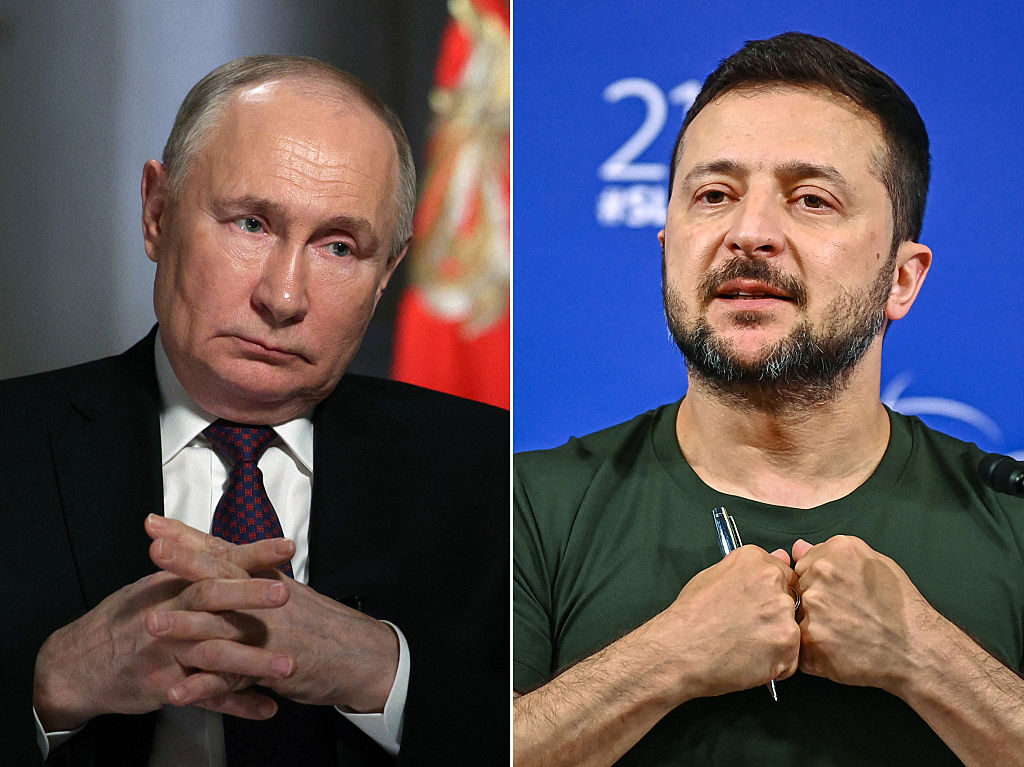
A Putin-Zelensky meeting is long overdue

Talk isn't always cheap. Credit: Getty

Talk isn’t always cheap. Credit: Getty

12 May 2025 - 7:00pm

It is a great pity that the proposals and counter-proposals of the Ukrainian and Russian governments in recent days have been mostly a show for the benefit of Donald Trump. For if the two sides really would sit down to talk in Istanbul as they did in March 2022, there might be a chance of bringing the war to an end.

This furious bout of diplomatic tennis has been caused by Trump’s threat to “walk away” from the peace process if the two sides do not agree soon. Both are desperate that if this happens, he should blame the other for the failure. If he blames Kyiv, then US military and intelligence aid to Ukraine will be suspended, greatly weakening the country’s war effort. If he blames Moscow, then this aid will continue. Whether it would halt the Russian advance is not clear, but it would certainly help the Ukrainians to slow it down and to go on inflicting heavy casualties on enemy forces. Moscow also hopes that even if the Ukraine peace talks break down, the Trump administration will still seek cooperation with Russia in other areas.

The latest diplomatic serve has been Zelensky’s proposal that Putin meet him for direct talks in Istanbul on Thursday (Putin had previously suggested that Ukrainian and Russian negotiators meet there). It is not clear, however, if the Ukrainian leader is still demanding Russia must first declare a 30-day ceasefire in order for this to happen. Since Russia now has the military advantage, it would mean that it would have to give up its main point of leverage in talks. And if — as is almost certain — the talks did not reach agreement and Russia resumed the war, it would be seen by Trump (and perhaps most of the world) as wholly responsible for the war’s continuation.

If Zelensky is willing to drop this condition, then Putin should go. Even if they spent most of the time shouting at each other, something might be achieved; and the refusal of world leaders to talk to each other is simply childish. On that score, if Putin did turn up in Istanbul he would theoretically be liable to arrest for war crimes on the warrant of the International Criminal Court. In practice, Turkey would ignore this, just as most Western countries have in practice managed to ignore the war crimes charges against Israel. Nonetheless, this is an example of how sanctimonious European legalism, heavily flavoured with hypocrisy, can complicate international diplomacy.

While Trump has failed to bring the two sides to a settlement, and the war will continue, it is worth noting that his administration has achieved a good deal in the past three months. As of January, Kyiv’s official position was that it would not negotiate with the Putin administration at all, unless Russia first withdrew completely from all the territory it has occupied in Ukraine since 2014 — a completely pointless proposition. Russia, for its part, has now accepted that Ukraine has the right to join the European Union — something which, if it can be achieved, would be of far greater economic benefit to Kyiv than Nato membership.

If Ukraine and Russia can finally agree to meet and talk without preconditions, then Istanbul is a good place to do so. The March 2022 talks in Turkey did not reach an agreement, but they seem to have made real progress on some of the basic terms for any realistically conceivable settlement. Among them is the stipulation that Ukraine should be neutral with international guarantees; that Russia should remain in occupation of certain territories, but that their legal status should be deferred to future negotiation; that Kyiv can accept certain limits on its armed forces, but not to the point where its defences would be seriously undermined; and that any guarantees concerning the linguistic and cultural rights of Russian speakers in Ukraine must be matched by guarantees for Ukrainians in Russia.

A meeting in Turkey won’t end the war overnight, but it could restart the only serious path to peace. The outlines of a deal already exist. What’s missing is the political will. If Putin and Zelensky are serious about ending the bloodshed, they should sit down and talk.


Anatol Lieven is a former war correspondent and Director of the Eurasia Program at the Quincy Institute for Responsible Statecraft in Washington DC.

lieven_anatol

China is threatening America in the AI race

Reports sugget Zhipu AI  has released a new model that can rival leading US systems. Credit: Getty

Reports sugget Zhipu AI has released a new model that can rival leading US systems. Credit: Getty

1 July 2026 - 10:18am

China is trying to catch up with America on artificial intelligence. The Wall Street Journal has reported that Zhipu AI — one of China’s six “AI tiger” LLMs — has released a new model that can rival leading US systems, including Anthropic’s Mythos, in cybersecurity tasks such as pinpointing security bugs. While this marks a milestone in China’s drive to catch up with Western AI capabilities, strong performance on a single benchmark does not mean it has taken the lead. Chinese models still lag behind their Western counterparts in broader capabilities, such as autonomous operation. Skepticism is therefore warranted before resorting to hysterical conclusions, but complacency about the geopolitical implications of China’s AI advances would be an even greater mistake.

On the infrastructure side, Chinese AI is still constrained by access to advanced chips, with American labs way ahead in computing capacity as well as investment. Analysis from earlier this year suggests that Chinese models are likely to be at least a few months behind those in the US. But they are still continuing to make progress, or that the geopolitical importance of AI will be decided only by whose LLM has ventured deeper into the technological frontier. The practical applications of AI, countries’ to capture foreign markets, and the application of AI into the real economy will matter just as much.

Here, China may hold an advantage. As with its dominance across many critical supply chains, Beijing may not need to produce the most advanced AI systems — only those that are affordable and widely deployable. In doing so, it could consolidate global influence by supplying functional, low-cost AI at scale.

Beijing seems to be pursuing exactly that path, developing an AI “open-source” strategy that offers affordable, widely available AI models for companies and individuals to use and modify as they wish. The production of the DeepSeek AI model, which matched the performance of Silicon Valley tools such as ChatGPT at a fraction of the cost for users, created goodwill among Chinese models with developers.

The four most popular models on OpenRouter, an AI hardware platform for developers, are now all Chinese. The goal for China is not only to win the frontier-model race, but to make its systems the default layer of AI adoption across industries and global markets. For most economies, the choice is increasingly between an affordable tool they can deploy now and a more robust one that may be out of reach.

And while the countries adopting Chinese models may be exposed to political pressure and cyber threats from Beijing, safer and more capable alternatives matter little if they are unaffordable. American AI companies are already under pressure to monetize products whose operating costs are rising. If Chinese open-source models become the cheap default for startups, universities, governments and businesses across the developing world, then America’s AI lead will be eroded from below.

Perhaps more concerning for America in the long run is how AI can give Chinese manufacturing even more strength, through the ongoing integration of AI as a general-purpose technology. China’s new Five-Year Plan mentioned AI more than 50 times and includes an “AI+” action plan aimed at spreading AI across the economy.

Beijing has been pioneering automation of its critical infrastructure for years, with promising recent results in increasing warplane production capacity. In that regard, China’s open-model strategy and manufacturing dominance will reinforce each other. Cheap, adaptable models accelerate deployment across the real economy while those deployments generate real-world data and use cases that can feed back into further model improvement.

The United States should not dismiss the importance of its lead in the AI race. That lead worries Beijing, not least because a more automated Chinese economy would also become more vulnerable to AI-generated cyber threats. But nor should Washington assume that China cannot catch up with American capabilities over time.

This AI competition represents part of a broader struggle over tech supply chains and geopolitical influence. Decisions over whether to adopt US or Chinese models could produce a more fragmented global reality, with different regions relying on different cloud providers, chips and security structures. The result will likely be a global economy which is divided into competing spheres, rather than one which produces a single winner.


Miquel Vila is a political and geopolitical risk consultant focusing on industrial strategy, critical infrastructure and global supply chains.

miquelvilam