




X Close

A digital currency won’t free Europe

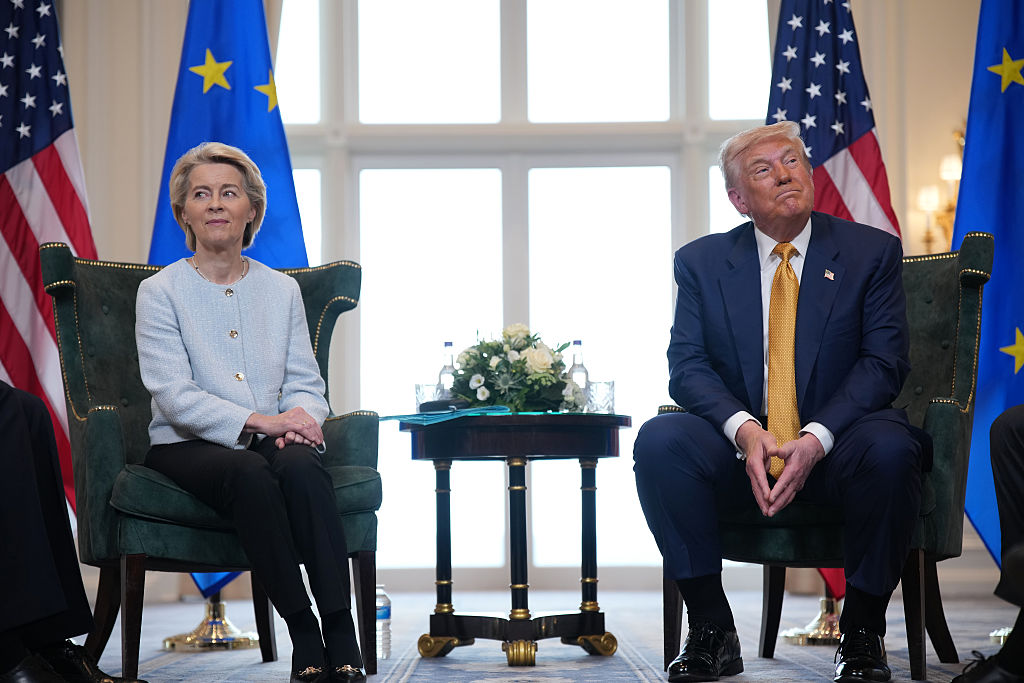
The Trump administration has used America's financial system to sanction European citizens. Credit: Getty

The Trump administration has used America's financial system to sanction European citizens. Credit: Getty

June 25 2026 - 12:03pm

The European Central Bank (ECB) scored a parliamentary breakthrough on Tuesday. The European Parliament’s economic affairs (ECON) committee endorsed its long-gestating plan for a digital euro, and in doing so paved the way for a central-bank-backed electronic payment instrument meant to loosen the eurozone’s grip on US credit card networks. The vote doesn’t amount to a final adoption: ECON has merely set Parliament’s negotiating position. Another vote will be needed and Council negotiations still lie ahead.

In essence, the digital euro would be an electronic wallet distributed by banks or fintechs but guaranteed directly by the ECB. This would let eurozone residents pay online and in person without routing through a US intermediary. The money wouldn’t come from a commercial bank deposit or funds held in a private fintech app, but would be a direct liability of the ECB.

Six years in the making, the project has become a priority since Donald Trump’s return to the White House. His administration has slapped tariffs on the EU and other allies, and Washington’s readiness to weaponize its grip on Visa and Mastercard payments is no longer a distant possibility.

The Trump administration has recently broadened its hostility to Europe and shown nothing is off the cards. The risk was recently highlighted by American sanctions being placed on European officials it didn’t like — among them UN Special Rapporteur on the Palestinian territories Francesca Albanese and several International Criminal Court (ICC) judges. As a result, those individuals can no longer open a bank account anywhere in Europe, since any bank dealing with them risks being sanctioned itself.

As Slovenian judge Beti Hohler put it, being sanctioned cut her off from her Apple ID, iCloud, Amazon, Airbnb and PayPal “overnight, without advance warning”. French judge Nicolas Guillou, also sanctioned, described himself as “effectively blacklisted by much of the world’s banking system”. Washington, in other words, can erase a European citizen’s financial existence and governments are powerless to stop it. That’s the problem the digital euro is meant to solve. But does this plan actually have any prospect of achieving that purpose?

The idea is simple enough: money would be issued directly by the ECB rather than by a commercial bank, so citizens effectively hold an account with the central bank itself. Today, the bulk of European card and digital payments flow through Visa, Mastercard and US platforms like Apple Pay and PayPal; a genuinely sovereign digital euro would let Europe run its own payment rails, immune to a US company’s — or the US government’s — say-so.

There is the possibility that a digital euro risks becoming a vehicle for centralizing financial surveillance at the ECB level, eroding both privacy and national banking sovereignty. On paper, the current draft answers this: privacy-by-design principles, zero-knowledge proofs to verify transactions without exposing personal data and no ECB access to identifying information.

However, German MEP Fabio De Masi, who voted against the bill, points out that the digital euro is slated for integration into the EU’s digital identity (EUDI) wallet — meaning payment data and identity verification will eventually merge. The one genuine privilege of physical companies is the ability to transact below the radar, but this would survive in neither the digital euro’s online nor its offline form. Even worse: large factions in Parliament want the digital euro wired directly into the enforcement of EU sanctions against EU citizens themselves, which is worrying for civil freedom.

So, it’s clear Europeans need to extricate themselves from American financial tutelage. But the answer can’t be to hand more power to the very Brussels institutions that have spent decades hollowing out the sovereignty of European nation-states, often at Washington’s own request.


Thomas Fazi is an UnHerd columnist and translator. His latest book is The Covid Consensus, co-authored with Toby Green.

battleforeurope

China is threatening America in the AI race

Reports sugget Zhipu AI  has released a new model that can rival leading US systems. Credit: Getty

Reports sugget Zhipu AI has released a new model that can rival leading US systems. Credit: Getty

July 1 2026 - 10:18am

China is trying to catch up with America on artificial intelligence. The Wall Street Journal has reported that Zhipu AI — one of China’s six “AI tiger” LLMs — has released a new model that can rival leading US systems, including Anthropic’s Mythos, in cybersecurity tasks such as pinpointing security bugs. While this marks a milestone in China’s drive to catch up with Western AI capabilities, strong performance on a single benchmark does not mean it has taken the lead. Chinese models still lag behind their Western counterparts in broader capabilities, such as autonomous operation. Skepticism is therefore warranted before resorting to hysterical conclusions, but complacency about the geopolitical implications of China’s AI advances would be an even greater mistake.

On the infrastructure side, Chinese AI is still constrained by access to advanced chips, with American labs way ahead in computing capacity as well as investment. Analysis from earlier this year suggests that Chinese models are likely to be at least a few months behind those in the US. But they are still continuing to make progress, or that the geopolitical importance of AI will be decided only by whose LLM has ventured deeper into the technological frontier. The practical applications of AI, countries’ to capture foreign markets, and the application of AI into the real economy will matter just as much.

Here, China may hold an advantage. As with its dominance across many critical supply chains, Beijing may not need to produce the most advanced AI systems — only those that are affordable and widely deployable. In doing so, it could consolidate global influence by supplying functional, low-cost AI at scale.

Beijing seems to be pursuing exactly that path, developing an AI “open-source” strategy that offers affordable, widely available AI models for companies and individuals to use and modify as they wish. The production of the DeepSeek AI model, which matched the performance of Silicon Valley tools such as ChatGPT at a fraction of the cost for users, created goodwill among Chinese models with developers.

The four most popular models on OpenRouter, an AI hardware platform for developers, are now all Chinese. The goal for China is not only to win the frontier-model race, but to make its systems the default layer of AI adoption across industries and global markets. For most economies, the choice is increasingly between an affordable tool they can deploy now and a more robust one that may be out of reach.

And while the countries adopting Chinese models may be exposed to political pressure and cyber threats from Beijing, safer and more capable alternatives matter little if they are unaffordable. American AI companies are already under pressure to monetize products whose operating costs are rising. If Chinese open-source models become the cheap default for startups, universities, governments and businesses across the developing world, then America’s AI lead will be eroded from below.

Perhaps more concerning for America in the long run is how AI can give Chinese manufacturing even more strength, through the ongoing integration of AI as a general-purpose technology. China’s new Five-Year Plan mentioned AI more than 50 times and includes an “AI+” action plan aimed at spreading AI across the economy.

Beijing has been pioneering automation of its critical infrastructure for years, with promising recent results in increasing warplane production capacity. In that regard, China’s open-model strategy and manufacturing dominance will reinforce each other. Cheap, adaptable models accelerate deployment across the real economy while those deployments generate real-world data and use cases that can feed back into further model improvement.

The United States should not dismiss the importance of its lead in the AI race. That lead worries Beijing, not least because a more automated Chinese economy would also become more vulnerable to AI-generated cyber threats. But nor should Washington assume that China cannot catch up with American capabilities over time.

This AI competition represents part of a broader struggle over tech supply chains and geopolitical influence. Decisions over whether to adopt US or Chinese models could produce a more fragmented global reality, with different regions relying on different cloud providers, chips and security structures. The result will likely be a global economy which is divided into competing spheres, rather than one which produces a single winner.


Miquel Vila is a political and geopolitical risk consultant focusing on industrial strategy, critical infrastructure and global supply chains.

miquelvilam