




X Close

A British DOGE will never succeed

Politics by meme and shitpost coming to a town near you. Credit: Getty

Politics by meme and shitpost coming to a town near you. Credit: Getty

22 February 2025 - 12:00pm

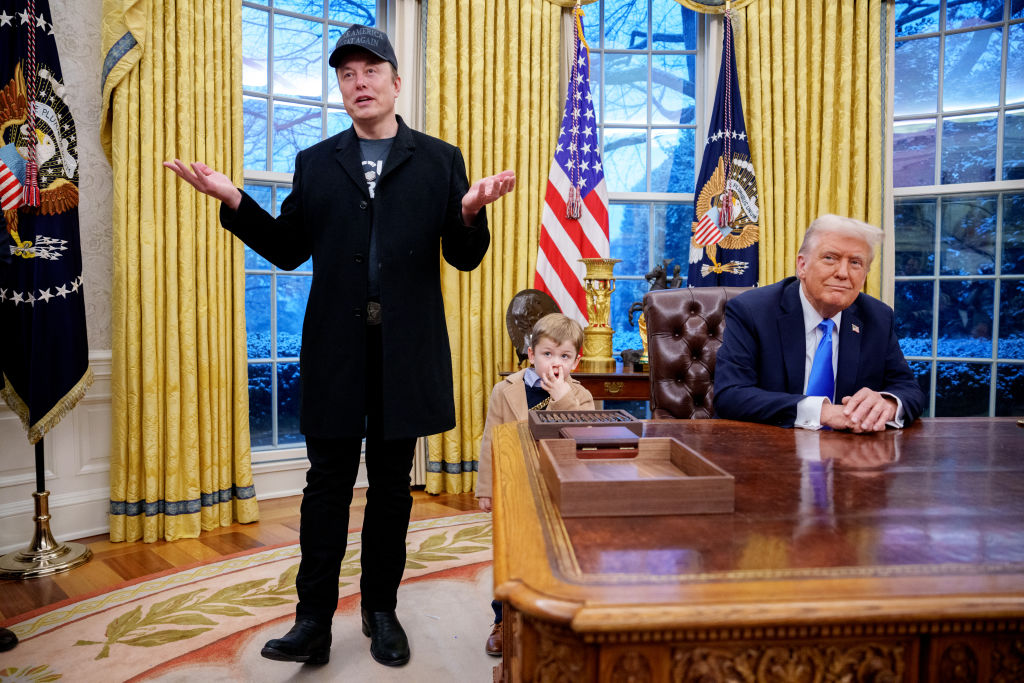
Elon Musk may be winding up half of America with his incessant and inflammatory tweets, and his powerful presence in the Trump White House. But in Britain, his drive to root out waste in the federal government is inspiring a number of conservatives to campaign for something similar.

Musk’s Department of Government Efficiency (DOGE) unit has sprouted “an army of British copycats” according to Politico, with various UK Right-wingers launching their own crusades against government waste. “They’ve been highlighting British government contracts, taking shots at perceived state over-reach,” it reports, adding that some are “weaponising publicly available information.”

It’s an easy case to make, particularly from Opposition — few will go out to defend government waste, and those that try will make a fool of themselves. Simply shine your searchlight in enough dark corners of the state and you’re bound to find some government-funded arty-farty project with an abstract, liberal-sounding name to serve as an unjustifiable exemplar that gives the story legs.

This is nothing new. The Right has campaigned against government waste and red tape for decades, even though they have little to show for it in practice. Just look at the Tories: after 14 years in power, government spending is higher than ever, with taxes approaching postwar highs.

The only new feature of this anti-waste movement is the motive. The activists behind it seem less driven by government efficiency as a conservative end in itself, animated instead by what they see as a new front in the culture war. Now, wasteful government spending has been explicitly given a “woke” identity, to energise activists.

Attaching a liberal label to government largesse will be an effective campaigning tool, but there is a danger here for the young British right behind the campaigns copy and pasted from the US. The merging of “terminally online” Right-wing culture between Britain and America, accelerated by Musk’s X platform, has resulted in British political activists aping the language of the US Right. DOGE-admirers should be wary of just how culturally detached they can appear to their fellow “NPC” citizens, for whom there doesn’t seem to be much empathy or respect.

Musk’s DOGE has promised to take a chainsaw to US federal government spending. But it is unclear that UK activists are really prepared to face the electorate wielding a chainsaw, ready to slice through some of the real big ticket items of government spending like the NHS, schools or defence. A couple of million pounds in grants to “woke” causes here or there is small fry compared to the vast scale of government expenditure on health, or pensions. Recognising this, Tory leader Kemi Badenoch said: “You can try and make services more efficient, or you can just stop doing things, which is what they’ve done in Argentina, which is the ‘Afuera’ model, as I call it. I think that’s likely to be much more effective.” Good luck communicating to the voters where the axe will fall, with public services already crumbling.

But for now, the movement is having fun, and seems almost relieved to be unburdened of the expectation of actually delivering — safe in the playful titillation of nudge-nudge wink-wink nomenclature, exemplified by the Spectator’s Project Against Frivolous Funding (SPAFF). This is Opposition politics by smirk and shitpost.

The British Right has jumped on board because it doesn’t require the hard, introspective and complicated thinking of what went wrong in government — and because it’s a template that already exists in the US, ready to copy. Jumping from ideology to ideology was one of the things that did for the Conservatives and their legacy in the last government. Why will this latest project prove any different?


James Sean Dickson is an analyst and journalist who Substacks at Himbonomics.

Gaylussite

China is threatening America in the AI race

Reports sugget Zhipu AI  has released a new model that can rival leading US systems. Credit: Getty

Reports sugget Zhipu AI has released a new model that can rival leading US systems. Credit: Getty

1 July 2026 - 10:18am

China is trying to catch up with America on artificial intelligence. The Wall Street Journal has reported that Zhipu AI — one of China’s six “AI tiger” LLMs — has released a new model that can rival leading US systems, including Anthropic’s Mythos, in cybersecurity tasks such as pinpointing security bugs. While this marks a milestone in China’s drive to catch up with Western AI capabilities, strong performance on a single benchmark does not mean it has taken the lead. Chinese models still lag behind their Western counterparts in broader capabilities, such as autonomous operation. Skepticism is therefore warranted before resorting to hysterical conclusions, but complacency about the geopolitical implications of China’s AI advances would be an even greater mistake.

On the infrastructure side, Chinese AI is still constrained by access to advanced chips, with American labs way ahead in computing capacity as well as investment. Analysis from earlier this year suggests that Chinese models are likely to be at least a few months behind those in the US. But they are still continuing to make progress, or that the geopolitical importance of AI will be decided only by whose LLM has ventured deeper into the technological frontier. The practical applications of AI, countries’ to capture foreign markets, and the application of AI into the real economy will matter just as much.

Here, China may hold an advantage. As with its dominance across many critical supply chains, Beijing may not need to produce the most advanced AI systems — only those that are affordable and widely deployable. In doing so, it could consolidate global influence by supplying functional, low-cost AI at scale.

Beijing seems to be pursuing exactly that path, developing an AI “open-source” strategy that offers affordable, widely available AI models for companies and individuals to use and modify as they wish. The production of the DeepSeek AI model, which matched the performance of Silicon Valley tools such as ChatGPT at a fraction of the cost for users, created goodwill among Chinese models with developers.

The four most popular models on OpenRouter, an AI hardware platform for developers, are now all Chinese. The goal for China is not only to win the frontier-model race, but to make its systems the default layer of AI adoption across industries and global markets. For most economies, the choice is increasingly between an affordable tool they can deploy now and a more robust one that may be out of reach.

And while the countries adopting Chinese models may be exposed to political pressure and cyber threats from Beijing, safer and more capable alternatives matter little if they are unaffordable. American AI companies are already under pressure to monetize products whose operating costs are rising. If Chinese open-source models become the cheap default for startups, universities, governments and businesses across the developing world, then America’s AI lead will be eroded from below.

Perhaps more concerning for America in the long run is how AI can give Chinese manufacturing even more strength, through the ongoing integration of AI as a general-purpose technology. China’s new Five-Year Plan mentioned AI more than 50 times and includes an “AI+” action plan aimed at spreading AI across the economy.

Beijing has been pioneering automation of its critical infrastructure for years, with promising recent results in increasing warplane production capacity. In that regard, China’s open-model strategy and manufacturing dominance will reinforce each other. Cheap, adaptable models accelerate deployment across the real economy while those deployments generate real-world data and use cases that can feed back into further model improvement.

The United States should not dismiss the importance of its lead in the AI race. That lead worries Beijing, not least because a more automated Chinese economy would also become more vulnerable to AI-generated cyber threats. But nor should Washington assume that China cannot catch up with American capabilities over time.

This AI competition represents part of a broader struggle over tech supply chains and geopolitical influence. Decisions over whether to adopt US or Chinese models could produce a more fragmented global reality, with different regions relying on different cloud providers, chips and security structures. The result will likely be a global economy which is divided into competing spheres, rather than one which produces a single winner.


Miquel Vila is a political and geopolitical risk consultant focusing on industrial strategy, critical infrastructure and global supply chains.

miquelvilam