




X Close

Steve Bannon has lost his influence on foreign policy

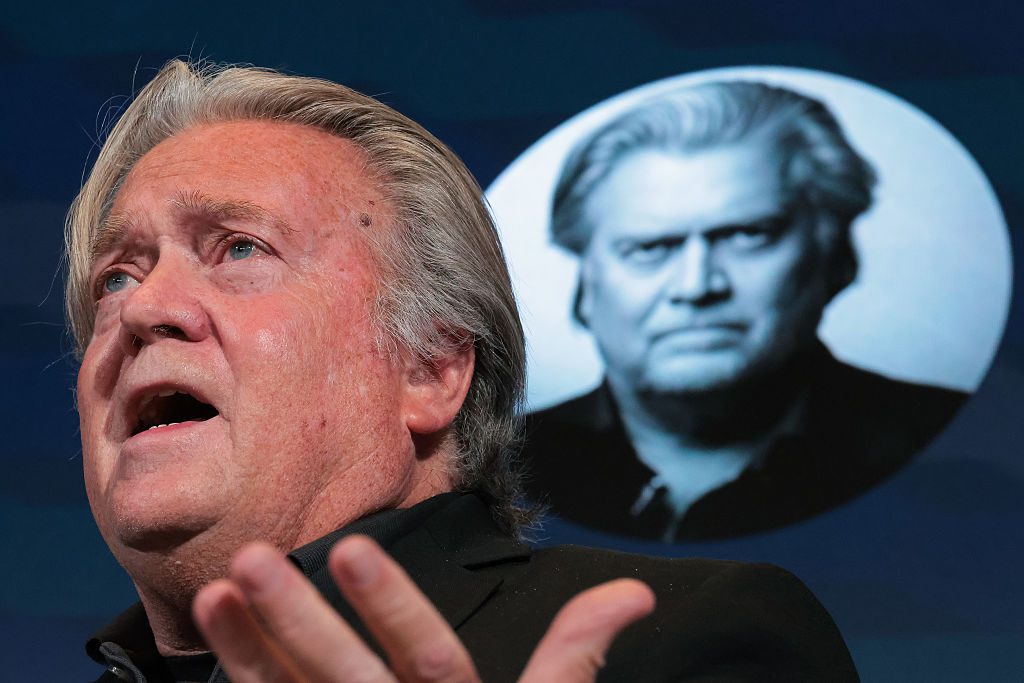
Steve Bannon is against foreign interventions — until he isn't. Credit: Getty

Steve Bannon is against foreign interventions — until he isn't. Credit: Getty

June 22 2025 - 7:50pm

Donald Trump’s decision to strike three Iranian nuclear site targets last night has officially involved the United States in the war between Israel and Iran. And contrary to the note of triumphant finality with which Trump announced the move on TruthSocial, the attack elevates the level of risk for Americans, in particular the roughly 40,000 US service personnel stationed in the region who are now exposed to the threat of Iranian retaliation.

There is also, however, another kind of risk which the President is courting, namely the political damage his decision is likely to incur. By impulsively embracing the “bomb now, ask questions later” interventionism that he has run against since 2016, Trump’s attitude reflects the George W. Bush and Barack Obama administrations in their respective interventions in Iraq and Libya. Those who put stock in the promise of Trump as the America-First “candidate of peace” must now wonder: how could this have happened?

Clues may be found in the figure of Steve Bannon. With impeccable MAGA credentials, his stance against foreign adventurism was — at least initially — unmistakable, amid warnings of an impending rift within the movement should Trump attack Iran. On Thursday, two days before the strike, Bannon had a scheduled lunch meeting with Trump which news sources claimed played an “outsized role” in the President’s Iran decision, as if to suggest that the strategist may have talked his former boss away from escalation. Then, last night just as reports about Bannon’s supposed influence were percolating, the President announced the execution of the strikes.

One thing this reveals about Bannon and the “peace wing” of the MAGA movement is just how weak and marginal they are when it comes to confronting entrenched neoconservative and pro-Netanyahu currents in the GOP — contrary to suggestions that the party has transformed under Trump. Additionally, the fact that Bannon has preemptively forgiven Trump for any such lapse toward interventionism and signalled that he and the base will offer their support no matter what the White House actually does shows how morally hollow and rudderless their movement is.

In fact, Bannon directed a message at Trump earlier this week that “we trust your judgment, you walked us through this” and “maybe we hate it but […] we’ll get on board.” This choice of personal fealty to the President over any semblance of principle is echoed by other MAGA stalwarts such as activist Charlie Kirk and Director of National Intelligence Tulsi Gabbard. Some, including Tucker Carlson and Marjorie Taylor Green, will find oblique ways to criticize the President, but no one is about to receive a Profile in Courage Award.

With this in mind, Trump — who is attuned to the feelings of his base like no one else in public life — likely sensed that the risk of political fracture was minimal given how little his supporters care about policy consistency. After all, MAGA — far from being a populist force for change — has displayed unthinking obedience to Trump and effectively caved on other major points of dispute with the GOP establishment, including tax cuts for the rich and the President’s own shocking admission that nothing really should change in the US’s cheap-labor immigration regime.

At this point, if MAGA takes the warmongering route, then it is basically no different from the party of Bush and Dick Cheney. As with so much else, Trump knows he can bomb Iran back to the Stone Age and his supporters will gladly follow along. To paraphrase Richard Nixon, they might as well say: we are all “radical war hawks” now.


Michael Cuenco is Senior Editor at American Affairs.
1TrueCuencoism

China is threatening America in the AI race

Reports sugget Zhipu AI  has released a new model that can rival leading US systems. Credit: Getty

Reports sugget Zhipu AI has released a new model that can rival leading US systems. Credit: Getty

July 1 2026 - 10:18am

China is trying to catch up with America on artificial intelligence. The Wall Street Journal has reported that Zhipu AI — one of China’s six “AI tiger” LLMs — has released a new model that can rival leading US systems, including Anthropic’s Mythos, in cybersecurity tasks such as pinpointing security bugs. While this marks a milestone in China’s drive to catch up with Western AI capabilities, strong performance on a single benchmark does not mean it has taken the lead. Chinese models still lag behind their Western counterparts in broader capabilities, such as autonomous operation. Skepticism is therefore warranted before resorting to hysterical conclusions, but complacency about the geopolitical implications of China’s AI advances would be an even greater mistake.

On the infrastructure side, Chinese AI is still constrained by access to advanced chips, with American labs way ahead in computing capacity as well as investment. Analysis from earlier this year suggests that Chinese models are likely to be at least a few months behind those in the US. But they are still continuing to make progress, or that the geopolitical importance of AI will be decided only by whose LLM has ventured deeper into the technological frontier. The practical applications of AI, countries’ to capture foreign markets, and the application of AI into the real economy will matter just as much.

Here, China may hold an advantage. As with its dominance across many critical supply chains, Beijing may not need to produce the most advanced AI systems — only those that are affordable and widely deployable. In doing so, it could consolidate global influence by supplying functional, low-cost AI at scale.

Beijing seems to be pursuing exactly that path, developing an AI “open-source” strategy that offers affordable, widely available AI models for companies and individuals to use and modify as they wish. The production of the DeepSeek AI model, which matched the performance of Silicon Valley tools such as ChatGPT at a fraction of the cost for users, created goodwill among Chinese models with developers.

The four most popular models on OpenRouter, an AI hardware platform for developers, are now all Chinese. The goal for China is not only to win the frontier-model race, but to make its systems the default layer of AI adoption across industries and global markets. For most economies, the choice is increasingly between an affordable tool they can deploy now and a more robust one that may be out of reach.

And while the countries adopting Chinese models may be exposed to political pressure and cyber threats from Beijing, safer and more capable alternatives matter little if they are unaffordable. American AI companies are already under pressure to monetize products whose operating costs are rising. If Chinese open-source models become the cheap default for startups, universities, governments and businesses across the developing world, then America’s AI lead will be eroded from below.

Perhaps more concerning for America in the long run is how AI can give Chinese manufacturing even more strength, through the ongoing integration of AI as a general-purpose technology. China’s new Five-Year Plan mentioned AI more than 50 times and includes an “AI+” action plan aimed at spreading AI across the economy.

Beijing has been pioneering automation of its critical infrastructure for years, with promising recent results in increasing warplane production capacity. In that regard, China’s open-model strategy and manufacturing dominance will reinforce each other. Cheap, adaptable models accelerate deployment across the real economy while those deployments generate real-world data and use cases that can feed back into further model improvement.

The United States should not dismiss the importance of its lead in the AI race. That lead worries Beijing, not least because a more automated Chinese economy would also become more vulnerable to AI-generated cyber threats. But nor should Washington assume that China cannot catch up with American capabilities over time.

This AI competition represents part of a broader struggle over tech supply chains and geopolitical influence. Decisions over whether to adopt US or Chinese models could produce a more fragmented global reality, with different regions relying on different cloud providers, chips and security structures. The result will likely be a global economy which is divided into competing spheres, rather than one which produces a single winner.


Miquel Vila is a political and geopolitical risk consultant focusing on industrial strategy, critical infrastructure and global supply chains.

miquelvilam