




X Close

MAGA split over Iran strikes could be permanent

Who's putting America first? Credit: Getty

Who's putting America first? Credit: Getty

June 20 2025 - 1:20pm

There is no question that MAGA is deeply divided over Donald Trump’s prospective support for an escalated military conflict with Iran. There is, however, a question of whether that divide is permanent, and how significantly it will damage the President’s coalition.

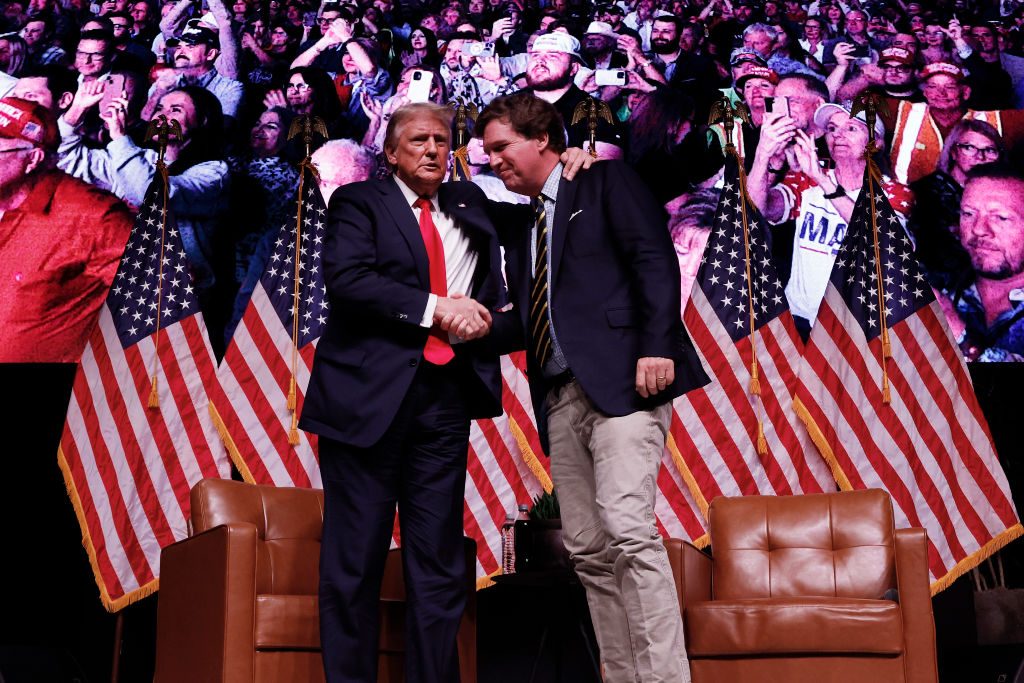
Trump is now publicly disparaging his own Director of National Intelligence, Tulsi Gabbard. He’s throwing jabs at Tucker Carlson. He’s drawing sharp rebukes from Steve Bannon and Candace Owens. His GOP allies Marjorie Taylor Greene and Matt Gaetz are angry. The split over Iran is very real, and the reason it exists at all is the very reason it could linger long into the future if Trump decides to authorize a strike on the Fordow nuclear site.

It is because of Trump that prominent supporters started to aggressively reconsider decades of conservative foreign policy — to the point where anti-interventionism became not just another plank in their worldviews but a load-bearing column. The President’s successful defenestration of every Republican candidate in 2016 was heavily dependent on his criticism of post-9/11 interventionism.

This resonated deeply with average Americans, some of whom were similarly moved by Barack Obama’s campaign in 2008, as expensive foreign entanglements began to feel like part of the same agenda which pushed open borders and financialization. Opposition to adventures in the Middle East are not an optional part of “America First” for those voters, and certainly not for MAGA thought leaders such as Carlson and Bannon.

If Trump hypothetically changed nothing about his campaign in 2024 other than adopting the foreign policy of Lindsey Graham, he’d never have won the support of people like Gabbard, who is currently being sidelined by hawks in the administration. It’s no surprise that libertarians in the party including Rand Paul and Thomas Massie are urging caution, but divisions are also causing trouble at the Pentagon, where Elbridge Colby and others reportedly find themselves in disagreement with the direction being pushed by General Erik Kurilla.

This is not just a problem for Trump in Washington. Beyond the Beltway, a Economist and YouGov poll this week found that 53% of 2024 Trump voters “do not want the country to join in Israel’s strikes”.

Trump must convince his allies, already exhausted with his inability to end conflicts in Ukraine and Gaza, that a strike on Fordow can be defined as “America First”. To be sure, the concept is more nebulous than many MAGA stakeholders with deeply ideological foreign policies like to admit. It’s not difficult to argue that permanently thwarting Iran’s nuclear ambitions with a limited strike which starts and ends with use of a bunker-buster is “America First” in theory. The problem is that MAGA is reasonably suspicious of the predicate intelligence reports, and reasonably suspicious of people who promise force will be limited.

Candace Owens wrote this week that “Donald Trump just completely fractured his base. And he did it for the very neocons who minted the #NeverTrump movement. Truly unbelievable.” Carlson, meanwhile, framed the debate starkly as one between “warmongers and peacemakers”. On the other side of the divide, conservative TV host Mark Levin has described the conflict as “good versus evil” and said: “you’re either a patriotic American who is going to get behind the President or you’re not.” On Fox News, he compared critics of the intervention to Marxist Islamists.

Needless to say, this is not going to end with Carlson and Levin agreeing to disagree. The two men and their respective allies were already at odds before Trump faced a decision on Iran, but the political stakes for the President now involve concretely siding with one over the other — and he can’t take that back. Unlike, say, the 2017 Syria strike or 2019 weapon sales to Ukraine, Trump won’t be able to cast this decision as a justifiable caveat to the populist definition of “America First” with those who take Carlson’s side.

It’s generally been true that the President could shoot someone on Fifth Avenue and maintain the support of his loyal base. But that loyalty has always been built in no small part on their trust in his strong disdain for elite interventionism. Trump risks losing more than Carlson, Owens, and Theo Von if he can’t make a persuasive case that a strike fits his own definition of “America First”. This time, his credibility with MAGA is actually on the line.


Emily Jashinsky is UnHerd‘s Washington correspondent.

emilyjashinsky

China is threatening America in the AI race

Reports sugget Zhipu AI  has released a new model that can rival leading US systems. Credit: Getty

Reports sugget Zhipu AI has released a new model that can rival leading US systems. Credit: Getty

July 1 2026 - 10:18am

China is trying to catch up with America on artificial intelligence. The Wall Street Journal has reported that Zhipu AI — one of China’s six “AI tiger” LLMs — has released a new model that can rival leading US systems, including Anthropic’s Mythos, in cybersecurity tasks such as pinpointing security bugs. While this marks a milestone in China’s drive to catch up with Western AI capabilities, strong performance on a single benchmark does not mean it has taken the lead. Chinese models still lag behind their Western counterparts in broader capabilities, such as autonomous operation. Skepticism is therefore warranted before resorting to hysterical conclusions, but complacency about the geopolitical implications of China’s AI advances would be an even greater mistake.

On the infrastructure side, Chinese AI is still constrained by access to advanced chips, with American labs way ahead in computing capacity as well as investment. Analysis from earlier this year suggests that Chinese models are likely to be at least a few months behind those in the US. But they are still continuing to make progress, or that the geopolitical importance of AI will be decided only by whose LLM has ventured deeper into the technological frontier. The practical applications of AI, countries’ to capture foreign markets, and the application of AI into the real economy will matter just as much.

Here, China may hold an advantage. As with its dominance across many critical supply chains, Beijing may not need to produce the most advanced AI systems — only those that are affordable and widely deployable. In doing so, it could consolidate global influence by supplying functional, low-cost AI at scale.

Beijing seems to be pursuing exactly that path, developing an AI “open-source” strategy that offers affordable, widely available AI models for companies and individuals to use and modify as they wish. The production of the DeepSeek AI model, which matched the performance of Silicon Valley tools such as ChatGPT at a fraction of the cost for users, created goodwill among Chinese models with developers.

The four most popular models on OpenRouter, an AI hardware platform for developers, are now all Chinese. The goal for China is not only to win the frontier-model race, but to make its systems the default layer of AI adoption across industries and global markets. For most economies, the choice is increasingly between an affordable tool they can deploy now and a more robust one that may be out of reach.

And while the countries adopting Chinese models may be exposed to political pressure and cyber threats from Beijing, safer and more capable alternatives matter little if they are unaffordable. American AI companies are already under pressure to monetize products whose operating costs are rising. If Chinese open-source models become the cheap default for startups, universities, governments and businesses across the developing world, then America’s AI lead will be eroded from below.

Perhaps more concerning for America in the long run is how AI can give Chinese manufacturing even more strength, through the ongoing integration of AI as a general-purpose technology. China’s new Five-Year Plan mentioned AI more than 50 times and includes an “AI+” action plan aimed at spreading AI across the economy.

Beijing has been pioneering automation of its critical infrastructure for years, with promising recent results in increasing warplane production capacity. In that regard, China’s open-model strategy and manufacturing dominance will reinforce each other. Cheap, adaptable models accelerate deployment across the real economy while those deployments generate real-world data and use cases that can feed back into further model improvement.

The United States should not dismiss the importance of its lead in the AI race. That lead worries Beijing, not least because a more automated Chinese economy would also become more vulnerable to AI-generated cyber threats. But nor should Washington assume that China cannot catch up with American capabilities over time.

This AI competition represents part of a broader struggle over tech supply chains and geopolitical influence. Decisions over whether to adopt US or Chinese models could produce a more fragmented global reality, with different regions relying on different cloud providers, chips and security structures. The result will likely be a global economy which is divided into competing spheres, rather than one which produces a single winner.


Miquel Vila is a political and geopolitical risk consultant focusing on industrial strategy, critical infrastructure and global supply chains.

miquelvilam